The Parable of the Poisoned Arrow: Why the Buddha Rejected Metaphysical Speculation
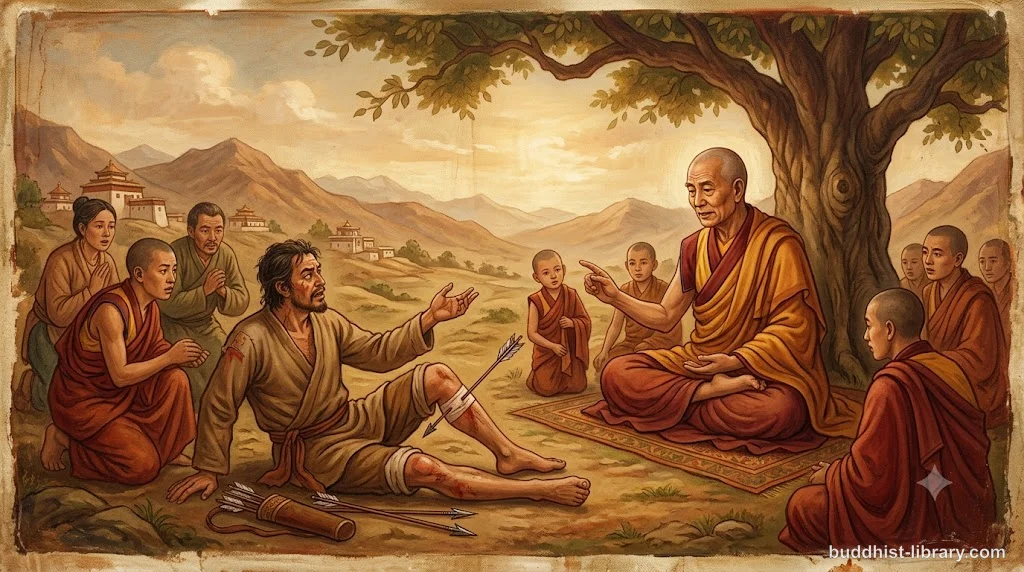
When a monk named Māluṅkyaputta demanded the Buddha answer ten metaphysical questions or he would disrobe, the Buddha responded with one of his most famous parables: a man struck by a poisoned arrow refuses treatment until he knows who shot it, what wood the arrow was made from, and every detail about the archer—and dies before getting answers. The lesson? Speculation wastes the time we have to actually end suffering.
What Is the Cūḷamāluṅkya Sutta?
The Cūḷamāluṅkya Sutta (MN 63), or “The Shorter Discourse to Māluṅkyaputta,” records an encounter between the Buddha and a monk frustrated by unanswered questions. Māluṅkyaputta had heard the Buddha remain silent on certain metaphysical issues and took it personally—he wanted definitive answers or he would leave the Saṅgha.
The Buddha’s response cuts to the heart of what Buddhism is and is not. This isn’t a system built to satisfy every curiosity about the cosmos. It’s a practical path designed to end dukkha—suffering, stress, and dissatisfaction.
This sutta appears in the Majjhima Nikāya (Middle Length Discourses) and remains one of the clearest statements of Buddhist pragmatism. The Buddha isn’t anti-intellectual; he’s anti-distraction.
What Were the Ten Undeclared Questions?
Māluṅkyaputta listed ten questions the Buddha had “set aside” without answering:
- Is the world eternal?
- Is the world not eternal?
- Is the world finite?
- Is the world infinite?
- Are the soul and the body the same?
- Are the soul and the body different?
- Does the Tathāgata exist after death?
- Does the Tathāgata not exist after death?
- Does the Tathāgata both exist and not exist after death?
- Does the Tathāgata neither exist nor not exist after death?
These questions assume metaphysical positions the Buddha deliberately avoided. Notice the pattern: they’re framed as either/or dichotomies, and each one presupposes concepts (like an eternal soul or a Tathāgata as a thing that “exists”) the Buddha had already deconstructed elsewhere.
Māluṅkyaputta wanted clear-cut answers. The Buddha gave him a parable instead.
How Does the Poisoned Arrow Parable Work?
The Buddha asked Māluṅkyaputta to imagine a man struck by a poisoned arrow. A surgeon arrives to help, but the man refuses treatment until he knows:
- Who shot the arrow
- What caste the archer belonged to
- Whether the archer was tall or short, dark or fair
- What village the archer came from
- What kind of bow was used
- What the bowstring was made of
- What type of arrow shaft it was
- What feathers fletched the arrow
- What the arrowhead was made of
The Buddha’s question: would that man survive?
Māluṅkyaputta’s answer: “No, Venerable Sir. The man would die before all that could be known.”
The Buddha’s point: exactly.
The ten questions Māluṅkyaputta demanded answers to are like asking about the archer’s height while poison spreads through your veins. They don’t lead to disenchantment, dispassion, cessation, peace, direct knowledge, enlightenment, or Nibbāna—the Buddha’s explicit criteria for what he teaches.
What Did the Buddha Actually Teach?
After the parable, the Buddha stated what he has declared:
- This is suffering (dukkha)
- This is the origin of suffering (samudaya—craving)
- This is the cessation of suffering (nirodha—Nibbāna)
- This is the path leading to the cessation of suffering (magga—the Noble Eightfold Path)
These are the Four Noble Truths, and the Buddha explained why he declared them: because they are useful. They lead directly to the end of suffering.
Everything else? If it doesn’t serve that purpose, the Buddha set it aside—not because he didn’t know the answer, but because answering wouldn’t help.
This is often called the Buddha’s “pragmatic silence” or the doctrine of the undeclared questions (Pāli: avyākata). It’s not agnosticism; it’s a refusal to waste time.
Why Did the Buddha Reject Speculation?
The parable reveals three reasons:
1. Urgency
Suffering is now. Birth, aging, sickness, and death are happening. We don’t have infinite time to philosophize. The arrow is in; the poison is spreading. Pull it out first.
2. Relevance
The questions Māluṅkyaputta asked don’t lead to liberation. Knowing whether the universe is eternal or finite won’t stop your craving. Understanding dependent origination and non-self will.
3. Wrong Framing
Many of the ten questions assume a “self” or “soul” exists in the first place—precisely what the Buddha’s teaching of anattā denies. Answering them would reinforce the wrong view. Better to deconstruct the question than validate its premises.
The Buddha wasn’t dodging hard questions. He was rejecting bad ones.
What Does This Mean for Practice?
The Cūḷamāluṅkya Sutta has direct implications for anyone walking the Buddhist path:
Focus on What Works
Endless debates about metaphysics, cosmology, or “what happens after Nibbāna” can become sophisticated procrastination. The Dhamma is a raft to cross the flood of suffering. Not a philosophy to argue about forever.
Test the Teaching
The Buddha’s criterion was simple: does this lead to the end of suffering? That’s a question you can answer through practice—meditation, ethical conduct, and cultivating wisdom. You don’t need to resolve cosmic questions to verify whether mindfulness reduces your stress.
Recognize Skillful Questions
Not all questions are equal. “Is the universe eternal?” is a time-waster. “How do I recognize craving when it arises?” is immediately useful. The Buddha taught to distinguish between speculation and genuine inquiry.
Don’t Mistake the Path for the Goal
Māluṅkyaputta’s ultimatum—“answer me or I leave”—reveals a misunderstanding of what the spiritual life is about. It’s not about having every question answered. It’s about ending suffering. Once the arrow is out and the poison is neutralized, you can discuss the archer’s biography if you still care (spoiler: you won’t).
Key Points About the Poisoned Arrow Parable
- The parable appears in the Cūḷamāluṅkya Sutta (MN 63), where a monk demands metaphysical answers from the Buddha
- The Buddha responds by comparing speculation to a man refusing medical treatment until he knows every detail about the arrow that wounded him
- The ten undeclared questions focus on whether the world is eternal, finite, and whether the Tathāgata exists after death
- The Buddha “declared” only the Four Noble Truths because they directly lead to the end of suffering
- The teaching emphasizes urgency, relevance, and proper framing over intellectual satisfaction
- This sutta is a cornerstone of Buddhist pragmatism and anti-speculative philosophy
- It doesn’t reject all inquiry—only questions that don’t serve liberation
FAQ
Why did the Buddha refuse to answer Māluṅkyaputta’s questions?
Because those questions were speculative and didn’t lead to the end of suffering. The Buddha taught only what was useful for liberation, not what satisfied intellectual curiosity.
What were the ten undeclared questions the Buddha refused to answer?
Whether the world is eternal or not eternal, finite or infinite, whether the soul and body are the same or different, and whether the Tathāgata exists or doesn’t exist after death.
What is the main lesson of the poisoned arrow parable?
Urgent matters require immediate action. Just as a wounded person doesn’t philosophize about the arrow before treatment, a spiritual seeker shouldn’t delay practice with endless speculation.
Did the Buddha reject all philosophical inquiry?
No—he rejected speculation that didn’t lead to liberation. He taught in-depth about suffering, its cause, its cessation, and the path, because understanding these ends suffering.
Is this the same as the “Simile of the Raft”?
No, though both appear in the Majjhima Nikāya and both warn against clinging to views. The raft simile (from the Alagaddūpama Sutta, MN 22) teaches that even the Dhamma should be let go once it’s served its purpose. The poisoned arrow teaches that irrelevant questions waste precious time.
How does this relate to the modern concept of “spiritual bypassing”?
Ironically, endless philosophical speculation can itself be a form of spiritual bypassing—using intellectual activity to avoid the direct, sometimes uncomfortable work of meditation and ethical transformation. The Buddha’s parable calls this out.
Conclusion: Pull the Arrow Out First
The Cūḷamāluṅkya Sutta is a wake-up call. We live in a world drowning in information, endless debate, and intellectual posturing. The Buddha’s response to Māluṅkyaputta is as relevant now as it was 2,500 years ago: some questions matter, and some don’t.
The ones that matter are the ones that reduce suffering—yours and others’. Everything else is the archer’s biography while the poison spreads.
Māluṅkyaputta understood. The Cūḷamāluṅkya Sutta ends with him delighting in the Buddha’s words. A later discourse (SN 35.95) records his eventual awakening. The speculation that seemed so urgent became irrelevant once he pulled the arrow out.
That’s the real lesson. The arrow is already in. Stop asking who shot it and start walking the path.
Read more:
- The Four Noble Truths: The Heart of the Buddha’s Teaching — The framework the Buddha did teach, because it directly addresses suffering and its end.
- The Noble Eightfold Path: A Complete Guide — The practical path the Buddha declared instead of metaphysical speculation.
- Anattā (Non-Self): What the Buddha Really Meant — Understanding why many of Māluṅkyaputta’s questions were wrongly framed from the start. āluṅkyaputta’s questions were wrongly framed from the start.
📖 Source / license: Cūḷamāluṅkya Sutta, Majjhima Nikāya 63, translated by Bhikkhu Bodhi and available on SuttaCentral and Access to Insight
Frequently asked questions
Why did the Buddha refuse to answer Māluṅkyaputta's questions?
Because those questions were speculative and didn't lead to the end of suffering. The Buddha taught only what was useful for liberation, not what satisfied intellectual curiosity.
What were the ten undeclared questions the Buddha refused to answer?
Whether the world is eternal or not eternal, finite or infinite, whether the soul and body are the same or different, and whether the Tathāgata exists or doesn't exist after death.
What is the main lesson of the poisoned arrow parable?
Urgent matters require immediate action. Just as a wounded person doesn't philosophize about the arrow before treatment, a spiritual seeker shouldn't delay practice with endless speculation.
Did the Buddha reject all philosophical inquiry?
No—he rejected speculation that didn't lead to liberation. He taught in-depth about suffering, its cause, its cessation, and the path, because understanding these ends suffering.