The Six Realms of Existence: Understanding Buddhist Cosmology
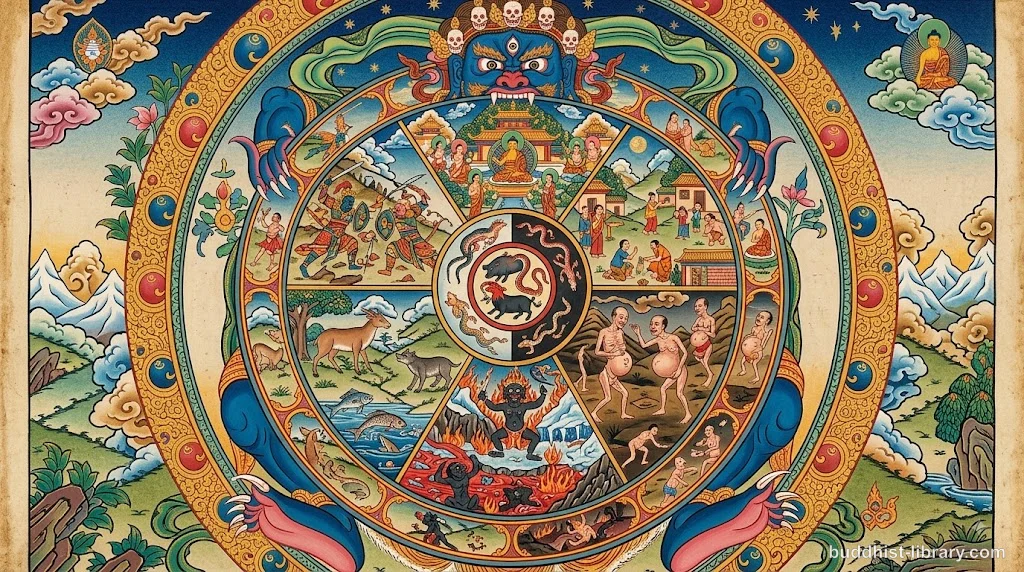
The six realms of existence in Buddhism—deva (celestial beings), asura (jealous gods), human, animal, preta (hungry ghosts), and naraka (hell beings)—describe the range of possible rebirths within saṃsāra, the cycle of birth and death. All six are temporary states shaped by karma and characterized by suffering, from which only liberation (nibbāna) provides permanent escape.
The doctrine of the six realms appears throughout Buddhist cosmology. It serves as a map of literal rebirth destinations—and as a psychological framework for understanding how suffering shapes consciousness. The realms illustrate one truth regardless of interpretation: unenlightened existence is fundamentally unsatisfactory (dukkha) and subject to change (anicca), whether experienced across lifetimes or within a single human day.
What Are the Six Realms in Buddhist Cosmology?
The six realms (sometimes five in Theravāda sources, which often subsume asuras into other categories) form concentric layers within the wheel of saṃsāra. Each realm is characterized by:
- Dominant mental state — the affliction that sustains rebirth there
- Quality of experience — the particular texture of suffering
- Karmic cause — the actions that lead to rebirth in that realm
- Duration — lifespan (though all are impermanent)
The Six Realms:
- Deva realm (celestial beings) — pleasure, long life, heedlessness
- Asura realm (jealous gods) — envy, conflict, competitiveness
- Human realm — mixed pleasure and pain, awareness of mortality
- Animal realm — ignorance, instinct, exploitation
- Preta realm (hungry ghosts) — craving, insatiable hunger
- Naraka realm (hell beings) — hatred, intense torment
These are not permanent destinations but waypoints in the cycle of rebirth. A being may traverse all six realms countless times before attaining liberation.
How Do the Realms Function in Early Buddhist Texts?
In the Pāli Canon, the six realms appear most explicitly in cosmological discourses such as the Devadūta Sutta (MN 130) and the Bālapandita Sutta (MN 129). The Buddha describes them as literal destinations—beings die in one realm and are reborn in another according to their kamma (karma).
Key textual foundations:
- Devadūta Sutta (MN 130) — describes the “divine messengers” (old age, sickness, death) and the consequences of unwholesome action: rebirth in the animal realm, the preta realm, or hell.
- Bālapandita Sutta (MN 129) — contrasts the fates of the fool (rebirth in lower realms) and the wise person (rebirth in deva or human realms, or liberation).
- Saṃyutta Nikāya 56.102–131 — vivid descriptions of hell realms and the rarity of human rebirth (the “blind turtle” simile).
The texts emphasize that all realms—even the most pleasurable deva realms—are temporary and subject to decay. Liberation is the only true refuge.
The Deva Realm: Bliss and Heedlessness
Devas (gods or celestial beings) enjoy long lifespans, radiant bodies, and abundant sensory pleasure. Rebirth here results from generous actions, moral conduct, and wholesome mental states.
Characteristics:
- Dominant quality — pleasure, beauty, leisure
- Karmic cause — dāna (generosity), sīla (virtue), calm meditation
- Suffering — subtle: heedlessness (pamāda), complacency, eventual death and rebirth in lower realms
Here lies the danger. Intoxicated by bliss, devas rarely practice the Dhamma. When their merit exhausts, they fall—sometimes dramatically. The texts record cases of devas who squandered their good fortune and plummeted straight into hell (SN 56.119).
The Buddha himself was born as a deva in the Tusita heaven before his final human birth, but he chose rebirth as a human precisely because only humans can awaken.
The Asura Realm: Envy and Strife
Asuras (sometimes translated as “jealous gods” or “titans”) are powerful beings consumed by envy of the devas’ splendor. They constantly wage war for control of celestial treasures.
Characteristics:
- Dominant quality — jealousy, pride, competitiveness
- Karmic cause — ambition, envy, virtue mixed with anger
- Suffering — perpetual conflict, dissatisfaction despite power
In some Theravāda cosmologies, asuras are classified within the deva or preta realms rather than as a separate sixth realm. Mahāyāna and Vajrayāna traditions typically count them distinctly.
Psychological reading: The asura state represents those who achieve worldly success yet remain consumed by comparison, rivalry, and the belief that happiness lies in dominance.
The Human Realm: The Precious Opportunity
The human realm stands alone in the cosmology. We experience enough suffering to motivate spiritual practice. Yet we also have leisure—time to study, reflect, meditate. This Goldilocks balance makes human birth uniquely conducive to liberation.
Characteristics:
- Dominant quality — mixture of pleasure and pain, awareness of mortality
- Karmic cause — moderate virtue, ethical conduct
- Opportunity — encounter with the Dhamma, capacity for enlightenment
The Buddha emphasized the rarity and preciousness of human birth through similes: imagine a blind turtle surfacing once every hundred years in a vast ocean, and a single wooden yoke floating on the waves—human rebirth is as rare as that turtle threading its head through the yoke (SN 56.48).
Humans can encounter the Dhamma, ordain, practice meditation, and attain the four stages of awakening. This opportunity is not available to beings in other realms—devas are too distracted, animals too dull, pretas and hell beings too tormented.
The Animal Realm: Ignorance and Instinct
Animals are characterized by ignorance (moha), limited cognitive capacity, and vulnerability. They live by instinct, subject to exploitation, fear, and the law of predation.
Characteristics:
- Dominant quality — ignorance, fear, servitude
- Karmic cause — unwholesome actions rooted in delusion
- Suffering — exploitation, inability to practice Dhamma, short lifespans
Early texts describe the animal realm as encompassing all non-human sentient beings—from insects to large mammals. Rebirth here results from actions driven by ignorance: neglecting ethics, following wrong view, or harming others out of stupidity rather than malice.
Psychological interpretation: The animal state can also describe moments in human life dominated by blind reactivity, where higher cognitive functions are eclipsed by instinct and fear.
The Preta Realm: Insatiable Craving
Pretas—hungry ghosts—embody insatiable craving made visible. Classical iconography depicts them with enormous bellies and throats the width of a needle. They can consume almost nothing. Yet they remain perpetually ravenous.
Characteristics:
- Dominant quality — craving (taṇhā), greed, stinginess
- Karmic cause — miserliness, hoarding, denying others’ needs
- Suffering — unquenchable thirst and hunger, isolation
The Petavatthu (Stories of Hungry Ghosts), part of the Khuddaka Nikāya, recounts tales of individuals reborn as pretas due to stinginess in life. Offerings and merit-sharing by living relatives can sometimes alleviate their suffering.
As psychological metaphor: The preta state mirrors human experiences of addiction, hoarding, or emotional hunger—never satisfied, always grasping.
The Naraka Realm: Torment and Purification
Naraka (hell realms) are states of intense suffering caused by hatred (dosa) and severe unwholesome karma. Early texts describe multiple hells—hot, cold, and variations thereof—where beings experience torment for immense (but not infinite) durations.
Characteristics:
- Dominant quality — hatred, malice, cruelty
- Karmic cause — killing, harming, tormenting others
- Suffering — physical and mental agony, seemingly endless duration
Key points from the texts:
- Hell is not eternal. Beings remain only as long as their bad karma sustains the rebirth, then are reborn elsewhere.
- The Devadūta Sutta (MN 130) vividly describes the “wardens of hell” and various torments—not as punishment from a deity, but as the natural fruition of one’s own actions.
- The Buddha used hell imagery pedagogically, to illustrate the gravity of ethical choices.
Modern interpretation: Some contemporary teachers read hell as extreme psychological states—rage, self-hatred, trauma—that can be experienced within human life.
Are the Realms Literal or Symbolic?
The question reflects an enduring tension between traditional cosmology and contemporary psychology.
The answer? Both. The interpretive framework you adopt shapes what the realms reveal—but the underlying truth remains consistent.
Literal (cosmological) view:
- Early Buddhist texts present the realms as actual planes of existence.
- Beings literally die and are reborn in these realms based on karma.
- This view is normative in traditional Theravāda, Mahāyāna, and Vajrayāna teachings.
Symbolic (psychological) view:
- The realms describe states of consciousness that can be experienced in a single human lifetime.
- Moments of rage = hell; moments of envy = asura; moments of insatiable craving = preta.
- This interpretation, popularized by teachers like Chögyam Trungpa and Jack Kornfield, does not necessarily deny cosmological rebirth but emphasizes immediate applicability.
Compatibility: Both readings reinforce the same ethical and meditative imperatives—cultivate wholesome states, abandon unwholesome ones, seek liberation. Whether the realms are future destinations or present experiences, they illustrate the textures of suffering (dukkha) and the urgency of the path.
Why Does the Human Realm Matter Most?
The human realm is called the “precious human rebirth” because it alone offers the balance necessary for awakening:
- Enough suffering to recognize dukkha and seek a way out.
- Enough leisure to study, reflect, and meditate.
- Access to the Dhamma — the teachings and the Saṅgha.
- Cognitive capacity to understand dependent origination, practice the path, and realize nibbāna.
Devas drown in pleasure. Animals lack the mental capacity. Pretas and hell beings are crushed by suffering. Only humans occupy the middle ground where liberation becomes possible.
The Buddha said:
“Suppose, bhikkhus, that this great earth were entirely covered by water, and a man were to toss a yoke with a single hole onto the water. An east wind would drive it westward; a west wind would drive it eastward… Now suppose there were a blind turtle that came up once at the end of each century. What do you think, bhikkhus, would that blind turtle, coming up once at the end of each century, insert its neck into that yoke with a single hole?”
“It would be by chance, venerable sir, after a very long time.”
“Sooner, bhikkhus, would that blind turtle insert its neck into that yoke with a single hole than a fool, once gone to the lower world, would regain the human state.”
— Saṃyutta Nikāya 56.48 (trans. Bhikkhu Bodhi)
This simile underscores the rarity of human birth and the urgency of practice.
Key Takeaways: The Six Realms and the Path
- The six realms are not permanent addresses. All beings within saṃsāra move among them driven by karma. Rebirth is impermanent; only nibbāna is beyond change.
- Each realm embodies a dominant affliction: devas = heedlessness, asuras = envy, humans = mixed states, animals = ignorance, pretas = craving, narakas = hatred.
- Human rebirth is precious because it alone provides the conditions for encountering and practicing the Dhamma.
- Both literal and psychological readings are valid. Traditional cosmology and contemporary psychology converge on the same imperative: recognize suffering, abandon its causes, cultivate the path.
- The six realms illustrate the scope of saṃsāra—and the necessity of liberation. Whether experienced across lifetimes or within a single day, all conditioned existence is marked by impermanence, suffering, and non-self.
The path to freedom is the same regardless of realm: ethical conduct (sīla), mental cultivation (samādhi), and wisdom (paññā) that sees through the illusion of separate selfhood and the craving that binds consciousness to the wheel.
Read more:
- What Is Saṃsāra? The Wheel of Rebirth in Buddhism — explore the broader cycle of existence and how karma propels beings through the six realms.
- Karma and Rebirth in Buddhism: How They Actually Work — understand the mechanics of action and result that determine rebirth across realms.
- What Is Nirvana (Nibbāna)? Meaning and Misconceptions — discover the state beyond all realms, the end of saṃsāra and the goal of the Buddhist path.
📖 Source / license: Majjhima Nikāya 129 (Bālapaṇḍita Sutta), MN 130 (Devadūta Sutta); Saṃyutta Nikāya 56.102–131; Bhikkhu Bodhi, *The Connected Discourses of the Buddha*; Ṭhānissaro Bhikkhu, *The Wings to Awakening*
Frequently asked questions
Are the six realms literal places or states of mind?
Early Buddhist texts present them as literal rebirth destinations shaped by karma, while many contemporary teachers also interpret them as psychological states experienced in this life. Both readings are compatible—the realms describe the quality of experience wherever consciousness arises.
Can beings move between the six realms?
Yes. Rebirth across realms is determined by karma—wholesome actions lead to favorable rebirths (deva, human), unwholesome actions to unfortunate ones (animal, hungry ghost, hell). Only liberation (nibbāna) ends this cycle permanently.
Why is the human realm considered most precious?
Humans have the optimal balance of suffering (motivating practice) and leisure (time to study and meditate). Devas experience too much pleasure to seek liberation; hell beings suffer too intensely to practice. Only humans encounter the Dhamma and can attain enlightenment.
Do all Buddhist traditions accept the six realms?
Theravāda typically describes five realms (combining asuras with other beings), while Mahāyāna and Vajrayāna traditions usually count six. All agree on the principle: saṃsāra encompasses multiple planes of existence shaped by karma and characterized by dukkha.