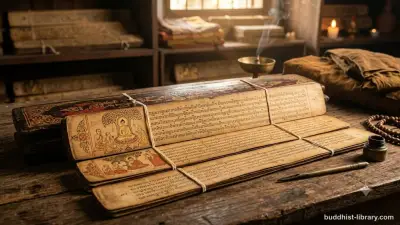
The Heart Sutra Explained: Emptiness and the Prajñāpāramitā
The Heart Sutra is a 260-word distillation of the Perfection of Wisdom teachings, declaring that “form is emptiness, emptiness is form.” It teaches that everything — body, feelings, mind, even the Four Noble Truths themselves — is empty of inherent existence, and that seeing this deeply brings liberation from fear and suffering.
What is the Heart Sutra?
The Prajñāpāramitāhṛdaya Sūtra — the Heart Sutra — is one of the shortest and most recited texts in Mahāyāna Buddhism. A few hundred words. Yet it has been chanted daily in monasteries across East Asia for over a millennium, memorized by laypeople, and translated into dozens of languages.
The sutra presents itself as a teaching given by the bodhisattva Avalokiteśvara (Guanyin, Kannon) to Śāriputra, one of the Buddha’s chief disciples. Its central claim is radical: everything we take to be solid, separate, and lasting is śūnyatā — empty of independent existence.
This is not nihilism. The sutra is not saying nothing exists. It is pointing to how things actually exist: not as isolated, permanent entities, but as fluid, interdependent processes.
Where does the Heart Sutra come from?
The Heart Sutra belongs to the Prajñāpāramitā (Perfection of Wisdom) literature, a collection of Mahāyāna texts that developed between the 1st century BCE and the 7th century CE. The longer Prajñāpāramitā sutras run to tens of thousands of lines. The Heart Sutra condenses their core insight into a single page.
Scholars debate whether the Heart Sutra was composed in India or China. The earliest known Sanskrit manuscript dates to around the 7th century CE, but Chinese translations appeared earlier. What matters is its impact: it became one of the most influential texts in East Asian Buddhism — chanted in Zen monasteries, Pure Land temples, and Tibetan centers alike.
What does “form is emptiness, emptiness is form” mean?
This is the sutra’s most famous line, and also its most misunderstood.
Form is emptiness means that physical things, sensations, mental states — everything we experience — do not have independent, unchanging essence. They arise through causes and conditions. A flower is “empty” because it is made of soil, water, sunlight, the seed, the gardener’s effort. Remove any of those conditions and there is no flower.
The flower has no “flower-ness” that exists on its own.
Emptiness is form means that emptiness is not a separate void behind things. It is the nature of things. When you see a flower, you are seeing emptiness in action — conditions coming together, momentarily stable, already dissolving.
This teaching echoes the Buddha’s earlier doctrine of dependent origination — nothing arises independently; everything is conditioned. The Heart Sutra takes that insight and sharpens it into a direct statement: there is no independent self anywhere.
Why does the sutra deny the aggregates, sense bases, and Four Noble Truths?
One of the most startling passages in the Heart Sutra is this:
“There is no form, no feeling, no perception, no mental formations, no consciousness. No eye, no ear, no nose, no tongue, no body, no mind… No suffering, no origin, no cessation, no path.”
At first glance, this seems to contradict the Buddha’s core teachings. The Five Aggregates, the sense bases, the Four Noble Truths — these are foundational frameworks in Buddhism. Why does the Heart Sutra say there is no Four Noble Truths?
The answer lies in the teaching method. The sutra is not denying that suffering exists conventionally, or that the path works. It is pointing to ultimate reality — the way things are when you look deeply.
From that perspective, even the teaching tools (aggregates, sense bases, truths) are empty of inherent existence. They are skillful frameworks, not fixed metaphysical objects.
Thich Nhat Hanh put it this way: the Heart Sutra is not demolishing the Four Noble Truths; it is completing them. Understanding that even the truths are empty prevents you from clinging to the teaching itself.
What is the Prajñāpāramitā (Perfection of Wisdom)?
Prajñāpāramitā literally means “perfection of wisdom” or “wisdom gone beyond.” It is the sixth of the six perfections (pāramitā) cultivated by bodhisattvas in Mahāyāna Buddhism: generosity, ethical conduct, patience, energy, meditation, and wisdom.
But this is not ordinary knowledge. Prajñāpāramitā is the direct insight into emptiness — seeing that all dharmas (phenomena) are without self-nature. The Prajñāpāramitā literature, including the Heart Sutra, exists to transmit this realization. The sutras are not theoretical treatises; they are meant to evoke the wisdom itself.
The Heart Sutra ends with a mantra:
Gate gate pāragate pārasaṃgate bodhi svāhā
”Gone, gone, gone beyond, gone utterly beyond — awakening, hail!”
This mantra is a compressed expression of the entire path: letting go, letting go completely, until even the one who lets go is released.
How does the Heart Sutra relate to non-self (anattā)?
While the Heart Sutra is a Mahāyāna text and the teaching on non-self (anattā) is found across all Buddhist schools, the two are closely related.
The Buddha taught that the five aggregates — form, feeling, perception, mental formations, consciousness — are not-self. You cannot find a permanent, independent “I” in any of them. This is a central teaching in the Pali Canon.
The Heart Sutra extends that logic: not only is there no self in the aggregates, the aggregates themselves are empty. Emptiness (śūnyatā) in Mahāyāna is the broadening of non-self (anattā) to include all phenomena, not just the person.
Some Theravāda teachers have pointed out that this is implicit in dependent origination. If everything arises conditionally, then nothing has inherent existence. The Heart Sutra makes that implication explicit.
Key Points: Understanding the Heart Sutra
- The Heart Sutra teaches emptiness (śūnyatā) — the absence of inherent, independent existence in all things.
- “Form is emptiness, emptiness is form” means that things lack fixed essence and that emptiness is not separate from the world we see.
- The sutra negates even the Four Noble Truths — not to deny their conventional truth, but to show that even teachings are empty of ultimate substance.
- It is the distilled essence of the Prajñāpāramitā — the Perfection of Wisdom literature that forms a central part of Mahāyāna Buddhism.
- The closing mantra (gate gate pāragate…) is chanted as both a teaching summary and a liberating invocation.
- Emptiness is not nihilism — it does not deny suffering, compassion, or ethics. It clarifies the conditioned, interdependent nature of reality.
Who was Avalokiteśvara, and why is he teaching here?
In the Heart Sutra, the teaching is delivered by Avalokiteśvara (known as Guanyin in Chinese, Kannon in Japanese, Chenrezig in Tibetan), the bodhisattva of compassion. This is significant.
Why would a sutra about emptiness — a teaching that can sound abstract or cold — be spoken by the embodiment of compassion?
Because the two are inseparable. Realizing emptiness does not lead to detachment in the sense of indifference. It leads to boundless compassion. When you see that nothing is separate, you naturally care for all beings as yourself.
Śāriputra, the student in the sutra, was known in the Pali Canon as the Buddha’s disciple foremost in wisdom. The fact that he receives this teaching suggests that even advanced understanding can be deepened by the Prajñāpāramitā insight.
How is the Heart Sutra practiced today?
The Heart Sutra is not just studied — it is chanted, recited, and used as a meditation object. In Zen monasteries, it is chanted daily. In some Tibetan lineages, reciting it is believed to clear obstacles and cultivate wisdom. Many practitioners memorize it, not only for devotion but because hearing the words repeatedly is said to plant the seed of realization.
The sutra also appears in unexpected places. Calligraphy of its opening lines hangs in temples and homes. In Japan, it has been set to music. In the West, it has been translated dozens of times, each version emphasizing different nuances — Edward Conze’s scholarly clarity, Thich Nhat Hanh’s poetic accessibility, Red Pine’s rootedness in Chinese Chan.
For many, the Heart Sutra serves as a koan: a puzzle that cannot be solved by conceptual thinking. What does it mean to say there is no suffering when suffering is obviously present? Sitting with that question, year after year, some practitioners report that the words suddenly open — not into an answer, but into direct seeing.
Common misunderstandings about emptiness
Emptiness is not nothingness. The most common error is to think the Heart Sutra is saying “nothing is real” or “the world is an illusion.” Emptiness means lacking independent existence, not lacking existence altogether. Things exist, but conditionally.
Emptiness does not mean everything is the same. Fire and water are both empty, but that does not make them identical. Emptiness is about the mode of existence (conditioned, interdependent), not the qualities of things.
Emptiness is not a view to hold. The sutra itself warns against clinging to emptiness. Some early Mahāyāna texts compare grasping at emptiness to picking up a venomous snake by the wrong end — more dangerous than grasping at form.
Emptiness does not cancel ethics. If everything is empty, does morality disappear? No. Conventional truth still operates. Harm still causes suffering. Emptiness clarifies that suffering is not metaphysically fixed, which makes liberation possible — but it does not erase the reality of cause and effect in everyday life.
Frequently Asked Questions
What does “form is emptiness, emptiness is form” actually mean?
It means that nothing exists independently or permanently. Form (physical things, experiences) is “empty” of inherent existence — things arise through causes and conditions, not on their own. And emptiness is not nothingness; it is the very nature of form, the way things actually are.
Is the Heart Sutra saying nothing exists?
No. Emptiness does not mean non-existence. It means things lack independent, permanent essence. The sutra is not denying the conventional reality of suffering, joy, objects, or people — it is pointing to their conditioned, interdependent nature.
Why is it called the “Heart” Sutra?
The word “heart” (hṛdaya in Sanskrit) can mean both the physical heart and the essence or core of something. This short text is considered the distilled heart of the much longer Prajñāpāramitā literature — the perfection of wisdom teachings.
Do I need to be Mahāyāna to study the Heart Sutra?
While the Heart Sutra is a Mahāyāna text, its teaching on emptiness resonates with insights found across Buddhist traditions. Theravāda teachings on non-self (anattā) and dependent origination point toward similar realizations, though the language and framework differ.
Conclusion: The Heart of Wisdom
The Heart Sutra is only 260 words, but those words have reverberated through Buddhist practice for over a thousand years. It is a teaching that resists being understood purely intellectually — not because it is mystical nonsense, but because it points to something that must be realized directly.
“Form is emptiness, emptiness is form” is not a riddle to solve. It is an invitation to see. When you look deeply at anything — a thought, a breath, a moment of pain — and see that it has no fixed core, no independent substance, something shifts. Fear loosens. Clinging relaxes. What remains is not nihilistic despair, but the possibility of genuine freedom.
That is the heart of the Prajñāpāramitā: wisdom that liberates.
Read more:
- What Is Dependent Origination (Paṭiccasamuppāda)? — The teaching that everything arises through causes and conditions, a foundation for understanding emptiness.
- Anattā (Non-Self): What the Buddha Really Meant — The doctrine of non-self in early Buddhism, which the Heart Sutra’s teaching on emptiness builds upon and extends.
- The Four Noble Truths: The Heart of the Buddha’s Teaching — The framework the Heart Sutra references and transcends in its teaching on ultimate reality.
📖 Source / license: Grounded in the Prajñāpāramitāhṛdaya Sūtra; translations and commentaries by Edward Conze, Thich Nhat Hanh, Red Pine, and the Dalai Lama; comparative analysis with Theravāda sources on non-self and dependent origination.
Frequently asked questions
What does 'form is emptiness, emptiness is form' actually mean?
It means that nothing exists independently or permanently. Form (physical things, experiences) is 'empty' of inherent existence — things arise through causes and conditions, not on their own. And emptiness is not nothingness; it is the very nature of form, the way things actually are.
Is the Heart Sutra saying nothing exists?
No. Emptiness does not mean non-existence. It means things lack independent, permanent essence. The sutra is not denying the conventional reality of suffering, joy, objects, or people — it is pointing to their conditioned, interdependent nature.
Why is it called the 'Heart' Sutra?
The word 'heart' (hṛdaya in Sanskrit) can mean both the physical heart and the essence or core of something. This short text is considered the distilled heart of the much longer Prajñāpāramitā literature — the perfection of wisdom teachings.
Do I need to be Mahāyāna to study the Heart Sutra?
While the Heart Sutra is a Mahāyāna text, its teaching on emptiness resonates with insights found across Buddhist traditions. Theravāda teachings on non-self (anattā) and dependent origination point toward similar realizations, though the language and framework differ.