What Is Vedanā? Understanding Feeling in Buddhist Meditation
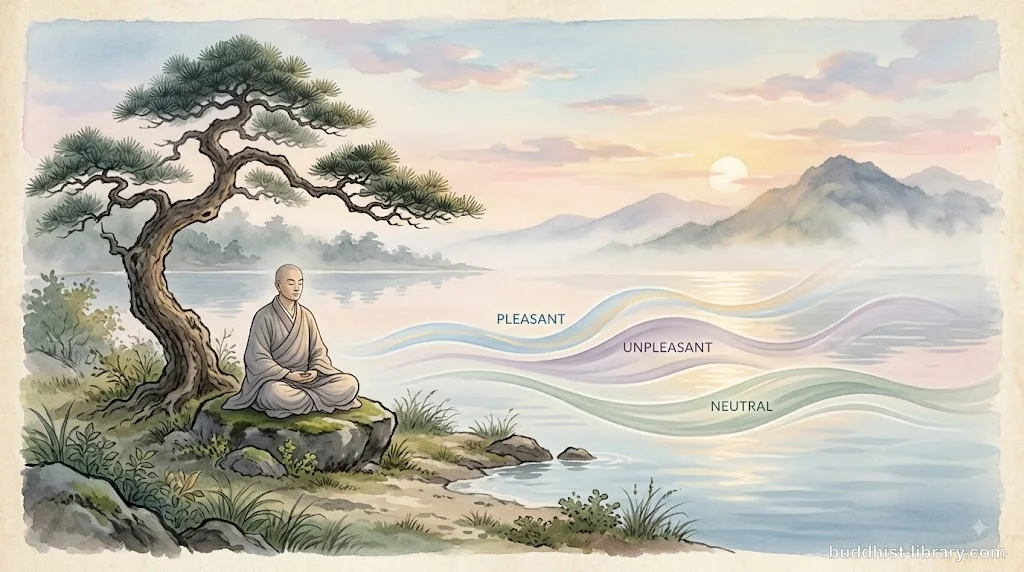
Vedanā—the feeling-tone of experience—is one of Buddhism’s most overlooked yet crucial teachings. It’s the pivot point where suffering either arises or is released, the moment when pleasant, unpleasant, or neutral sensation meets awareness before craving kicks in. Master this, and you’ve grasped a key to liberation.
The Buddha didn’t just mention vedanā in passing. He placed it at the center of the Satipaṭṭhāna Sutta—the Discourse on the Foundations of Mindfulness—as one of four essential domains of practice. He devoted an entire section of the Saṃyutta Nikāya (Vedanā-Saṃyutta) to exploring how feelings condition our responses, and he made vedanā a critical link in the chain of dependent origination (paṭiccasamuppāda). Why? Because vedanā is where the rubber meets the road in the mechanics of suffering.
What exactly is vedanā?
Vedanā is often translated as “feeling,” but that can mislead English speakers into thinking it means emotion. It doesn’t. Vedanā is much simpler—and more fundamental.
In Buddhist psychology, vedanā is the affective tone or hedonic quality that colors every moment of experience. When you see, hear, taste, touch, smell, or think, there’s always a feeling-tone present: pleasant (sukha vedanā), unpleasant (dukkha vedanā), or neither-pleasant-nor-unpleasant—neutral (adukkhamasukha vedanā, sometimes called upekkhā vedanā in the Abhidhamma).
That’s it. Not complex emotions like joy, anger, or anxiety—those involve additional mental formations (saṅkhāra) built on top of vedanā. Vedanā is the raw, pre-conceptual quality that arises the instant sense contact (phassa) occurs. You bite into a lemon: unpleasant vedanā. You hear praise: pleasant vedanā. You notice your breathing: often neutral vedanā—until you start preferring the in-breath or resisting the out-breath, and then it shifts.
The Pali texts are precise: vedanā is one of the five aggregates (khandhas)—form, feeling, perception, mental formations, and consciousness—that together create the illusion we call “self.” It’s not a separate entity; it’s a process, arising and passing in every moment of experience.
Why does vedanā matter so much?
Here’s the critical insight: vedanā is where craving (taṇhā) typically arises.
In the Buddha’s teaching on dependent origination, the sequence goes like this:
Contact (phassa) → Feeling (vedanā) → Craving (taṇhā) → Clinging (upādāna) → Becoming → Birth → Suffering
When pleasant vedanā arises, the untrained mind immediately craves more of it. When unpleasant vedanā arises, we crave its cessation—we want it gone. Even neutral vedanā can trigger craving: we get bored and crave stimulation.
This reaction happens fast. So fast it feels hardwired, like a reflex you can’t control. But the Buddha’s radical claim is that it’s not inevitable. Vedanā and craving are distinct links in the chain. There’s a gap—a moment of choice—between feeling and wanting. Mindfulness practice is about finding that gap and widening it.
The Vedanā-Saṃyutta puts it starkly: “The uninstructed person, when touched by a pleasant feeling, delights in it, welcomes it, and remains holding to it. When touched by a painful feeling, sorrows, grieves, and laments. Such a person is said to be bound by vedanā.” The instructed disciple, by contrast, “does not delight, welcome, or remain holding” to feelings—and thus is freed.
The three types of vedanā—and why neutral matters
The standard classification is threefold:
- Pleasant (sukha): The taste of chocolate, a cool breeze on a hot day, the satisfaction of finishing a task.
- Unpleasant (dukkha): Stubbing your toe, harsh criticism, the ache in your knees during meditation.
- Neutral (adukkhamasukha): The sensation of your foot resting on the floor, the sound of distant traffic—neither pulling you in nor pushing you away.
Most people fixate on pleasant and unpleasant feelings and ignore neutral ones. Big mistake. Neutral vedanā is where much of our life actually unfolds—ordinary moments, routine sensations. The untrained mind finds neutral vedanā boring and immediately seeks distraction (which is itself a form of craving). By learning to rest in neutral vedanā without needing to upgrade it to “pleasant,” we begin to break the addiction to stimulation.
The texts also mention finer distinctions—worldly versus spiritual pleasant and unpleasant feelings, for instance. A pleasant vedanā can arise from sensory indulgence (worldly) or from the joy of concentration (pīti and sukha in jhāna, spiritual). Recognizing this difference helps orient practice: we’re not trying to eliminate all pleasant feeling, just to see it clearly and not cling.
How do you practice with vedanā?
The Satipaṭṭhāna Sutta gives the method: when a pleasant feeling arises, know “a pleasant feeling has arisen.” When unpleasant, know it. When neutral, know it. The instruction sounds almost too simple, but that simplicity is the point.
You’re not analyzing why the feeling arose, not judging it as good or bad, not trying to change it. You’re just recognizing the bare quality: pleasant, unpleasant, or neutral. That recognition—clear, immediate, non-reactive—is what short-circuits the chain from vedanā to craving.
In practice, this can feel counterintuitive. When an unpleasant vedanā arises—say, physical pain in meditation—the reflex is to shift position, tense up, or mentally complain. Vedanā contemplation means pausing before that reflex, seeing the unpleasant quality clearly, and recognizing: “This is just vedanā. It’s impermanent. It’s not ‘me’ or ‘mine.’”
Over time, this practice reveals something startling: vedanā is not a solid thing. It pulses, shifts, has textures. A pain you thought was monolithic turns out to be a dance of sensations—sharp, dull, burning, aching—arising and passing. The “unpleasantness” itself can be seen as a pattern of vedanā flickering in and out of existence. That insight—direct, experiential—is what the Buddha called insight into anicca (impermanence) and anattā (non-self).
Common misunderstandings
“Observing vedanā means becoming emotionless.” No. Emotions can still arise, but you’re seeing the vedanā component within them without getting swept away. Compassion, for instance, often involves unpleasant vedanā (empathic distress) plus a skillful mental response. The goal isn’t to feel nothing; it’s to stop clinging to feelings.
“I should only cultivate pleasant vedanā.” Some traditions emphasize cultivating wholesome pleasant feelings like mettā (loving-kindness) or meditative joy, and that’s valid. But the deeper work is learning to relate skillfully to all vedanā—pleasant, unpleasant, neutral—without grasping or aversion. The freedom isn’t in having only pleasant experiences; it’s in not being enslaved by any feeling.
“Vedanā is the same as sensation (rūpa).” Confusion sometimes arises because pain, for example, involves both bodily sensation (form aggregate) and unpleasant vedanā (feeling aggregate). The texts distinguish them: the physical sensation is one thing; the affective quality of “this hurts” is vedanā. They arise together but can be discerned separately with practice.
Vedanā in the larger path
Contemplating vedanā isn’t an isolated technique—it’s woven into the entire Noble Eightfold Path. Right Effort includes not letting unwholesome states proliferate from a simple unpleasant vedanā. Right Mindfulness includes the direct instruction to observe feelings. Right Concentration deepens when you stop chasing pleasant feelings and resisting unpleasant ones during meditation.
It also connects intimately with the five aggregates. Seeing vedanā as just one component of experience—not “my feeling” but “a feeling, arising due to conditions”—directly undermines the illusion of self. And in the framework of dependent origination, mastering vedanā is how you interrupt the chain that leads to suffering.
The Ānāpānasati Sutta (Mindfulness of Breathing) explicitly includes steps where the meditator trains to “experience vedanā” and then to “calm vedanā”—recognizing that even the breath has a feeling-tone and learning to settle the reactive patterns around it.
Why this teaching is so practical
The beauty of vedanā contemplation is that it’s always accessible. You don’t need a meditation hall, a teacher in the room, or even a formal sitting session. Right now, as you read this, there are feeling-tones present: the comfort or discomfort of your posture, the interest or boredom you feel toward these words. Notice them. That’s the practice.
And it applies everywhere—eating, walking, working, arguing. When someone criticizes you, there’s an unpleasant vedanā. If you can catch that vedanā before the story of “they’re wrong” or “I’m a failure” kicks in, you’ve found the gap. That’s where freedom lives.
The texts say that an arahant—a fully awakened person—still experiences vedanā. They still feel pain when sick, pleasure when eating good food. The difference is they don’t crave or cling. Vedanā arises and passes, and they remain undisturbed. That’s the possibility the Buddha points to: not a life free of feelings, but a life free from being jerked around by them.
FAQ
What is vedanā in Buddhism?
Vedanā is the feeling-tone or affective quality of every experience—pleasant, unpleasant, or neutral. It’s one of the five aggregates and a crucial link in dependent origination where craving arises.
How is vedanā different from emotion?
Vedanā is simpler—just the bare pleasant/unpleasant/neutral quality before mental elaboration. Emotions like anger or joy involve additional mental formations (saṅkhāra) built on top of vedanā.
Why did the Buddha emphasize observing vedanā in meditation?
Because vedanā is where craving typically arises. By seeing vedanā clearly without reacting, we cut the chain of dependent origination that leads to suffering.
Can vedanā exist without an object?
No. Vedanā always accompanies contact (phassa) between a sense base and its object. There’s no such thing as a “free-floating” feeling in Buddhist psychology.
Do I need to eliminate all pleasant vedanā?
Not at all. The issue isn’t pleasant or unpleasant feelings—it’s clinging to them. Wholesome pleasant feelings (like joy in generosity or meditative bliss) are encouraged. The practice is learning non-clinging, not suppression.
How long does it take to see results from vedanā practice?
Some practitioners notice a shift in reactivity within weeks of consistent practice—catching the gap between feeling and craving. Deeper insight into impermanence and non-self can take months or years, depending on factors like retreat time, guidance, and the intensity of practice.
Conclusion
Vedanā is the hinge on which suffering swings. Miss it, and you’ll chase pleasure and flee pain for a lifetime. See it clearly, and you’ve found the place where the whole edifice of craving can be dismantled—not through force, but through understanding.
The Buddha’s instruction is beautifully direct: when a pleasant feeling arises, know it. When unpleasant, know it. When neither, know it. That’s the practice. Simple, accessible, transformative. And it’s available in this very moment.
Read more:
- The Five Aggregates (Khandhas): What We Mistake for ‘Self’ — Vedanā is the second aggregate, and understanding how it fits into the larger picture of the five khandhas reveals why there’s no permanent self to be found in experience.
- The Satipaṭṭhāna Sutta: Foundations of Mindfulness Explained — The full framework of mindfulness practice where vedanā contemplation appears as the second foundation, showing how feeling-tone observation connects to body, mind, and dhamma contemplation.
- What Is Dependent Origination (Paṭiccasamuppāda)? — See how vedanā sits as the critical link between sense contact and craving in the twelve-link chain that explains how suffering arises and how it can cease. it can cease.
📖 Source / license: Satipaṭṭhāna Sutta (MN 10), Vedanā-Saṃyutta (SN 36), Paṭiccasamuppāda formulation (SN 12.2)
Frequently asked questions
What is vedanā in Buddhism?
Vedanā is the feeling-tone or affective quality of every experience—pleasant, unpleasant, or neutral. It's one of the five aggregates and a crucial link in dependent origination where craving arises.
How is vedanā different from emotion?
Vedanā is simpler—just the bare pleasant/unpleasant/neutral quality before mental elaboration. Emotions like anger or joy involve additional mental formations (saṅkhāra) built on top of vedanā.
Why did the Buddha emphasize observing vedanā in meditation?
Because vedanā is where craving typically arises. By seeing vedanā clearly without reacting, we cut the chain of dependent origination that leads to suffering.
Can vedanā exist without an object?
No. Vedanā always accompanies contact (phassa) between a sense base and its object. There's no such thing as a 'free-floating' feeling in Buddhist psychology.