What Is Dependent Origination (Paṭiccasamuppāda)?
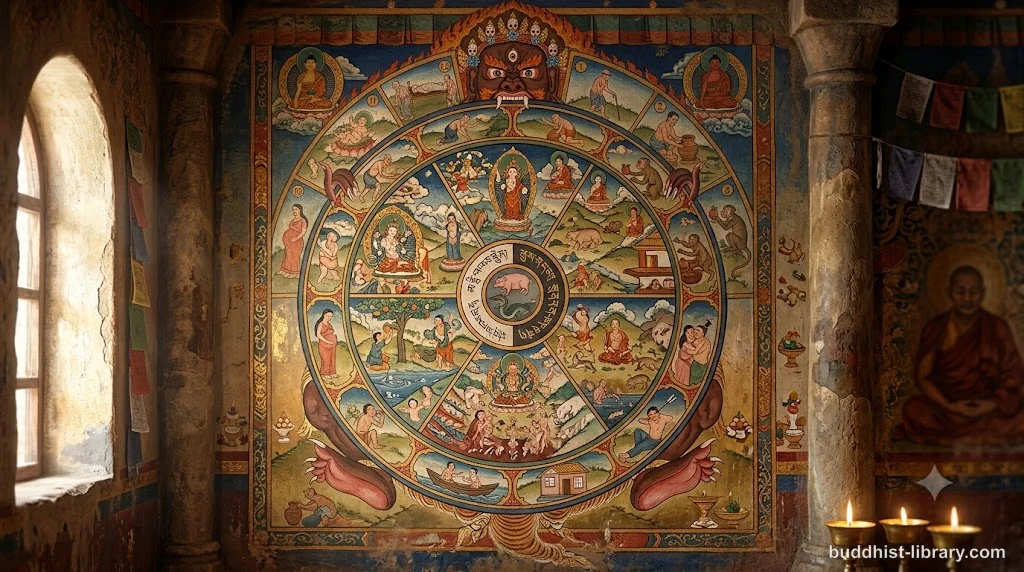
Dependent Origination (Paṭiccasamuppāda) is the Buddha’s explanation of how suffering arises and ceases. Nothing exists independently—everything depends on causes and conditions. By understanding the twelve interconnected links, from ignorance to aging-and-death, we see exactly where to intervene in the cycle of suffering.
What does “Dependent Origination” mean?
Dependent Origination—known in Pali as Paṭiccasamuppāda—is one of the most profound teachings in Buddhism. The Buddha called it “the Dhamma,” the truth that reveals both the problem and the solution.
The term translates roughly as “this being, that becomes.” A recognition that phenomena don’t arise in isolation. They emerge from a web of conditions. When specific causes are present, specific effects follow. When those causes cease, the effects cease too.
This teaching appears throughout the Pāli Canon, most prominently in the Nidāna-Saṃyutta (Connected Discourses on Causation). The Buddha declared: “One who sees Dependent Origination sees the Dhamma; one who sees the Dhamma sees Dependent Origination.”
Unlike The Four Noble Truths, which present suffering and its end as a framework, Dependent Origination shows the mechanism. The step-by-step process through which suffering is constructed—and more importantly, how it can be deconstructed.
Why is Dependent Origination important?
Dependent Origination answers the central question: Why do we suffer?
Many philosophical and religious systems point to a first cause—a creator god, an eternal soul, or pure chance. Buddhism takes a different path.
The Buddha taught that suffering doesn’t arise from a single source but from a network of conditions reinforcing each other in a cycle. Understanding this cycle has practical consequences:
It reveals agency. You’re not a passive victim. Suffering persists because conditions sustain it—conditions you can observe and change.
It dismantles self-view. When you see that “you” are an ongoing process rather than a fixed entity, clinging loses its grip.
It points to liberation. If suffering arises from conditions, removing those conditions ends suffering. Not through metaphysical speculation, but through direct observation of cause and effect.
The Venerable Ṭhānissaro Bhikkhu writes: “The teaching on this/that conditionality is the Buddha’s answer to the question of how there can be order and intelligibility in the world without a controlling agent or an underlying ground.” (The Shape of Suffering, 2016)
What are the twelve links of Dependent Origination?
The classic formulation presents twelve links (nidānas), each conditioning the next:
- Ignorance (avijjā) — Not knowing the Four Noble Truths; misperceiving reality as permanent, satisfying, and self.
- Formations (saṅkhārā) — Volitional actions—mental, verbal, physical—driven by ignorance. These create karma.
- Consciousness (viññāṇa) — Awareness that arises conditioned by karma. In rebirth contexts, this is the “rebirth-linking consciousness.”
- Name-and-form (nāma-rūpa) — The psycho-physical organism: mental factors (name) and material form.
- Six sense bases (saḷāyatana) — The six faculties: eye, ear, nose, tongue, body, mind.
- Contact (phassa) — The meeting of sense base, object, and consciousness.
- Feeling (vedanā) — Pleasant, unpleasant, or neutral sensations arising from contact.
- Craving (taṇhā) — The thirst for pleasure, for existence, or for non-existence in response to feeling.
- Clinging (upādāna) — Intensified craving; grasping at sensory pleasures, views, rituals, or self-doctrine.
- Becoming (bhava) — The active process of existence, driven by karma and clinging, that generates a future state.
- Birth (jāti) — The manifestation of a new existence (literal rebirth or the arising of a new experiential moment).
- Aging-and-death (jarāmaraṇa) — Decay, dissolution, sorrow, and death—the inevitable outcome of birth.
The Buddha taught: “When this exists, that comes to be; with the arising of this, that arises. When this does not exist, that does not come to be; with the cessation of this, that ceases.” (SN 12.2)
This formula can be read in three timeframes:
- Across lifetimes (explaining rebirth)
- Within a single life (how patterns of suffering form)
- Moment-to-moment (the micro-mechanics of craving and clinging)
How does Dependent Origination work in practice?
Consider a simple example: You see a dessert (contact). A pleasant feeling arises. Craving follows—I want that. You grab it (clinging), eat it, then feel regret or want more (suffering arising from becoming).
The chain didn’t start with the dessert. It started with ignorance—the background assumption that pleasure can provide lasting satisfaction. That ignorance shaped past actions (formations), which conditioned your present consciousness and sense bases to respond this way.
In meditation, you can observe the process in slow motion.
Before craving arises, there’s just feeling—pleasant or unpleasant.
With awareness, you notice the impulse to cling or push away before acting on it.
By not feeding craving, the chain breaks. Becoming doesn’t solidify. Suffering doesn’t take root.
This is why the Buddha called craving the “seamstress”—it stitches one moment of experience to the next, creating the illusion of continuity and self.
What’s the relationship between Dependent Origination and emptiness?
Theravāda traditions emphasize Dependent Origination as a causal teaching—showing how suffering arises and ceases. Mahāyāna schools connect it to emptiness (śūnyatā).
Nāgārjuna, the founder of Madhyamaka philosophy, argued that Dependent Origination is emptiness. If everything arises dependently, nothing has inherent existence.
A table is “empty” not because it’s an illusion, but because it’s a temporary assembly of wood, nails, human intention, and the conditions that brought those together.
This doesn’t negate the teaching—it deepens it. Whether you interpret the twelve links as causal mechanics or as expressions of emptiness, the practical point remains: clinging to any link as permanent or self generates suffering.
Both interpretations agree: see the process clearly, and you’re liberated from it.
Key Points to Remember
- Dependent Origination explains suffering’s cause and cessation through twelve interconnected links.
- Nothing arises independently—all phenomena depend on conditions. Change the conditions, and the outcome changes.
- Ignorance is the root condition, not a cosmic first cause. It’s a lack of clear seeing, and it can be remedied.
- Craving and clinging perpetuate the cycle, but they can be observed and interrupted in real time.
- The teaching applies across timeframes: lifetimes (rebirth), years (habit formation), and moments (thoughts arising).
- Different traditions emphasize different aspects, but the core remains: understanding conditions leads to freedom.
How do I use Dependent Origination in meditation?
Meditation brings the twelve links from theory to direct experience.
1. Observe feeling (link 7) before craving (link 8) arises.
Sit quietly. Notice sensations—warmth, tingling, tension. Label them pleasant, unpleasant, or neutral. Watch for the moment craving appears: I want more of this or I want this to stop.
That gap—between feeling and craving—is where freedom lives.
2. Investigate contact (link 6).
When a sound arises, notice three things happening at once: the ear (sense base), the sound (object), and awareness of the sound (consciousness). These three conditions produce contact. Without any one of them, contact doesn’t arise.
This reveals the constructed nature of experience.
3. Trace suffering back to ignorance (link 1).
When you feel frustrated, anxious, or dissatisfied, ask: What am I assuming about this moment?
Often, you’ll find a hidden belief—This should be different, I need this to be happy, This defines who I am. Those are formations born from ignorance. Seeing them clearly weakens their hold.
4. Practice cessation.
The Buddha taught Dependent Origination in both forward (arising) and reverse (cessation) modes. In meditation, notice: When craving ceases, clinging ceases. When clinging ceases, becoming ceases. When becoming ceases, suffering ceases.
You don’t have to make this happen—just stop feeding the chain and watch it collapse on its own.
For a systematic framework to work with these insights, explore The Noble Eightfold Path—Right View and Right Concentration provide the foundation for observing these links directly.
Frequently Asked Questions
What are the twelve links of Dependent Origination?
The twelve links are: ignorance, formations, consciousness, name-and-form, six sense bases, contact, feeling, craving, clinging, becoming, birth, and aging-death. Each link conditions the next in a cycle that perpetuates suffering.
Is Dependent Origination the same across all Buddhist traditions?
The twelve-link framework is common to Theravāda, Mahāyāna, and Vajrayāna, though interpretations differ. Theravāda emphasizes moment-to-moment arising, while Mahāyāna traditions often connect it to emptiness (śūnyatā). All agree it explains how suffering arises from conditions.
How does Dependent Origination relate to karma and rebirth?
Dependent Origination shows the causal process through which karma leads to rebirth. Ignorance and formations generate karma, which conditions consciousness in a new life. Understanding these links helps break the cycle.
Can Dependent Origination be observed in daily life?
Yes. Notice how craving (link 8) follows pleasant feelings (link 7), leading to clinging (link 9) and suffering. By observing these links in real time, you can intervene—choosing awareness over automatic reaction.
Conclusion — Seeing the web, finding the exit
Dependent Origination isn’t abstract philosophy—it’s a map. It shows exactly how suffering is assembled, link by link, and exactly where to intervene.
The teaching doesn’t ask you to believe in rebirth or adopt a metaphysical position. It asks you to look closely at your own experience: How does craving follow feeling? How does clinging solidify becoming? How does ignorance condition it all?
When you see the process clearly, you gain leverage.
You’re no longer a passive participant in suffering’s construction. You become the one who can choose—at the gap between feeling and craving, between contact and reaction—to step off the wheel.
As the Buddha taught: “When ignorance is abandoned and true knowledge has arisen, one does not cling to sensual pleasures, does not cling to views, does not cling to rules and observances, does not cling to a doctrine of self. Not clinging, one is not agitated. Unagitated, one personally attains Nibbāna.” (MN 44)
That’s the promise of Dependent Origination. Not a distant salvation, but a present freedom available the moment you see clearly.
📖 Source / license: Saṃyutta Nikāya 12.2 (Paṭiccasamuppāda Sutta), translated by Bhikkhu Bodhi in The Connected Discourses of the Buddha
Frequently asked questions
What are the twelve links of Dependent Origination?
The twelve links are: ignorance, formations, consciousness, name-and-form, six sense bases, contact, feeling, craving, clinging, becoming, birth, and aging-death. Each link conditions the next in a cycle that perpetuates suffering.
Is Dependent Origination the same across all Buddhist traditions?
The twelve-link framework is common to Theravāda, Mahāyāna, and Vajrayāna, though interpretations differ. Theravāda emphasizes moment-to-moment arising, while Mahāyāna traditions often connect it to emptiness (śūnyatā). All agree it explains how suffering arises from conditions.
How does Dependent Origination relate to karma and rebirth?
Dependent Origination shows the causal process through which karma leads to rebirth. Ignorance and formations generate karma, which conditions consciousness in a new life. Understanding these links helps break the cycle.
Can Dependent Origination be observed in daily life?
Yes. Notice how craving (link 8) follows pleasant feelings (link 7), leading to clinging (link 9) and suffering. By observing these links in real time, you can intervene—choosing awareness over automatic reaction.