What Is Papañca? Understanding Mental Proliferation in Buddhism
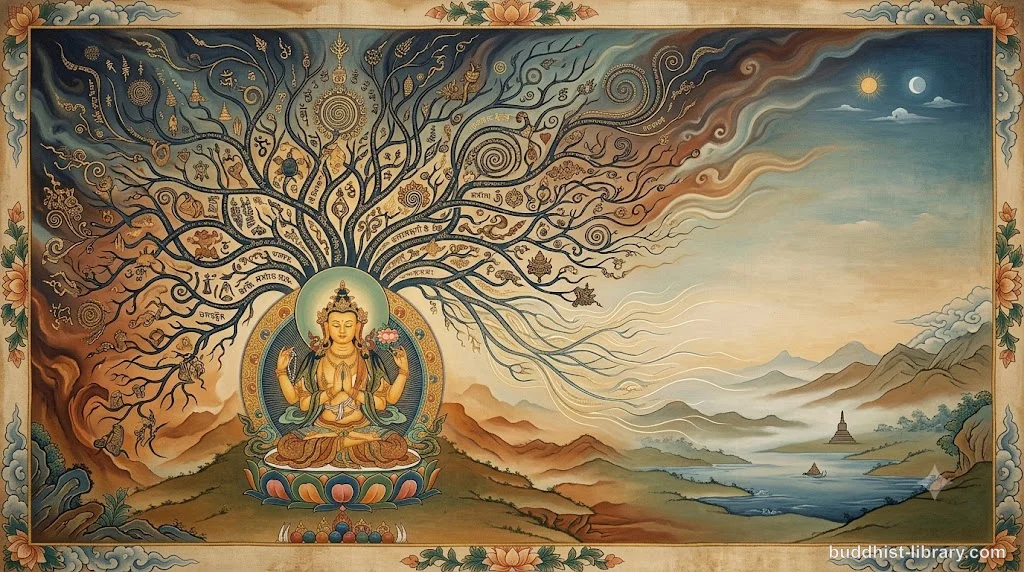
Papañca is the mind’s compulsive habit of turning simple experiences into elaborate conceptual dramas. Instead of simply seeing, hearing, or feeling, the untrained mind immediately spins stories, judgments, and fantasies—a process that the Buddha identified as a root cause of psychological suffering.
The Pali term papañca (Sanskrit: prapañca) appears throughout early Buddhist texts but resists clean translation. Scholars have tried “conceptual proliferation,” “mental proliferation,” “elaboration,” “reification,” “diffuseness”—each capturing a facet of the same phenomenon. What they all point toward is this: the mind builds increasingly baroque conceptual structures on top of what was originally just bare seeing, hearing, touching.
What Does Papañca Mean in Buddhist Psychology?
Papañca describes the process by which the mind takes a simple sensory contact and expands it into an elaborate conceptual and emotional narrative. The classic teaching comes from the Madhupindika Sutta (MN 18), where the Buddha traces how mental proliferation arises:
“Dependent on the eye and forms, eye-consciousness arises. The meeting of the three is contact. With contact as condition there is feeling. What one feels, that one perceives. What one perceives, that one thinks about. What one thinks about, that one mentally proliferates. With what one has mentally proliferated as the source, perceptions and notions tinged by mental proliferation beset a man…”
This progression shows how perception becomes thought, and thought detonates into papañca—a cascade of associations, judgments, memories, projections. What started as simply seeing an object becomes “my object,” “better than theirs,” “reminds me of when…” The chain has no natural stopping point.
The term papañca comes from the root pañc, “to spread out” or “expand.” The prefix pa- intensifies it—excessive spreading, like ink dropped into water.
How Does Mental Proliferation Work?
Papañca operates through three primary mechanisms, often called the “three obsessions” (papañca-saññā-saṅkhā):
The obsession with “I am” creates solid selfhood and personal territory. See an attractive object? The mind immediately builds “I want this,” “This is mine,” “This defines who I am.”
The obsession with craving (taṇhā) elaborates pleasant experiences into fantasies of acquisition, possession, enjoyment. A single pleasant taste triggers mental scenarios about future meals, restaurants, social status connected to food preferences.
The obsession with conceit compares relentlessly. “Am I better?” “They’re beneath me.” “I deserve more recognition.” Each comparative thought spawns new branches.
The danger of papañca lies not in concepts themselves—language and thought have practical uses—but in the involuntary and compulsive nature of this proliferation. The mind doesn’t stop at useful information; it continues spinning stories, constructing elaborate edifices of “me,” “mine,” and “what I am.”
What Is the Relationship Between Papañca and Suffering?
The Buddha identified papañca as intimately connected to dukkha (suffering) through several mechanisms:
Papañca creates the illusion of a solid, permanent self. By constantly thinking “I am this,” “I want that,” “They wronged me,” the mind reifies a sense of fixed identity. This illusory self then becomes something to defend, aggrandize, and worry about—a constant source of stress.
Mental proliferation multiplies suffering. One unpleasant experience becomes a vast narrative of injustice, future catastrophe, self-pity. Physical pain gets overlaid with “Why me?” “This is unfair,” “What will happen next?” The Buddha called this the second arrow—we shoot ourselves repeatedly with our own proliferating thoughts.
Papañca obscures reality. When the mind is busy proliferating concepts about experience, it cannot see experience directly. The conceptual overlay becomes more real than the underlying sensory data, leading to misunderstanding and unskillful action.
In the Madhupiṇḍika Sutta, the Buddha describes an awakened one as someone whom “perceptions and notions tinged by mental proliferation no longer beset.” This doesn’t mean the arahat never thinks or uses concepts, but that thinking serves a purpose without spinning into compulsive, suffering-generating elaboration.
How Can We Recognize Papañca in Daily Life?
Papañca manifests constantly in ordinary consciousness. Consider these common examples:
In relationships: Someone gives you a neutral look. Your mind takes off: “They’re angry with me. Why? What did I do? They never appreciated me anyway. I should…” A facial expression becomes a five-act drama.
During meditation: You sit to observe the breath. Within moments, you’re planning dinner, replaying yesterday’s conversation, imagining tomorrow, judging your practice, comparing yourself to other meditators. One wandering moment explodes into a full-scale proliferation festival.
With pleasant experiences: You taste something delicious. Instead of simply tasting, the mind proliferates: “This is the best. I need to come back here. I should tell everyone. What if they don’t have this next time? Maybe I can recreate the recipe…” The direct pleasure is buried under conceptual elaboration.
With achievements: You accomplish something worthwhile. Rather than simple satisfaction, papañca arises: “This proves I’m capable. Now people will respect me. What should I do next to maintain this image? What if my next project fails?”
The key recognition is the unnecessary multiplication of thoughts beyond what the situation requires. You need some thinking to navigate life—but papañca is the compulsive extra 90% that serves only to create suffering.
What Are the Buddhist Practices for Reducing Papañca?
The Buddha taught several approaches to reduce mental proliferation:
Mindfulness (sati) catches proliferation in the act. By training attention to notice when the mind has left bare experience and entered conceptual elaboration, practitioners can interrupt the cycle. The instruction in Right Mindfulness (Sammā Sati) is to observe experience directly without adding commentary.
Investigating feeling (vedanā) breaks the proliferation chain. The Madhupindika Sutta shows that mental proliferation follows from feeling. By carefully observing pleasant, unpleasant, and neutral feeling tones before they trigger conceptual thought, one can prevent papañca from arising. This is central to Vedanā practice.
Developing concentration (samādhi) stabilizes the mind. In deep meditative absorption (jhāna), the conditions for papañca are temporarily suspended. The mind rests in direct experience without the proliferating activity of conceptual thought. This provides direct knowledge of what consciousness is like without papañca—a powerful motivation for practice.
Wisdom (paññā) sees through the proliferating constructs. As insight matures, one recognizes that the elaborate self-narratives papañca creates are not ultimately real. The “I” that papañca constantly elaborates is revealed as a process, not an entity. This seeing undermines the whole proliferating tendency at its root.
The Sabbāsava Sutta (MN 2) teaches that some mental taints (āsava) are eliminated “by seeing,” some “by restraining,” some “by using,” and some “by enduring.” Papañca is primarily eliminated by seeing—direct insight into its empty, constructed nature.
How Does Papañca Relate to Other Buddhist Concepts?
Understanding papañca clarifies several related teachings:
Papañca and the three marks of existence: Mental proliferation obscures impermanence (anicca) by creating narratives of permanence and continuity. It obscures suffering (dukkha) by adding layers that make suffering seem solid and meaningful rather than conditioned and empty. It obscures non-self (anattā) by constantly constructing an elaborate sense of “me” and “mine.”
Papañca and dependent origination: In the Dependent Origination formula, papañca operates in the link between feeling and craving. When feeling is met with papañca, craving multiplies; when feeling is met with clear awareness, craving doesn’t gain a foothold.
Papañca and the fetters: The obsession with conceit that drives papañca is directly connected to the fetter of “I am” conceit (māna), which is only eliminated at full awakening. Earlier stages of liberation reduce but don’t fully eliminate papañca.
Papañca and skillful action: The Middle Way doesn’t advocate stopping all thought. Discriminating wisdom uses concepts skillfully without becoming lost in them. The difference is between using thought as a tool versus being compulsively driven by proliferating ideation.
What Do Modern Buddhist Teachers Say About Papañca?
Contemporary teachers have explored papañca using different angles:
Bhikkhu Bodhi emphasizes that papañca creates the “illusion of a substantial self navigating a world of discrete objects.” His translation emphasizes how proliferation constructs the entire subject-object duality that we take as reality.
Thanissaro Bhikkhu focuses on papañca as “complication”—the mind’s tendency to make things more complex than they need to be. He relates this to the Buddha’s teaching on skillful simplification: reducing suffering by not adding unnecessary layers to experience.
Ven. Ñāṇananda, in Concept and Reality in Early Buddhist Thought, provides an extensive analysis of papañca as the reification of concepts. He argues that much of what we take as “reality” is actually papañca-generated conceptual overlay mistaken for direct perception.
Contemporary Vipassana teachers often use papañca to explain why noting practice works: by labeling phenomena simply (“thinking,” “feeling,” “planning”), the mind learns to recognize proliferation and return to bare experience before getting caught in elaborate stories.
Can Papañca Ever Be Completely Eliminated?
The early texts are clear: complete cessation of papañca happens at full awakening—the arahat stage. The Madhupindika Sutta describes the arahat as one whom “perceptions and notions tinged by mental proliferation no longer beset.”
Does this mean arahats never think? No. They plan, communicate, navigate the world using concepts. The difference is that their thinking is intentional and functional, not compulsive and proliferating.
For practitioners at earlier stages, the goal is progressive reduction:
Stream-enterers have unshakable confidence in the path and have eliminated views based on papañca-driven identity construction, but conceptual proliferation around other topics continues.
Once-returners and non-returners progressively weaken sensory craving and aversion, which reduces the fuel for papañca, but subtle proliferation around the sense of “I am” remains.
Full awakening eliminates even the most subtle proliferating tendency. The mind can still use concepts instrumentally but no longer involuntarily proliferates them into elaborate narratives of self.
Here’s the practical takeaway: you don’t need arahat-level attainment to benefit from understanding papañca. Simply recognizing it—catching your mind in the act of spinning elaborate stories—and learning to disengage brings significant relief. The path is gradual, and every reduction counts.
Read more:
- What Is Dukkha? Understanding Suffering in Buddhism — Mental proliferation is a major mechanism by which dukkha multiplies beyond the bare facts of painful experience.
- Anattā (Non-Self): What the Buddha Really Meant — Papañca constantly creates the illusion of a solid self; understanding anattā reveals this construction as empty process.
- Right Mindfulness (Sammā Sati): The Seventh Factor of the Noble Path — Mindfulness practice directly interrupts papañca by returning attention to bare experience before proliferation takes hold.
📖 Source / license: Madhupindika Sutta (MN 18), translated by Bhikkhu Bodhi in *The Middle Length Discourses of the Buddha*; Ñāṇananda, *Concept and Reality in Early Buddhist Thought*
Frequently asked questions
What is papañca in simple terms?
Papañca is mental proliferation—the mind's automatic habit of spinning elaborate stories, judgments, and conceptual elaborations from simple sensory experiences. It transforms 'I see a person' into complex narratives about me, them, relationships, past and future.
How does papañca cause suffering?
Papañca creates suffering by adding layers of conceptual overlay onto direct experience. When we mentally elaborate on what we perceive, we create divisions (me vs. them), judgments (good vs. bad), and narratives that trigger craving, aversion, and the sense of a fixed self—all sources of dukkha.
Can papañca be stopped completely?
While fully eliminating papañca requires deep meditative insight (typically associated with arahat attainment), anyone can reduce it through mindfulness practice. By catching the mind in the act of proliferating and returning to bare attention, we gradually weaken this habitual pattern.
What is the difference between thinking and papañca?
Not all thinking is papañca. Practical, purposeful thought (planning a meal, solving a problem) serves a function. Papañca is the *unnecessary* mental elaboration—the obsessive rehashing, fantasy spinning, and conceptual proliferation that happens automatically and creates suffering without serving any useful purpose.