What Is Samādhi? Understanding Concentration in Buddhist Meditation
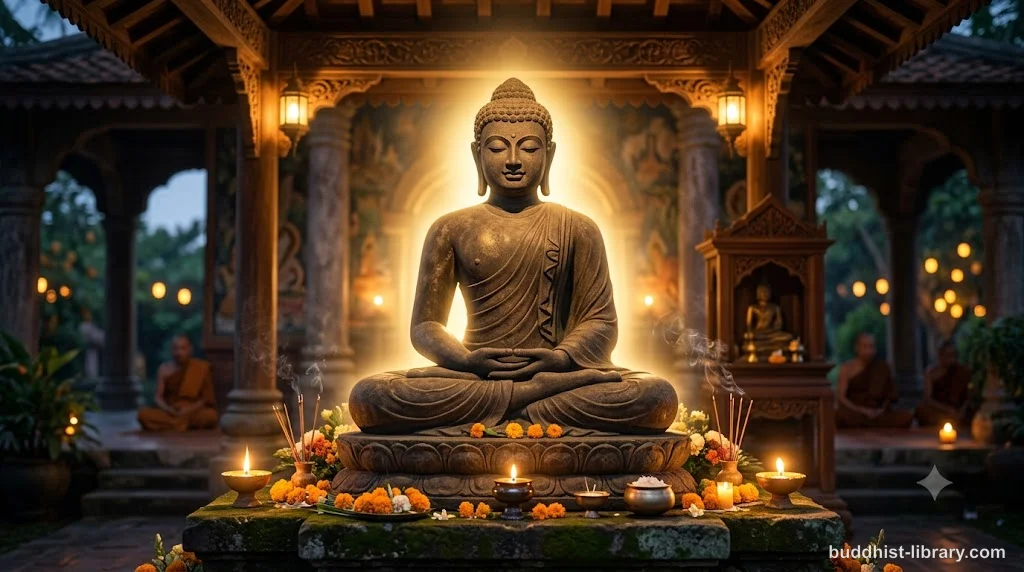
Samādhi is the quality of concentrated, unified attention in which the mind rests steadily on a single object without wandering. As the eighth factor of the Noble Eightfold Path, it transforms scattered awareness into a powerful tool for insight, calm, and—ultimately—liberation from suffering.
What does samādhi mean?
The Pali term samādhi (Sanskrit: samādhi) comes from roots meaning “to put together” or “to collect.” Think of how a lens focuses scattered sunlight into a single, intense beam—that’s what the mind does when it gathers itself around one point, becoming stable and undistracted.
Samādhi isn’t suppressing thoughts. It’s training attention so completely that the mind naturally settles into stillness. The fifth-century meditation manual Visuddhimagga defines it as “the centering of consciousness and consciousness-concomitants evenly and rightly on a single object.” Precise language for a precise state.
In the Sāmaññaphala Sutta (DN 2), the Buddha outlines the gradual training: ethical conduct (sīla) provides the foundation, mindfulness (sati) directs awareness, and samādhi unifies and stabilizes that awareness into deeper states of absorption. Each builds on the previous.
How does samādhi differ from mindfulness?
Mindfulness and concentration are partners, not synonyms.
Mindfulness (sati) is present-moment awareness—the capacity to notice what’s happening right now without distraction or judgment. Samādhi is the quality of that awareness when it becomes collected, one-pointed, and stable. One chooses the object; the other holds it steady.
An analogy: mindfulness is the hand that holds the candle; samādhi is the stillness of the flame when the hand stops shaking. You can be mindful of many things in sequence—body sensations, sounds, thoughts passing through—but samādhi deepens when awareness narrows to a single anchor (often the breath) and stays there.
In the Cūḷavedalla Sutta (MN 44), the nun Dhammadinnā explains: “Unification of mind is concentration… whatever is mindfulness and awareness, these are qualities associated with concentration.” They arise together, each supporting the other.
What are the levels of samādhi?
Buddhist texts describe samādhi on a spectrum:
Momentary concentration (khaṇika-samādhi)
The mind touches its object briefly—a second or two—before moving on. This is the baseline for everyday mindfulness practice. Even fleeting moments of concentration begin to reduce mental chatter.
Access concentration (upacāra-samādhi)
The mind settles into longer periods of stability on the meditation object. Distractions fade to the background. Physical discomfort may lessen. Some meditators report a quality of brightness or subtle joy. This state is often considered the threshold to deeper absorption.
Absorption concentration (appanā-samādhi)
The mind merges fully with its object. The sense of effort drops away, replaced by ease and continuity. This is the territory of the jhānas—refined states of meditative absorption described in the suttas.
The Buddha attained the four (or eight, in expanded lists) jhānas before his awakening and continued to practice them afterward. In the Ānāpānasati Sutta (MN 118), he teaches breath meditation leading progressively through these absorptions.
What are the jhānas?
The jhānas (Sanskrit: dhyānas) are states of deep meditative absorption, each characterized by specific mental factors. Not mystical achievements. They’re trainable, reproducible states accessible to any committed practitioner willing to put in the hours.
First jhāna: Applied and sustained thought quiet down. The mind experiences joy (pīti) and happiness (sukha) born of withdrawal from sensory distraction—you’re still aware of the meditation object, but effort becomes easier, almost effortless.
Second jhāna: Thinking stops entirely. Awareness unifies into a single flow. Joy and happiness continue, now more refined—described as born of concentration rather than withdrawal.
Third jhāna: Joy, which can feel energizing or even agitating, fades. What remains is a calm, steady happiness and equanimity. The breath may become very subtle. Sometimes it seems to disappear.
Fourth jhāna: Even happiness subsides. The mind rests in pure equanimity and one-pointedness—utterly clear, balanced, imperturbable.
Beyond these four, the texts describe four arūpa (formless) jhānas: infinite space, infinite consciousness, nothingness, and neither-perception-nor-non-perception. This is the edge of what concentration alone can reach.
How does samādhi lead to wisdom?
Concentration alone doesn’t produce insight. This matters. The Buddha rejected the extreme of pure absorption just as he rejected harsh asceticism—he integrated samādhi into a balanced path where concentration serves wisdom.
When the mind is concentrated, it becomes pliable, workable—what the suttas call kammanīya. Distractions and emotional reactivity lose their grip. From this stable platform, you can observe phenomena clearly: sensations rising and passing, the constructed nature of thoughts, the impermanent and impersonal quality of everything you experience.
This is where vipassanā (insight) arises. You see the three marks of existence—impermanence (anicca), suffering (dukkha), and non-self (anattā)—not as concepts but as direct, immediate truths. Samādhi provides the magnification; wisdom sees what’s there.
The relationship is reciprocal. As the Ānāpānasati Sutta teaches, mindfulness of breathing develops both concentration and insight. Attending closely to the breath steadies the mind (samādhi), and observing its changing texture—sometimes coarse, sometimes refined, sometimes nearly imperceptible—reveals impermanence (insight).
How do I develop samādhi?
Choose an object
The breath is traditional and accessible. Other options include a visual mark (kasiṇa), a repeated phrase (mantra), or body sensations. Pick one and stick with it. Switching objects restarts the process.
Sit regularly
Daily practice builds momentum. Even 15 minutes a day accumulates. The mind learns concentration the way muscles learn a movement—through repetition.
Establish ethical conduct
Concentration is difficult if you’re burdened by guilt, fear of consequences, or agitation from harmful actions. The five precepts aren’t arbitrary rules; they’re practical supports for a calm mind.
Let go of striving
Paradoxically, forcing concentration breaks it. Effort is needed to return attention when it wanders, but once the mind settles, relax into the experience. Trust the process.
Work with a teacher
Books and apps help, but meditation has always been taught person-to-person. A skilled teacher can spot subtle mistakes—overeffort, sleepiness disguised as calm, attachment to pleasant states—and offer precise corrections.
What are the common obstacles?
The five hindrances (nīvaraṇa) are the classic list:
- Sensory desire: The mind chases pleasant images, fantasies, plans.
- Ill will: Resentment, irritation, imagined arguments.
- Sloth and torpor: Drowsiness, dullness, mental fog.
- Restlessness and worry: Agitation, anxiety, inability to settle.
- Doubt: Questioning whether the practice works, whether you’re doing it right, whether it’s worth the time.
Each has antidotes. Sensory desire weakens when you reflect on impermanence—pleasure doesn’t last, and clinging only tightens the knot. Ill will softens with loving-kindness practice. Sloth responds to energy—walking meditation, opening the eyes, standing. Restlessness calms when you let the breath be your anchor. Doubt fades as you see results.
Key points
- Samādhi is unified, one-pointed attention—the mind collected and stable on a single object.
- It’s the eighth factor of the Noble Eightfold Path, working in concert with ethical conduct and wisdom.
- Concentration develops through stages: momentary, access, and absorption (jhāna).
- The jhānas are trainable states, not mystical achievements—they refine the mind into a tool for insight.
- Samādhi supports wisdom: a concentrated mind sees impermanence, suffering, and non-self clearly.
- Daily practice, ethical living, and letting go of striving all accelerate development.
- The five hindrances are the main obstacles; each has specific antidotes.
Conclusion
Samādhi is not an escape from reality—it’s a way of seeing reality more clearly. By training the mind to rest on a single point, you discover a quality of awareness that’s steady, spacious, and responsive rather than reactive.
The path is gradual. Some days the mind settles easily. Other days it’s restless, distracted, caught in old patterns. Both are part of the training.
The Buddha’s instruction was simple: return to the breath, again and again, with patience and without judgment. Over time, the mind learns to come home.
Read more:
- How to Start Buddhist Meditation: A Beginner’s Guide — practical instructions for establishing a daily meditation practice, including posture, breath awareness, and working with common obstacles.
- The Noble Eightfold Path: A Complete Guide — understand how right concentration fits into the Buddha’s integrated system of ethical conduct, mental cultivation, and wisdom.
- What Is Mindfulness (Sati) in Buddhism? — clarifies the relationship between mindfulness and concentration, and how they work together on the path.
📖 Source / license: Sāmaññaphala Sutta (DN 2), Ānāpānasati Sutta (MN 118), Cūḷavedalla Sutta (MN 44). Translations by Bhikkhu Bodhi (Wisdom Publications) and Ṭhānissaro Bhikkhu (Access to Insight, dhammatalks.org).
Frequently asked questions
Is samādhi the same as mindfulness?
No. Mindfulness (sati) is present-moment awareness; samādhi is the concentrated, unified quality of that awareness. They work together—mindfulness chooses the object, samādhi holds it steady.
Do I need jhāna to reach enlightenment?
Buddhist traditions differ. The early suttas describe the Buddha attaining jhāna before his awakening, and he recommended it. However, some teachers emphasize momentary concentration (khaṇika-samādhi) as sufficient for insight. The debate continues.
Can samādhi be harmful?
Wrong concentration (micchā-samādhi) focused on unwholesome objects—planning harm, nursing resentment—reinforces suffering. Right concentration (sammā-samādhi) rests on ethical conduct and wholesome intentions, creating the foundation for liberation.
How long does it take to develop samādhi?
Progress varies widely. Some meditators report deeper concentration within weeks of daily practice; others work for years. Consistency, proper instruction, ethical conduct, and letting go of striving all accelerate development.