The Alagaddūpama Sutta: The Snake Simile and Right Understanding
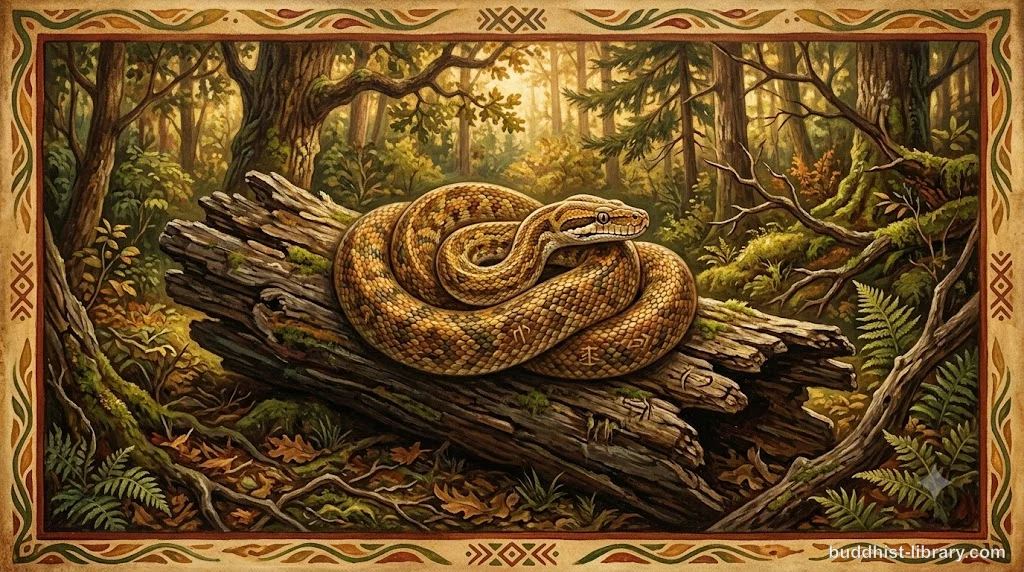
The Alagaddūpama Sutta—the Snake Simile Discourse—is the Buddha’s sharp warning against misunderstanding the Dharma. Like a snake grasped wrongly that bites back, the teachings misunderstood lead to harm instead of freedom. Right understanding means seeing impermanence, suffering, and non-self clearly—not twisting the Dharma to fit our desires or clinging to views as if they were absolutes.
What Is the Alagaddūpama Sutta?
The Alagaddūpama Sutta (MN 22) is the 22nd discourse in the Majjhima Nikāya (Middle Length Discourses) of the Pali Canon. Delivered at Sāvatthī, it records the Buddha’s rebuke of the monk Ariṭṭha, who had misrepresented the teaching by claiming that sensual pleasures are not obstacles to the path. Using vivid similes—the snake and the raft—the Buddha corrects not only Ariṭṭha’s distortion but also addresses broader dangers: clinging to wrong views, grasping at the teaching itself, and misunderstanding the doctrine of non-self (anattā).
This sutta is foundational for understanding right view (sammā diṭṭhi)—the first factor of the Noble Eightfold Path—and the Buddha’s insistence on precision in how we receive and hold his teachings.
Why Does the Buddha Use the Snake Simile?
The sutta opens with the Buddha addressing the monks about a man who searches for a water snake. Spotting one, he grabs it carelessly—by the body or tail. The snake coils back and bites his hand, arm, or another limb, causing death or deadly suffering. Why? Because he grasped it wrongly.
Another man, also seeking a snake, uses a forked stick. He pins the snake’s head, grasps it properly by the neck, and though the snake writhes and coils around his limbs, it cannot bite. He remains safe because he grasped it rightly.
The Buddha then delivers the punch line: “So too, monks, some misguided individuals study the Dharma—discourses, verses, expositions, stanzas, exclamations, sayings, birth stories, marvels, and analyses—but having studied them, they do not examine the meaning with wisdom. Not examining the meaning with wisdom, they do not gain a reflective acceptance of those teachings. Instead, they study the Dharma only for the sake of criticizing others and winning arguments. They do not experience the good for the sake of which they studied the Dharma. Those teachings, being wrongly grasped, conduce to their harm and suffering for a long time.”
What Was Ariṭṭha’s Wrong View?
Ariṭṭha, a former vulture trainer turned monk, held the pernicious view that “as I understand the Dharma taught by the Blessed One, those things called obstructions by the Blessed One are not able to obstruct one who engages in them.” In plain language: he believed sensual pleasures do not hinder spiritual progress.
The Buddha questioned him repeatedly; Ariṭṭha stubbornly clung to his position. The Buddha then rebuked him sharply before the assembly, pointing out that he had grossly misrepresented the teaching. The Buddha had repeatedly taught that sensual pleasures are “of little satisfaction, much suffering, much despair,” and that abandoning attachment to them is essential for liberation.
This episode cuts to a critical danger: interpreting the Dharma to justify our desires rather than to see things as they are.
Ariṭṭha wanted permission for indulgence, so he twisted the teaching to grant it. The Buddha calls this grasping the Dharma by the tail.
What Is the Raft Simile?
After correcting Ariṭṭha, the Buddha offers a second simile—the raft—to show the proper relationship to the Dharma itself:
“Monks, suppose a man on a journey sees a great expanse of water, the near shore dangerous and fearful, the far shore safe. There is no ferryboat or bridge. He thinks: ‘I will gather grass, twigs, branches, and leaves, bind them into a raft, and supported by the raft, cross over safely by paddling with my hands and feet.’ Having done so and crossed over, he thinks: ‘This raft has been very helpful. Suppose I were to hoist it on my head or carry it on my back and go wherever I want.’ Would he be using the raft properly?”
The monks respond: “No, venerable sir.”
The Buddha continues: “What should he do? Having crossed over and reached the far shore, he should think: ‘This raft has been very helpful. Suppose I were to haul it onto dry land or let it float away, and then go wherever I want.’ This is how he would be using the raft properly.”
Then comes the key teaching: “So I have shown you, monks, how the Dharma is similar to a raft—for the purpose of crossing over, not for grasping. Understanding this simile of the raft, you should abandon even good states, how much more so bad states.”
This is radical.
Even skillful teachings, wholesome mental states, and right views are tools—not possessions. Once you’ve crossed the river of suffering (saṃsāra), you don’t cling to the raft of Dharma. To grasp the Dharma as “my teaching,” “my view,” “my identity” is to turn a liberating tool into a new form of bondage.
What Does the Sutta Teach About Self and Non-Self?
The latter portion of the sutta addresses the subtlest wrong grasp: misunderstanding the teaching of non-self (anattā). The Buddha presents a series of questions directed at hypothetical monks who hold various views about the self:
- “Do you see, monks, any such grasping of a self-view that would not give rise to sorrow, lamentation, pain, grief, and despair?”
- The monks answer: “No, venerable sir.”
The Buddha then lists six common wrong views about self and the five aggregates (form, feeling, perception, mental formations, consciousness):
- “This is mine.”
- “This I am.”
- “This is my self.”
Each of these views—whether applied to the body, feelings, perceptions, thoughts, or consciousness—leads to clinging and suffering. Why? Because all these phenomena are impermanent (anicca), subject to change, and not under our ultimate control. Identifying with them, we suffer when they change or cease.
The correct understanding is not to assert “I have no self” (annihilationism, another extreme view), but to see clearly: “This is not mine, this I am not, this is not my self.”
This is a phenomenological observation, not a metaphysical claim. It’s the difference between clinging to a view (“there is no self”) and simply seeing things as they are—conditioned, impermanent, not fit to be clung to.
When a monk sees the five aggregates this way, he becomes disenchanted, dispassionate, and liberated. He no longer fabricates a “self” around changing phenomena. This is grasping the Dharma rightly—by the neck, not the tail.
Key Points: The Alagaddūpama Sutta
- The snake simile: Grasping the Dharma wrongly—through misunderstanding, self-serving interpretation, or intellectual pride—leads to harm and prolonged suffering, like being bitten by a snake grabbed by the tail.
- Ariṭṭha’s wrong view: Claiming that sensual pleasures are not obstacles is a gross distortion of the Buddha’s teaching, born from desire rather than wisdom.
- The raft simile: The Dharma is a means to an end—crossing over suffering—not an end in itself. Once liberation is achieved, even right views must be released. Clinging to the raft after crossing is as foolish as clinging to wrong views before crossing.
- Right understanding of non-self: The teaching of anattā is not “I have no self” (a view to grasp), but seeing clearly that the five aggregates are impermanent, conditioned, and not fit to be identified with. This seeing leads to dispassion and freedom.
- Purpose over possession: Study the Dharma to understand and practice it, not to win debates, assert identity, or justify craving. The point is liberation, not pride in “my view.”
How Do We Grasp the Dharma Rightly?
The Alagaddūpama Sutta offers practical guidance:
- Examine teachings with wisdom: Don’t accept the Dharma superficially or twist it to fit desires. Investigate the meaning deeply, test it against experience, and apply it sincerely.
- Study for liberation, not for vanity: The purpose of learning the Dharma is to cross over suffering—not to accumulate knowledge, win arguments, or build a spiritual identity.
- Hold views lightly: Even skillful views (like the Noble Eightfold Path or the Four Noble Truths) are tools. When their function is fulfilled, they too are let go. This is why the Buddha said to abandon even good states, let alone bad ones.
- See the aggregates as not-self: Observe body, feelings, perceptions, mental formations, and consciousness without clinging. See their impermanence and conditioned nature. This is the right grasp—seeing clearly without grasping a position.
- Avoid the extremes: Don’t assert “I have a self” (eternalism) or “I have no self” (nihilism). Both are conceptual fabrications. The middle way is to see phenomena as they are—dependently arisen, empty of inherent selfhood.
Why Does This Sutta Matter Today?
The Alagaddūpama Sutta remains urgently relevant. We live in an age of abundant access to teachings—texts, talks, online forums—but this abundance brings its own danger. We can collect teachings like possessions, weaponize them in debates, or cherry-pick passages to justify what we already want to do. All of this is grasping the snake by the tail.
The sutta is also a corrective to intellectual pride in Buddhist circles. Knowing about Buddhism—doctrines, terms, history—is not the same as practicing it. The monk who can recite the entire Tipiṭaka but has not examined its meaning with wisdom and applied it to uproot greed, hatred, and delusion has grasped the Dharma wrongly. Meanwhile, the practitioner who knows little but sees impermanence directly, lets go of clinging, and crosses over to freedom has grasped it rightly.
Finally, the raft simile offers a profound antidote to spiritual materialism—the tendency to accumulate practices, beliefs, and identities as if they were achievements. The Dharma is not here to make us into “Buddhists” with views to defend. It’s here to free us from suffering. Once that’s done, even the raft is released.
Conclusion: Handle With Wisdom
The Alagaddūpama Sutta is the Buddha at his most direct. There is no room for half-measures or self-deception. If you approach the Dharma carelessly—studying it for pride, distorting it to fit your desires, clinging to views as if they were ultimate truths—you will be bitten. The very teachings meant to liberate you will become sources of suffering.
But if you grasp the Dharma rightly—with wisdom, humility, and the clear intention to cross over suffering—it will carry you safely to the far shore. And when you arrive, you’ll know what to do: set the raft down and walk on, free.
Read more:
- Right View (Sammā Diṭṭhi): The Foundation of the Buddhist Path — The first factor of the Noble Eightfold Path is to see things as they truly are, without distortion—the antidote to the wrong views warned against in the Snake Simile Sutta.
- The Five Aggregates (Khandhas): What We Mistake for ‘Self’ — Understanding form, feeling, perception, mental formations, and consciousness as impermanent and not-self is central to the Alagaddūpama Sutta’s teaching on liberation.
- What Is Anattā (Non-Self)? What the Buddha Really Meant — The Snake Simile Sutta’s nuanced treatment of self and non-self shows why anattā is not a belief to grasp, but a direct seeing that frees.
📖 Source / license: Alagaddūpama Sutta (MN 22), translated by Bhikkhu Bodhi in *The Middle Length Discourses of the Buddha* (Wisdom Publications, 1995); also available at Access to Insight and SuttaCentral.
Frequently asked questions
What is the Alagaddūpama Sutta about?
The Alagaddūpama Sutta (MN 22) is the Buddha's teaching on right understanding versus wrong views. Using the simile of a snake—dangerous when grabbed incorrectly, but safe when handled properly—the Buddha warns against misunderstanding the Dharma, clinging to views, and misinterpreting the teaching of non-self.
Why is it called the Snake Simile Sutta?
It's named after the Buddha's famous simile: just as a snake grasped by the tail will turn and bite, the Dharma wrongly grasped leads to harm and suffering instead of liberation. The right grasp brings safety and freedom.
What did the monk Ariṭṭha misunderstand in this sutta?
Ariṭṭha wrongly claimed that sensual pleasures are not obstructions to the path—a dangerous distortion of the Buddha's teaching. The Buddha corrected him sharply, emphasizing that sensual desires are indeed obstacles and must be abandoned.
What does the raft simile in this sutta teach?
The raft simile teaches that the Dharma is a tool for crossing over suffering, not a possession to cling to. Once you've crossed the river, you leave the raft behind—you don't carry it on your head. Even right views must eventually be released.
How does this sutta address the question of self and non-self?
The sutta warns against both the view 'I have a self' and the nihilistic view 'I have no self.' The Buddha teaches that clinging to either view causes suffering. The goal is to see phenomena as they are—conditioned, impermanent, not-self—without reifying any position.