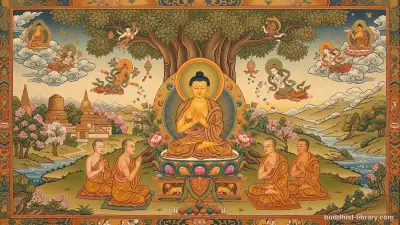
The Udāna: The Buddha's Inspired Utterances

The Udāna is a collection of 80 short suttas from the Pali Canon, each culminating in the Buddha’s spontaneous verse utterances—expressions of joy, wonder, or realization spoken at moments of profound insight. These “inspired utterances” reveal the Buddha’s inner experience and offer glimpses into the liberating wisdom that shaped his teaching.
What Is the Udāna?
The word udāna (Pali: उदान) literally means “up-breathing” or “exhalation.” In Buddhist usage, though, it means something more specific: an inspired utterance that arises spontaneously from deep spiritual realization. The Udāna is the third book of the Khuddaka Nikāya (Minor Collection) in the Sutta Piṭaka, one of the three “baskets” of the Pali Canon.
What makes the Udāna different? Unlike texts focused on systematic instruction, it captures moments of spontaneous expression. The Buddha speaks these verses not in response to questions, but as natural overflow of his awakened awareness when witnessing profound truths or significant events. They’re unscripted—the Buddha thinking aloud.
Each of the 80 suttas follows a consistent structure: a prose narrative sets the scene and context, then the Buddha utters his inspired verse. These verses are often cryptic, poetic, and dense with meaning. They reflect states of consciousness beyond ordinary conceptual thought.
Why Did the Buddha Utter These Verses?
The suttas make clear that udānas arise spontaneously, not by deliberate composition. The Buddha would witness a situation—a monk attaining awakening, a deluded person clinging to views, the peace of renunciation—and a verse would arise expressing the essence of that moment. Not composed. Just arising.
This spontaneity matters. The Buddha’s teaching (Dhamma) wasn’t merely intellectual doctrine; it emerged from direct realization. The Udāna verses show us the Buddha’s mind in action: seeing dependent origination unfold, recognizing the subtle workings of craving, celebrating the freedom of Nibbāna. These aren’t polished sermons. They’re glimpses of awakened awareness responding to the world in real time.
The text itself describes these utterances as arising “on that occasion” (tena samayena), emphasizing their immediacy.
Structure and Content of the Udāna
Eight Chapters, Eighty Suttas
The Udāna is organized into eight vaggas (chapters), each containing ten suttas:
- Bodhi Vagga — Utterances related to awakening
- Mucalinda Vagga — Including the famous story of the nāga king sheltering the Buddha
- Nanda Vagga — Featuring the Buddha’s half-brother Nanda
- Meghiya Vagga — On the attendant Meghiya and prerequisites for awakening
- Soṇa Thera Vagga — Stories of various monks and their practice
- Jaccandha Vagga — On the blind, both physically and spiritually
- Cūḷa Vagga — “The Small Chapter,” diverse teachings
- Pāṭaligāmiya Vagga — Named after Pāṭaligāma village, including late-life events
Recurring Themes
Several themes appear throughout the Udāna:
- Awakening and liberation — Many suttas describe monks attaining arahantship and the Buddha’s utterances celebrating their freedom
- The peace beyond conflict — Multiple verses point to the unconditioned, the unborn, the deathless
- Renunciation — The joy and peace that come from letting go
- The foolishness of clinging — Verses contrasting the wise with the deluded
- Dependent origination — The chain of causation underlying all existence
- Nibbāna — Direct pointers to the goal of the path
Notable Udānas: Examples from the Text
On the Unborn (Ud 8.3)
Perhaps the most famous udāna concerns the unconditioned:
“There is, monks, an unborn, unbecome, unmade, unfabricated. If there were not that unborn, unbecome, unmade, unfabricated, there would be no escape from the born, become, made, fabricated. But precisely because there is an unborn, unbecome, unmade, unfabricated, therefore there is escape from the born, become, made, unfabricated.”
This verse points directly to Nibbāna, the goal beyond all conditioned phenomena.
On Awakening (Ud 1.1–3)
The first three suttas describe the Buddha’s experience immediately after awakening under the Bodhi tree. He contemplates dependent origination forward and backward, marveling at how this profound teaching had remained hidden, yet is so clear to the awakened mind:
“When phenomena become clear
To the ardent meditating brahman,
All his doubts vanish
Since he understands phenomenal causation.”
On Blind Meghiya (Ud 4.1)
The attendant Meghiya wants to meditate alone in a mango grove, but the Buddha advises him that five things must mature first: good friendship, virtue, discussions on Dhamma, energy, and wisdom. Meghiya goes anyway and struggles with unwholesome thoughts. The Buddha’s udāna expresses the teaching:
“For one with an immature mind,
Not established in the true Dhamma,
Wavering in conviction—
Wisdom doesn’t reach fullness.”
How the Udāna Differs from Other Texts
Not Systematic Teaching
Unlike the Four Noble Truths or the Noble Eightfold Path, which present systematic frameworks, the Udāna is impressionistic. It offers snapshots—moments when the Buddha’s realization expressed itself spontaneously. Think of it as the difference between a manual and a diary.
Dense, Poetic Language
The verses are cryptic and condensed. They assume familiarity with Buddhist teachings and use symbolic language—references to “the flood” (ogha), “the fetter” (saṃyojana), and “the unshaken” (aneñja) pack layers of meaning into single words.
This density makes the Udāna challenging. But also rewarding. Each verse invites contemplation and can reveal new meanings on repeated reading.
Glimpses of the Buddha’s Inner Life
Most suttas show the Buddha as teacher. The Udāna shows him as experiencer. We see what moved him to speak, what filled him with wonder or concern. This humanizes the teaching—it reminds us that liberation is a lived reality, not just a concept.
Key Teachings in the Udāna
The Conditioned and the Unconditioned
A central theme is the contrast between saṅkhata (the conditioned, fabricated, dependent) and asaṅkhata (the unconditioned, unfabricated, independent). The conditioned includes everything subject to arising and passing—all phenomena, all experience. The unconditioned is Nibbāna, which doesn’t arise, doesn’t pass, and isn’t dependent on conditions.
The Udāna’s verses on the unconditioned (Ud 8.1–4) are among the most direct statements in the Canon on what transcends the conditioned world.
Non-Attachment to Views
Several suttas address those who cling rigidly to views and opinions. The Buddha’s utterances emphasize that freedom comes not from holding the “right” view intellectually, but from direct seeing that transcends all conceptual positions.
The Prerequisites for Awakening
The Meghiya suttas (Ud 4.1) outline five conditions necessary for awakening:
- Good friendship (kalyāṇamittatā)
- Virtue (sīla)
- Dhamma discussion (dhammī kathā)
- Energy (viriya)
- Wisdom (paññā)
This list complements other formulations like the Seven Factors of Enlightenment.
Renunciation Brings Joy
Multiple udānas celebrate the peace and happiness that arise from renunciation. This isn’t the grim self-denial of asceticism, but the genuine contentment that comes from releasing craving and clinging.
How to Read the Udāna
Context Matters
Always read the prose narrative before the verse. The verse often won’t make sense in isolation—it’s the Buddha’s response to a specific situation. Skip the narrative, and you’ll be puzzled.
Contemplate, Don’t Just Analyze
The verses resist purely intellectual understanding. They’re meant to evoke recognition, not just convey information. Sit with a verse. Return to it over time. It can reveal dimensions that analysis alone won’t uncover.
Use It in Practice
When you encounter moments in meditation or daily life that mirror the Udāna’s situations—freedom from a hindrance, insight into impermanence, the peace of Right Concentration—recall the relevant verse. The Udāna becomes a companion to your own experience, not just ancient scripture.
Compare Translations
The verses are Pali poetry, and translations vary significantly. Ṭhānissaro Bhikkhu’s translation (Access to Insight) emphasizes precision; John D. Ireland’s (BPS) is more literary. Read both. The full meaning lives somewhere between them.
The Udāna in the Broader Canon
The Udāna belongs to the Khuddaka Nikāya, which also includes the Dhammapada, the Sutta Nipāta, and other collections. While the Khuddaka Nikāya is sometimes called the “Minor Collection,” many of its texts are among the most beloved and influential in Buddhism.
The Udāna’s early composition is suggested by its linguistic simplicity and thematic coherence with the core teachings found in the four main Nikāyas (Dīgha, Majjhima, Saṃyutta, Aṅguttara).
Practical Value of the Udāna
Inspiration
The Udāna shows that awakening is real. Monks and nuns attained liberation, and the Buddha witnessed and celebrated it. Not as myth or distant possibility—as witnessed fact.
Pointers to the Unconditioned
In a Canon full of systematic analysis of conditioned phenomena, the Udāna’s verses on the unconditioned offer a different approach: direct pointing. They remind us that the goal isn’t just understanding saṃsāra but realizing what lies beyond it. Sometimes you need the map. Sometimes you need someone pointing at the destination.
Wisdom in Daily Life
Many suttas address everyday situations—conceit, jealousy, misguided asceticism, the struggle to meditate. The Buddha’s responses, crystallized in verse, offer guidance that remains relevant 2,500 years later.
A Different Tone
The Udāna’s spontaneity gives it freshness and immediacy. It’s the Buddha unscripted, responding naturally to the world around him. This can feel more personal and direct than the formal discourses—and for some practitioners, that makes all the difference.
Conclusion
The Udāna occupies a unique place in the Pali Canon. Its 80 suttas preserve the Buddha’s inspired utterances—spontaneous expressions of awakened awareness arising in response to specific moments. Through these verses, we glimpse not just the Buddha’s teaching but his lived realization.
Reading the Udāna is like overhearing the Buddha thinking aloud. The verses are dense, poetic, sometimes cryptic. But they point directly to the heart of the Dhamma: the conditioned versus the unconditioned, the peace of renunciation, the freedom of Nibbāna, and the way to awakening.
For those walking the Buddhist path, the Udāna serves as both inspiration and instruction. Evidence that liberation is possible. A guide to the understanding that makes it real.
Read more:
- The Dhammapada: An Introduction to the Buddha’s Verses — Another canonical collection of the Buddha’s verses, organized by theme and offering practical wisdom for daily life.
- What Is Nirvana (Nibbāna)? Meaning and Misconceptions — The Udāna’s verses on the unconditioned point directly to Nibbāna; this article clarifies what the goal of the path actually is.
- The Pali Canon (Tipiṭaka): Structure and Contents of Early Buddhist Scriptures — Understand where the Udāna fits within the broader structure of the Pali Canon and the three baskets of early Buddhist texts.
📖 Source / license: Udāna (tr. Ṭhānissaro Bhikkhu, Access to Insight; tr. John D. Ireland, Buddhist Publication Society)
Frequently asked questions
What does Udāna mean in Pali?
Udāna means 'inspired utterance' or 'solemn utterance' in Pali. It refers to spontaneous expressions of joy, wonder, or realization that arise from deep spiritual experience, particularly the Buddha's own exclamations at profound moments.
How is the Udāna organized?
The Udāna contains 80 suttas arranged in 8 chapters (vaggas) of 10 suttas each. Each sutta includes a prose narrative establishing context, followed by the Buddha's inspired verse utterance.
Is the Udāna part of the earliest Buddhist texts?
Yes. The Udāna belongs to the Khuddaka Nikāya of the Sutta Piṭaka in the Pali Canon, which preserves the earliest Buddhist teachings. Many scholars consider it among the older texts in the Khuddaka Nikāya.