The Anattālakkhaṇa Sutta: The Buddha's Second Sermon on Non-Self
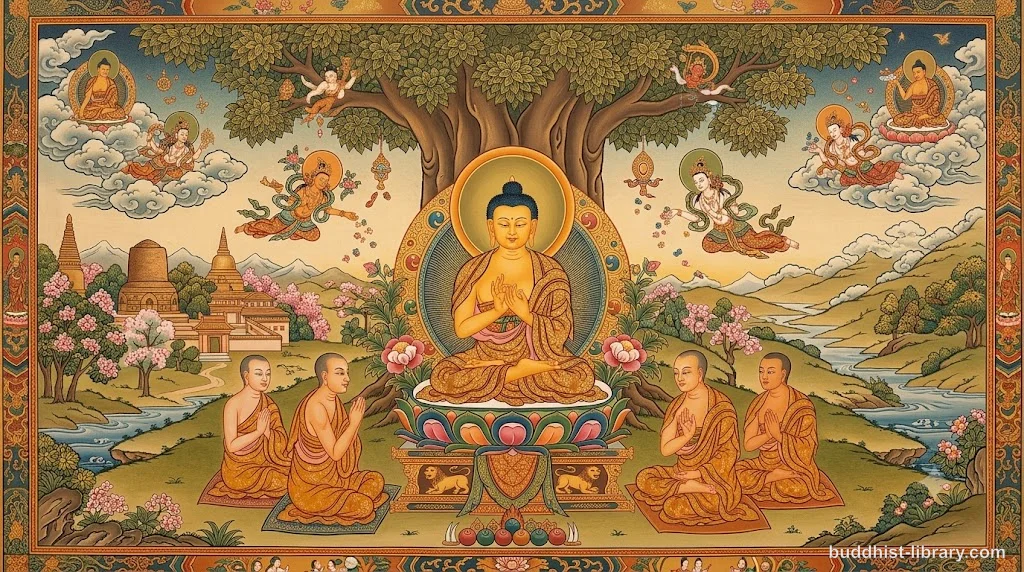
The Anattālakkhaṇa Sutta is the Buddha’s second discourse after his enlightenment, teaching that none of the five aggregates—form, feeling, perception, mental formations, or consciousness—can be identified as a permanent, controllable self. Delivered to his first five disciples at Isipatana, this sermon led all five to full awakening.
What Is the Anattālakkhaṇa Sutta and Why Does It Matter?
The Anattālakkhaṇa Sutta (Pali: Anattālakkhaṇa Sutta; “The Discourse on the Characteristic of Non-Self”) appears in the Saṃyutta Nikāya (SN 22.59) of the Pali Canon. Historically, it stands as the Buddha’s second formal teaching after his enlightenment, delivered just days after the famous first sermon on the Four Noble Truths.
While the first sermon introduced what to do (follow the Noble Eightfold Path to end suffering), the second sermon clarifies who does it—or more precisely, demonstrates that there is no permanent “who” to be found. The teaching dismantles the intuitive belief in a fixed, enduring self by systematically analyzing the five aggregates (khandhas) that make up experience.
This discourse is pivotal because it tackles the most persistent delusion in human experience: the assumption that somewhere within body and mind exists a stable, autonomous “I.” The Buddha’s method here is not mystical but analytical—he invites direct investigation of immediate experience.
How Does the Buddha Structure His Argument?
The sutta follows a precise logical pattern, repeated identically for each of the five aggregates. The Buddha asks his audience to consider whether each aggregate can truly be “self” by testing it against three criteria:
The permanence test: Is this aggregate permanent or impermanent? The monks acknowledge: impermanent.
The suffering test: If impermanent, does it lead to suffering or to happiness? The monks respond: to suffering.
The identification test: Then is it fitting to regard what is impermanent, suffering, and subject to change as “This is mine, this I am, this is my self”? The monks answer: No, venerable sir.
This structure—known in Buddhist logic as the tilakkhaṇa (three characteristics) argument—demonstrates that anything impermanent, unsatisfactory, and subject to change cannot serve as a stable identity. The Buddha applies this reasoning to:
- Form (rūpa): the physical body and material world
- Feeling (vedanā): pleasant, unpleasant, or neutral sensations
- Perception (saññā): recognition and labeling of experience
- Mental formations (saṅkhāra): volitions, intentions, and mental habits
- Consciousness (viññāṇa): awareness through the six sense doors
Each aggregate, when examined, reveals itself as a process—not a possession. You cannot command your body to never age, your feelings to remain pleasant, your perceptions to stay sharp, your habits to never shift, or your consciousness to persist unchanged. The lack of ultimate control exposes the lack of an ultimate controller.
What Does “Anattā” Actually Mean in This Context?
Translating anattā as “no-self” can mislead Western readers into thinking the Buddha denied personhood or taught nihilism. The Pali term atta corresponds to the Sanskrit ātman, the Vedic concept of an eternal, unchanging soul that migrates through rebirths and eventually merges with Brahman.
The Buddha’s teaching is not that “you don’t exist”—clearly, conventional persons exist and experience suffering. Rather, he taught that nowhere within the five aggregates can a permanent, independent, controllable essence be found. The self we intuitively cling to is a mental construct superimposed on a flowing process.
The Anattālakkhaṇa Sutta makes this practical. The Buddha doesn’t ask the monks to adopt a philosophical position; he asks them to look directly at their own aggregates and verify: Can you command them? Do they obey you? When body fails, feelings shift, and mind wavers—where is the master?
The answer that emerges from honest observation is disenchantment (nibbidā)—not despair, but clear-seeing that frees energy from the hopeless project of shoring up what was never stable to begin with.
How Did the Five Monks Respond to This Teaching?
The canonical account records a dramatic outcome. The text states:
“While this discourse was being spoken, the minds of the group of five monks were liberated from the taints through not clinging.”
All five attained arahantship—full awakening—upon hearing this teaching. This stands in contrast to the first sermon, where only Koṇḍañña gained the “vision of the Dhamma” (stream-entry, the first stage of awakening).
Why the difference? Scholars and practitioners suggest that the first sermon established the framework (the Four Noble Truths and the path), while the second sermon provided the experiential key: letting go of identification with the aggregates. When the five monks directly perceived that none of the aggregates could be held as “self,” clinging collapsed—and with it, suffering.
The text emphasizes “through not clinging” (anupādāya)—the release came not from acquiring some new state but from relinquishing the grasping that had always caused suffering. This illustrates a core Buddhist principle: awakening is a subtraction, not an addition.
What Are the Key Meditation Instructions in This Sutta?
While the Anattālakkhaṇa Sutta is often read as philosophy, it also contains contemplative practice instructions embedded in its structure. The Buddha directs the monks:
“Whatever kind of form there is, whether past, future, or present; internal or external; gross or subtle; inferior or superior; far or near—all form should be seen as it really is with correct wisdom thus: ‘This is not mine, this I am not, this is not my self.’”
This formula—repeated for all five aggregates—outlines a systematic vipassanā (insight) meditation on non-self. The practitioner is instructed to:
- Expand the scope: Don’t just examine present experience. Investigate past and future forms, internal bodily states and external objects, obvious and subtle phenomena.
- Apply wisdom: Use paññā (discernment) to see directly, not just think conceptually.
- Relinquish ownership: Recognize three levels of identification—“This is mine” (possession), “This I am” (identity), “This is my self” (essence)—and release each.
This method counters the mind’s habit of selective ownership. We might intellectually accept that other people’s bodies are impermanent, but maintain a subtle exception for “my” body. The Buddha’s instruction is to investigate all instances of each aggregate without exception.
How Does This Teaching Relate to Dependent Origination?
The Anattālakkhaṇa Sutta’s analysis of the five aggregates as impermanent and conditioned aligns directly with the teaching of paṭiccasamuppāda (dependent origination). Both doctrines point to the same truth from different angles.
Dependent origination explains how suffering arises: through a chain of conditions (ignorance → formations → consciousness → name-and-form, etc.). The anattā teaching explains what is caught in that chain: not a self, but impersonal aggregates responding to conditions.
When the sutta states that the aggregates are “subject to change” (vipariṇāmadhamma), it echoes the dependent origination principle: “When this exists, that comes to be; when this ceases, that ceases.” Nothing stands alone; everything is conditioned.
Recognizing this interdependence dissolves the view of an independent self. If consciousness depends on name-and-form, and name-and-form depends on consciousness (as the Mahānidāna Sutta teaches), then neither can be the autonomous agent we imagine “self” to be.
What Common Misunderstandings Should We Avoid?
Misunderstanding #1: “Anattā means I don’t exist.”
The Buddha never denied conventional existence. He used personal pronouns, acknowledged moral responsibility, and taught a path for persons to follow. The teaching is that the permanent, independent self we imagine doesn’t exist—not that the conventional, conditioned person doesn’t function.
Misunderstanding #2: “Non-self is just a belief to adopt.”
The Buddha presented anattā as something to be seen directly through investigation, not accepted on faith. The sutta’s repeated instruction is to “see with correct wisdom”—a contemplative verification, not a doctrinal position.
Misunderstanding #3: “If there’s no self, why practice?”
This is the classic “paradox” that dissolves upon inspection. Conventionally, there is a person who suffers and can follow a path. Ultimately, that person is revealed as a process, not an entity—but processes can still change direction. The raft analogy applies: use the concept of “I am practicing” to cross the river, then recognize even that raft as non-self once you’ve reached the far shore.
Misunderstanding #4: “Non-self means I can do whatever I want.”
The opposite. Recognizing anattā undercuts the “I” that justifies selfish action. Karma still operates; actions have consequences. The teaching refines ethical responsibility by removing the delusion that props up greed and conceit.
How Can We Apply This Teaching in Daily Practice?
The Anattālakkhaṇa Sutta offers a contemplation method for everyday life:
Body events: When pain, illness, or aging arises, recall: “This body is not mine to command. It is impermanent, unsatisfactory, and not-self.” This doesn’t eliminate pain but removes the secondary suffering of resisting what cannot be controlled.
Emotional upheavals: When strong feelings arise (anger, grief, elation), investigate: “Can I command this feeling to stay or go? Is it mine, or is it a conditioned response arising due to causes?” This creates space around emotion, reducing identification.
Mental proliferation: When obsessive thoughts loop, recognize: “These mental formations are not self. They arise due to conditions and will cease when conditions change.” This weakens the grip of rumination.
Consciousness itself: In meditation, observe the very awareness that knows experience. Is it stable? Does it remain the same when drowsy, alert, concentrated, or distracted? Seeing consciousness as conditioned and impermanent is one of the most liberating insights the sutta offers.
The practice is not to convince yourself that there’s no self, but to investigate directly whether the aggregates behave like a self—and to see clearly when they don’t.
What Is the Historical and Textual Context?
The Anattālakkhaṇa Sutta is located in the Khandha-saṃyutta (“Connected Discourses on the Aggregates”) of the Saṃyutta Nikāya, one of the five major collections of the Pali Canon. Its Pali designation is SN 22.59.
Textual tradition places this discourse at Isipatana (modern Sarnath, near Varanasi) during the Buddha’s first rainy season retreat after his enlightenment. The audience—the five ascetics who had previously abandoned Siddhattha when he gave up extreme austerity—had just heard the first sermon and were now ready for deeper teaching.
The sutta’s structure mirrors other early discourses: formulaic repetition (a mnemonic device in oral tradition), direct questioning, and progressive disclosure. The simile-free, logic-driven style suggests this was an early systematization of the Buddha’s insight for those already inclined toward analytical practice.
Chinese and Sanskrit parallels exist (SA 34, T 109), confirming the discourse’s antiquity and centrality across Buddhist schools—Theravāda, Sarvāstivāda, and Mahāyāna traditions all preserve versions, though they differ in minor details. The core argument remains identical.
Key Points
- The Anattālakkhaṇa Sutta is the Buddha’s second sermon, teaching non-self through analysis of the five aggregates.
- The argument is empirical: since the aggregates are impermanent, unsatisfactory, and beyond our control, they cannot be identified as a permanent self.
- The teaching is not nihilism—it refutes the eternalist view of an unchanging soul, not the conventional existence of persons.
- All five monks attained full awakening upon hearing this discourse by releasing identification with the aggregates.
- The sutta includes meditation instructions: investigate all forms of each aggregate (past, future, present; internal, external) and see directly “This is not mine, this I am not, this is not my self.”
- Anattā complements dependent origination: both reveal conditioned, impersonal processes where we imagine a self.
- Misunderstandings arise when anattā is treated as a belief rather than a direct insight to be verified through practice.
- Daily application involves observing body, feelings, perceptions, mental formations, and consciousness—and noticing their uncontrollable, changing nature.
Frequently Asked Questions
What is the Anattālakkhaṇa Sutta?
The Anattālakkhaṇa Sutta (SN 22.59) is the Buddha’s second sermon, delivered to his five former companions shortly after his first teaching. It systematically analyzes the five aggregates to demonstrate that none constitute a permanent self.
Why is it called the “second sermon”?
Chronologically, it follows the Dhammacakkappavattana Sutta (the first sermon on the Four Noble Truths). Together, these two discourses form the foundation of the Buddha’s teaching—the first introducing the path, the second clarifying what walks it.
How does the Buddha prove non-self in this sutta?
The Buddha uses a logical argument: if the aggregates were self, we could command them (“Let my body be thus, let my body not be thus”). Since we cannot control them and they lead to affliction, they cannot be identified as self.
What happened after the Buddha taught this discourse?
According to the Pali Canon, all five monks attained arahantship (full awakening) upon hearing this teaching. The text records that “through not clinging, their minds were liberated from the taints.”
Does “anattā” mean I don’t exist at all?
No. The Buddha denied the existence of a permanent, independent, unchanging self—not the conventional person. You exist as a process conditioned by causes; you do not exist as an eternal, autonomous entity immune to change.
Can I practice Buddhism if I still feel like “I” exist?
Yes—the sense of self is a deeply conditioned perception, and early practice uses conventional “I” language. The insight into anattā typically deepens gradually through meditation and study. The path begins exactly where you are.
Conclusion
The Anattālakkhaṇa Sutta stands as one of the most radical texts in the Buddhist canon. Where other philosophies of the Buddha’s time sought to identify, purify, or liberate an eternal self, the Buddha offered something different: the invitation to look directly and discover that no such self has ever existed.
This is not a teaching to believe. It’s a teaching to verify.
The five aggregates—body, feelings, perceptions, mental formations, consciousness—are available for examination right now. Are they permanent? Can you control them? Do they lead to lasting satisfaction? The answers reveal themselves through honest investigation. In that seeing, the tight knot of self-concern begins to loosen.
What remains when that knot unravels is not emptiness in the nihilistic sense. It’s freedom. The freedom that comes from no longer defending what was never there, no longer mourning what could never last, no longer clinging to what was always beyond control.
The five monks heard this teaching and were liberated. The teaching has not changed. The aggregates still wait to be seen clearly.
Read more:
- Anattā (Non-Self): What the Buddha Really Meant — explores the broader implications of non-self teaching across different Buddhist traditions and addresses common misconceptions about what anattā does and doesn’t mean.
- The Five Aggregates (Khandhas): What We Mistake for ‘Self’ — provides a detailed examination of each of the five aggregates that the Buddha analyzed in this discourse, with practical contemplation exercises.
- What Is Dependent Origination (Paṭiccasamuppāda)? — explains how the teaching of dependent origination complements the anattā doctrine by revealing the conditioned, process-based nature of all phenomena. a.
📖 Source / license: SuttaCentral (SN 22.59), translated by Bhikkhu Bodhi; Access to Insight translation by Ṭhānissaro Bhikkhu
Frequently asked questions
What is the Anattālakkhaṇa Sutta?
The Anattālakkhaṇa Sutta (SN 22.59) is the Buddha's second sermon, delivered to his five former companions shortly after his first teaching. It systematically analyzes the five aggregates to demonstrate that none constitute a permanent self.
Why is it called the 'second sermon'?
Chronologically, it follows the Dhammacakkappavattana Sutta (the first sermon on the Four Noble Truths). Together, these two discourses form the foundation of the Buddha's teaching—the first introducing the path, the second clarifying what walks it.
How does the Buddha prove non-self in this sutta?
The Buddha uses a logical argument: if the aggregates were self, we could command them ('Let my body be thus, let my body not be thus'). Since we cannot control them and they lead to affliction, they cannot be identified as self.
What happened after the Buddha taught this discourse?
According to the Pali Canon, all five monks attained arahantship (full awakening) upon hearing this teaching. The text records that 'through not clinging, their minds were liberated from the taints.'