The First Sermon: The Dhammacakkappavattana Sutta Explained
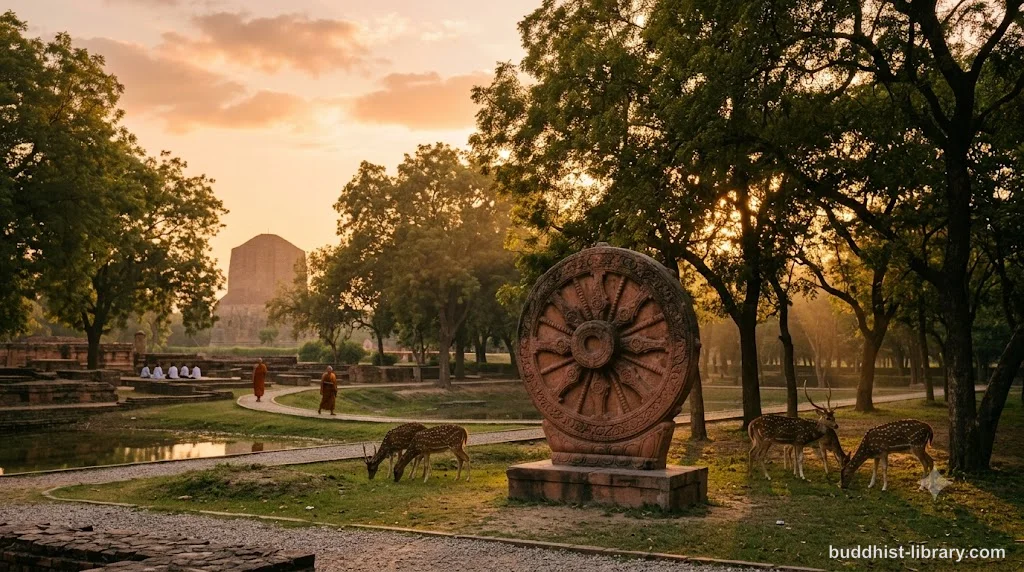
The Dhammacakkappavattana Sutta (Setting in Motion the Wheel of Dhamma) is the Buddha’s first teaching after his enlightenment, delivered at the Deer Park in Sarnath to five former companions. In this discourse, recorded in Saṃyutta Nikāya 56.11, the Buddha introduced the Middle Way, expounded the Four Noble Truths with their twelve aspects, and set in motion the teaching that would become Buddhism.
What Is the Dhammacakkappavattana Sutta?
This is where Buddhism begins.
After attaining enlightenment under the Bodhi tree at Bodh Gaya, the Buddha walked approximately 250 kilometers to Isipatana (modern-day Sarnath, near Varanasi). He went looking for the five ascetics who had practiced with him during his years of extreme self-mortification — the same five who had abandoned him when he accepted food and gave up punishing his body.
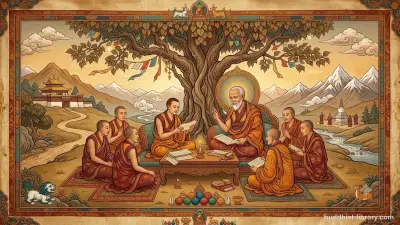
These monks — Koṇḍañña, Bhaddiya, Vappa, Mahānāma, and Assaji — had agreed among themselves to ignore the Buddha when he arrived. They considered him a failure, someone who had given up the austere path. But as he walked toward them across the deer park, something in his presence made their resolution crumble. They rose to greet him.
What followed was a teaching so precise and penetrating that by its conclusion, Koṇḍañña had attained stream-entry (sotāpanna) — the first human being to realize the Dhamma through the Buddha’s instruction.
Why Did the Buddha Reject Two Extremes?
The sermon begins with a warning. The Buddha identifies two paths that one who has gone forth must avoid:
Addiction to sensual pleasures (kāmasukhallikānuyoga) — the pursuit of gratification through the senses. He calls this “low, vulgar, worldly, ignoble, unbeneficial.”
Devotion to self-mortification (attakilamathānuyoga) — extreme asceticism that punishes the body. He calls this “painful, ignoble, unbeneficial.”
The Buddha spoke from direct experience. Before renunciation, he had lived in three palaces, surrounded by luxury. After leaving, he spent six years practicing austerities so severe they nearly killed him — reducing himself to skin and bones, eating a single grain of rice per day.
Neither worked.
The Middle Way he discovered is the Noble Eightfold Path — right view, right intention, right speech, right action, right livelihood, right effort, right mindfulness, and right concentration. This path avoids both indulgence and self-torture, leading to vision, knowledge, peace, awakening, and nibbāna.
What Are the Four Noble Truths in This Sutta?
The heart of the Dhammacakkappavattana Sutta is the exposition of the Four Noble Truths (cattāri ariyasaccāni):
1. The Noble Truth of Suffering (Dukkha)
“Birth is suffering, aging is suffering, illness is suffering, death is suffering; union with what is displeasing is suffering; separation from what is pleasing is suffering; not to get what one wants is suffering. In brief, the five aggregates subject to clinging are suffering.”
The Buddha does not claim that everything is suffering, but that clinging to conditioned phenomena — the five aggregates of form, feeling, perception, mental formations, and consciousness — inevitably leads to dukkha.
2. The Noble Truth of the Origin of Suffering (Samudaya)
“It is this craving (taṇhā) which leads to renewed existence, accompanied by delight and lust, seeking delight here and there; that is, craving for sensual pleasures, craving for existence, craving for extermination.”
Suffering arises because of craving — the thirst for pleasure, for continued existence, or even for annihilation. This craving binds beings to saṃsāra, the cycle of rebirth.
3. The Noble Truth of the Cessation of Suffering (Nirodha)
“It is the remainderless fading away and cessation of that same craving, the giving up and relinquishing of it, freedom from it, non-reliance on it.”
Nibbāna is not mere annihilation but the cessation of craving. When craving ceases, suffering ceases. This is not a state of nothingness but of liberation — freedom from the compulsions that drive existence.
4. The Noble Truth of the Path Leading to the Cessation of Suffering (Magga)
“It is this Noble Eightfold Path; that is, right view, right intention, right speech, right action, right livelihood, right effort, right mindfulness, right concentration.”
The path is practical and gradual. It encompasses wisdom (right view and intention), ethical conduct (right speech, action, livelihood), and mental discipline (right effort, mindfulness, concentration).
What Are the Twelve Aspects of the Four Noble Truths?
The Buddha presents each truth in three aspects (ti-parivaṭṭa), yielding twelve aspects in total. For each truth, he describes:
- Knowledge (ñāṇa) — “This is the Noble Truth of suffering.”
- Task (kicca) — “This suffering should be fully understood.”
- Accomplishment (kata) — “This suffering has been fully understood.”
For the second truth: “This is the origin… This origin should be abandoned… This origin has been abandoned.”
For the third: “This is the cessation… This cessation should be realized… This cessation has been realized.”
For the fourth: “This is the path… This path should be developed… This path has been developed.”
This structure emphasizes that the truths are not merely doctrinal but experiential. The Buddha did not simply teach concepts; he pointed to realities to be directly known and tasks to be completed.
How Did the Five Ascetics Respond?
When the Buddha finished teaching, something remarkable happened.
The earth-dwelling devas — the lowest tier of celestial beings — exclaimed: “The Wheel of Dhamma has been set in motion by the Blessed One at Varanasi, in the Deer Park at Isipatana — the incomparable wheel which cannot be stopped by any ascetic, brahmin, deva, Māra, Brahmā, or anyone in the world!”
This cry spread. Successive orders of devas took it up, rising through the heavens until it reached the Brahmā realm. All of this in a moment.
Among the five human listeners, Koṇḍañña had attained stream-entry (sotāpatti) — the first stage of awakening. The Buddha saw it and declared, “Koṇḍañña has understood! Koṇḍañña has understood!” From that moment forward, the elder was known as Aññā-Koṇḍañña: “Koṇḍañña Who Understood.”
Within days, the other four also attained stream-entry. The first monastic community (Saṅgha) was established. Buddhism as a distinct teaching tradition had begun.
Why Is This Sutta Foundational to All Buddhist Traditions?
The Dhammacakkappavattana Sutta is revered across Theravāda, Mahāyāna, and Vajrayāna traditions as the inaugural teaching. It is:
- The structural foundation: The Four Noble Truths became the organizing framework for all subsequent Buddhist doctrine.
- The practical foundation: The Noble Eightfold Path remains the core practice across every tradition, though methods differ.
- The historical foundation: This discourse marks the beginning of the Buddha’s teaching career (approximately 2,600 years ago, though dates are debated).
In Theravāda countries, the full-moon day of Āsāḷha (usually July) is celebrated as Āsāḷha Pūjā or Dhamma Day, commemorating this first sermon.
Key Takeaways
- The Dhammacakkappavattana Sutta is the Buddha’s first discourse after enlightenment, delivered to five ascetics at Deer Park.
- It introduces the Middle Way between sensual indulgence and self-mortification.
- It expounds the Four Noble Truths: suffering, its origin (craving), its cessation (nibbāna), and the path (the Noble Eightfold Path).
- Each truth has three aspects (knowledge, task, accomplishment), forming twelve aspects in total.
- The sermon resulted in Koṇḍañña’s stream-entry, the first awakening among the Buddha’s disciples.
- This discourse is foundational to all Buddhist traditions and is celebrated annually on Āsāḷha Pūjā.
How Can You Study This Sutta Today?
Modern practitioners have excellent access to this foundational text:
Pāli Canon Location: Saṃyutta Nikāya 56.11 (also found in slightly different form in Vinaya Mahāvagga I.6)
Recommended English Translations:
- Bhikkhu Bodhi, The Connected Discourses of the Buddha (Wisdom Publications, 2000) — scholarly, precise
- Ṭhānissaro Bhikkhu, available free at dhammatalks.org — clear, practice-oriented
- SuttaCentral SN 56.11 — multiple translations side-by-side
Study Approach:
- Read the sutta in full, slowly. Notice the structure: rejection of extremes → Middle Way → Four Truths → twelve aspects.
- Reflect on each truth in sequence. The Buddha intended them to be understood progressively, not merely as abstract propositions.
- Consider the task associated with each truth. Suffering is to be understood, craving abandoned, cessation realized, the path developed. These are verbs, not nouns.
- Return to the text periodically. As your practice deepens, you will see layers you missed initially.
Many monasteries and Dhamma centers offer courses specifically on the Four Noble Truths based on this sutta. Engaging with a teacher or study group can illuminate aspects difficult to grasp from reading alone.
Conclusion
The Dhammacakkappavattana Sutta is a diagnosis and a prescription. The Four Noble Truths are not dogma. They are realities the Buddha claimed to have seen directly — and he insisted others could verify them through practice.
The Noble Eightfold Path is not a set of commandments. It is a training.
When the Buddha set the Wheel of Dhamma in motion 2,600 years ago, he pointed to truths he had realized and invited others to test them. That invitation has never closed.
Read more:
- The Four Noble Truths: The Heart of the Buddha’s Teaching — a detailed exploration of the framework introduced in this first sermon, showing how each truth builds on the last.
- The Noble Eightfold Path: A Complete Guide — the practical training the Buddha prescribed in this sutta, broken down factor by factor for modern practitioners.
- What Is Nirvana (Nibbāna)? Meaning and Misconceptions — understanding the cessation of suffering that the Buddha taught as the third Noble Truth in this discourse.
📖 Source / license: Translated by Bhikkhu Bodhi in The Connected Discourses of the Buddha (Wisdom Publications, 2000); also available at SuttaCentral SN 56.11 and Access to Insight
Frequently asked questions
What does Dhammacakkappavattana mean?
Dhammacakkappavattana (Pāli) means 'Setting in Motion the Wheel of Dhamma.' It refers to the Buddha's first teaching after his enlightenment, which initiated the spread of his doctrine.
Why is this sutta called the First Sermon?
It is the first discourse the Buddha gave after attaining enlightenment. He delivered it to the five ascetics who had previously practiced with him, at the Deer Park in Sarnath near Varanasi.
What are the two extremes the Buddha rejected?
The Buddha rejected sensual indulgence (addiction to pleasure) and self-mortification (extreme asceticism). He taught the Middle Way between these extremes as the path to awakening.
What is the significance of the Wheel of Dhamma?
The wheel symbolizes the Buddha's teaching spreading throughout the world. When the Buddha delivered this sermon, he 'set the wheel in motion' — beginning the transmission of the Dhamma that continues today.