What Is the Pali Canon (Tipiṭaka)? Structure and Contents of Early Buddhist Scriptures
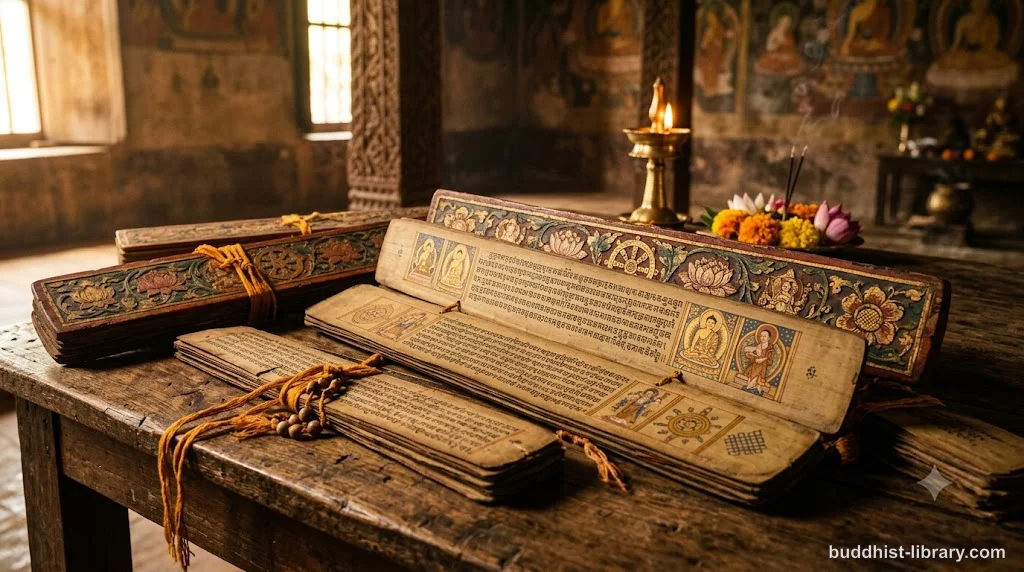
The Pali Canon, or Tipiṭaka (“Three Baskets”), is the oldest complete collection of the Buddha’s teachings, preserved in the Pali language by the Theravāda tradition. Spanning over 10,000 pages in English, it contains the Vinaya (monastic rules), Suttas (discourses), and Abhidhamma (philosophical analysis)—forming the scriptural foundation of early Buddhism and offering a comprehensive guide to the path of awakening.
If you’re exploring Buddhism seriously, you’ll eventually wonder: where did all this come from? The answer is the Pali Canon.
It’s not a single book you read cover to cover. It’s a library—an archive of teachings preserved for over 2,000 years. Understanding its structure means you can actually navigate this vast collection instead of feeling overwhelmed by it.
What Does “Tipiṭaka” Mean?
The word Tipiṭaka (Sanskrit: Tripiṭaka) literally means “Three Baskets.” The name comes from the ancient practice of storing palm-leaf manuscripts in three separate baskets, each containing a major division of the Buddha’s teachings.
These three divisions are:
- Vinaya Piṭaka — The “Basket of Discipline” (monastic conduct and ethics)
- Sutta Piṭaka — The “Basket of Discourses” (the Buddha’s teachings and dialogues)
- Abhidhamma Piṭaka — The “Basket of Higher Doctrine” (systematic philosophy and psychology)
Each basket serves a different purpose, yet together they form a coherent whole: ethics (Vinaya), meditation and wisdom (Sutta), and analytical understanding (Abhidhamma).
The Vinaya Piṭaka: Rules for Monastics and the Early Sangha
The Vinaya Piṭaka contains the code of conduct for Buddhist monks (bhikkhus) and nuns (bhikkhunīs). It includes:
- The Pāṭimokkha — 227 rules for monks, 311 for nuns (the core training rules recited every fortnight)
- Origin stories — Narratives explaining why each rule was established
- Legal procedures — Guidelines for ordination, confession, dispute resolution, and communal harmony
The Vinaya is primarily for monastics, but laypeople benefit from understanding it too. Why? The rules reflect the Buddha’s practical wisdom about ethical living, community dynamics, and the relationship between conduct and mental cultivation. Many precepts have direct parallels in the Five Precepts that guide lay practice.
And here’s something unexpected: the Vinaya preserves some of the earliest biographical details about the Buddha and the formation of the Sangha. Reading it reveals the Buddha not as a distant deity, but as a teacher responding to real situations. Jealousy. Greed. Conflict. Aspiration. Human stuff.
The Sutta Piṭaka: The Heart of the Canon
The Sutta Piṭaka is the most widely read section of the Canon. It contains over 10,000 discourses (suttas) attributed to the Buddha and his chief disciples. This “Basket of Discourses” is subdivided into five collections (Nikāyas):
1. Dīgha Nikāya (Long Discourses)
34 lengthy suttas covering topics like the life of the Buddha, cosmology, ethics, and meditation. Notable texts include the Mahāparinibbāna Sutta (the Buddha’s final days) and the Sāmaññaphala Sutta (the fruits of the contemplative life).
2. Majjhima Nikāya (Middle-Length Discourses)
152 suttas of moderate length, often considered the most accessible introduction to the Buddha’s teaching. This collection includes the Satipaṭṭhāna Sutta on the foundations of mindfulness and the Cūḷavedalla Sutta, where the nun Dhammadinnā explains deep doctrine.
3. Saṃyutta Nikāya (Connected Discourses)
Over 2,800 short suttas grouped by theme. Topics include dependent origination, the five aggregates, sense bases, and the Noble Eightfold Path. This collection is ideal for focused study of specific teachings.
4. Aṅguttara Nikāya (Numerical Discourses)
Over 9,500 short texts organized by number (from ones to elevens). For example, the “Book of Ones” discusses single qualities like mindfulness, while the “Book of Fours” covers topics in groups of four—the Four Noble Truths, the four Brahmavihāras, etc.
5. Khuddaka Nikāya (Minor Collection)
A miscellaneous collection of 15–18 texts (depending on the tradition), including beloved works like:
- The Dhammapada — 423 verses, one of the most widely read Buddhist texts (introduction here)
- Udāna — “inspired utterances” by the Buddha
- Therīgāthā and Theragāthā — poems of enlightened monks and nuns
- Jātaka — stories of the Buddha’s past lives
The Sutta Piṭaka is where you find practical instructions for meditation, ethical conduct, and the cultivation of wisdom. Whether you’re interested in mindfulness of breathing, loving-kindness, or understanding what the Buddha meant by suffering, the Suttas provide direct, often poetic guidance.
The Abhidhamma Piṭaka: Systematic Philosophy
The Abhidhamma Piṭaka represents a detailed, analytical approach to the teachings. Composed several centuries after the Buddha’s death (but attributed to his enlightenment-week insights in traditional accounts), it systematizes the Suttas into categories of:
- Mental factors (cetasikas) — 52 mental states that arise with consciousness
- Consciousness types (cittas) — 89 or 121 distinct moments of awareness
- Matter (rūpa) — the physical elements and their interactions
- Processes — How perception, thought, karma, and rebirth unfold moment by moment
The Abhidhamma can feel abstract and scholastic compared to the narrative warmth of the Suttas. It’s less concerned with stories and more with mapping the mechanics of experience—what Bhikkhu Bodhi calls “a science of experience.” Not science in the modern empirical sense. More like rigorous phenomenological analysis.
Most practitioners don’t begin here. And honestly, you don’t need to.
The Abhidhamma is traditionally studied after a solid grounding in the Suttas, when questions about consciousness, causality, and mental processes demand more precision. Some meditation teachers (especially in the Burmese tradition) use Abhidhamma frameworks to explain insight practice. Others emphasize the Suttas alone. Both approaches work.
How Was the Pali Canon Preserved?
The Canon’s preservation is remarkable. The Buddha’s teachings were transmitted orally by specialized reciters (bhāṇakas) who memorized entire collections. Chanting, repetition, and formulaic structure made this possible. Around the 1st century BCE, during a famine in Sri Lanka, monks wrote the texts on palm leaves for the first time, fearing the oral tradition might be lost.
Since then, the Pali Canon has been copied, studied, chanted, and translated across centuries. The version we have today is astonishingly consistent across different manuscript traditions (Sinhala, Burmese, Thai), suggesting careful transmission.
In the 19th and 20th centuries, scholars began translating the Canon into European languages. The Pali Text Society (founded 1881) produced the first complete English translation. Today, resources like SuttaCentral.net and Access to Insight offer free, searchable translations of the entire Canon.
Why Does the Pali Canon Matter for Modern Practitioners?
You might never read the entire Canon. That’s fine. Most people don’t.
But knowing it exists—and what it contains—grounds your practice in a living tradition. Here’s why it matters:
Authority and authenticity
When you read a sutta, you’re as close as we can get to the Buddha’s original teaching. While scholars debate the historicity of individual texts, the core doctrines—the Four Noble Truths, dependent origination, anattā, anicca—are consistent throughout.
Practical guidance
The Canon isn’t abstract philosophy. It’s filled with meditation instructions, ethical advice, and psychological insights. Want to learn how to start meditation? The Suttas provide step-by-step guidance. Struggling with anger? There are discourses on patience and loving-kindness. The Canon anticipates almost every question a practitioner might ask.
A check against modern distortions
Buddhism has adapted to many cultures. Sometimes it picks up ideas foreign to the Buddha’s original teaching.
The Canon lets you verify claims. Did the Buddha really teach X? You can check. And you should—especially with the flood of “Buddhist” self-help content that strips out inconvenient parts (like renunciation or the reality of suffering). This is the spirit of the Kālāma Sutta: don’t accept something just because it sounds Buddhist. Investigate.
Inspiration
Reading the words of the Buddha—and the poems of monks and nuns who awakened 2,500 years ago—can be deeply moving. Their struggles, insights, and humanity remind you that liberation isn’t theoretical. Real people, facing real suffering, found real freedom using these teachings.
Key Principles When Reading the Pali Canon
Start with the Suttas, not the Vinaya or Abhidhamma
Unless you’re a monastic or academic, begin with the Sutta Piṭaka. The Dhammapada, Satipaṭṭhāna Sutta, and Ānāpānasati Sutta are excellent entry points.
Context matters
Suttas were spoken to specific audiences—laypeople, monastics, brahmins, skeptics. Understanding the listener helps you grasp the teaching. Good translations (Bhikkhu Bodhi, Ṭhānissaro Bhikkhu) provide introductions and notes.
Repetition is intentional
The Canon repeats itself—a lot. This aided oral memorization and emphasized key points. If you find it tedious, modern anthologies extract the essential teachings without the repetition.
Not every word is literal
The Buddha used similes, metaphors, and provisional language. He adapted his teaching to his audience’s capacity. Some passages are meant to inspire faith; others demand analytical investigation. The tradition recognizes this flexibility.
Translations vary
Pali terms like dukkha, dhamma, and saṅkhāra have no perfect English equivalents. Different translators make different choices. Reading multiple translations deepens understanding.
Where to Start: Recommended Texts for Beginners
If you’re new to the Canon, these texts offer a strong foundation:
- The Dhammapada — poetic, accessible, covers the essence of the path
- Satipaṭṭhāna Sutta (Majjhima Nikāya 10) — foundations of mindfulness
- Ānāpānasati Sutta (Majjhima Nikāya 118) — mindfulness of breathing
- Kālāma Sutta (Aṅguttara Nikāya 3.65) — critical thinking and independent inquiry
- Mettā Sutta (Khuddaka Nikāya, Sutta Nipāta) — loving-kindness practice
For deeper study, Bhikkhu Bodhi’s anthology In the Buddha’s Words organizes key suttas by theme, providing an excellent roadmap through the Canon.
The Pali Canon in Relation to Other Buddhist Scriptures
The Pali Canon is one of several early Buddhist canons. Mahāyāna Buddhism developed its own scriptures (the Chinese and Tibetan canons), which include the Pali texts plus additional sūtras like the Lotus Sūtra, Heart Sūtra, and Prajñāpāramitā literature.
Scholars recognize that all Buddhist canons preserve early material, though in different languages and with different emphases. The Pali Canon is valued for its completeness and relative antiquity—it’s the only early canon fully preserved in an Indian language close to what the Buddha spoke.
This doesn’t mean Pali Buddhism is “more authentic” than Mahāyāna or Vajrayāna. Each tradition has its strengths. The Pali Canon offers a clear, systematic presentation of early Buddhism, while later traditions explore dimensions of compassion, emptiness, and skillful means that Theravāda practitioners also value (even if expressed differently).
The Living Canon: Study, Chant, Practice
The Pali Canon isn’t a museum piece. In Theravāda countries, monks chant Pali texts daily. Laypeople study the Dhammapada, listen to sutta recitations, and memorize verses. The Canon shapes ritual, art, ethical norms, and meditation practice.
In the West, the Canon is increasingly accessible. SuttaCentral offers over 30,000 translations in dozens of languages. Podcasts, study groups, and online courses make these ancient texts relevant to modern seekers. You don’t need to become a Pali scholar—though learning a little Pali enriches your understanding—to benefit from the teachings.
Conclusion: A Map, Not the Territory
The Buddha compared his teaching to a raft—useful for crossing the river of suffering, but not something to cling to once you’ve reached the other shore.
The Pali Canon is the same. It’s a map. A guide. A record of what worked for those who walked the path before us.
Reading it deepens your understanding. But the real work is practice: meditation, ethical living, cultivating wisdom and compassion. The texts point the way. You have to walk it.
Whether you approach the Canon as a scholar, a practitioner, or a curious seeker, it offers something rare: a coherent, comprehensive, and timelessly relevant guide to understanding suffering and finding freedom.
In a world of spiritual consumerism and quick fixes, the Pali Canon invites you to go deeper. Not to study for information. To study for transformation.
Read more:
- The Satipaṭṭhāna Sutta: Foundations of Mindfulness Explained — One of the most important meditation texts in the Canon, offering the Buddha’s comprehensive guide to mindfulness practice.
- The Dhammapada: An Introduction to the Buddha’s Verses — A perfect entry point to the Pali Canon, this beloved collection distills the essence of the Buddha’s teaching into 423 memorable verses.
- The Kālāma Sutta: The Buddha on Independent Inquiry and Free Thinking — Discover the sutta that encourages you to test the teachings yourself—a principle central to engaging with the Canon wisely.
📖 Source / license: Access to Insight (accesstoinsight.org) • SuttaCentral.net • Bhikkhu Bodhi's translations and introductions
Frequently asked questions
Is the Pali Canon the same as the Buddhist Bible?
No. While the Pali Canon is a complete collection of the Buddha's teachings, it's not a single unified book. It's a vast library of texts covering conduct, discourses, and philosophical analysis. Unlike the Bible, it doesn't claim divine authorship—the texts record the Buddha's teachings and the early monastic community's development.
Which Buddhist traditions use the Pali Canon?
The Pali Canon is the scriptural foundation of Theravāda Buddhism, practiced mainly in Sri Lanka, Myanmar, Thailand, Cambodia, and Laos. Mahāyāna and Vajrayāna traditions have their own expanded canons (Chinese and Tibetan), but they share many core texts with the Pali tradition.
Do I need to read the entire Pali Canon to practice Buddhism?
No. The Canon is vast—over 10,000 pages in English translation. Most practitioners focus on key texts like the Dhammapada, major suttas (Satipaṭṭhāna, Ānāpānasati, Kālāma), and selected discourses. Even the Buddha recommended different teachings for different people based on their needs and capacity.
What language was the Pali Canon originally written in?
The Canon is written in Pali, a Middle Indo-Aryan language related to Sanskrit. The Buddha likely taught in various regional languages, but Pali became the liturgical language that preserved his teachings. The texts were transmitted orally for about 400 years before being written down in Sri Lanka around the 1st century BCE.