The Ānāpānasati Sutta: The Buddha's Teaching on Mindfulness of Breathing
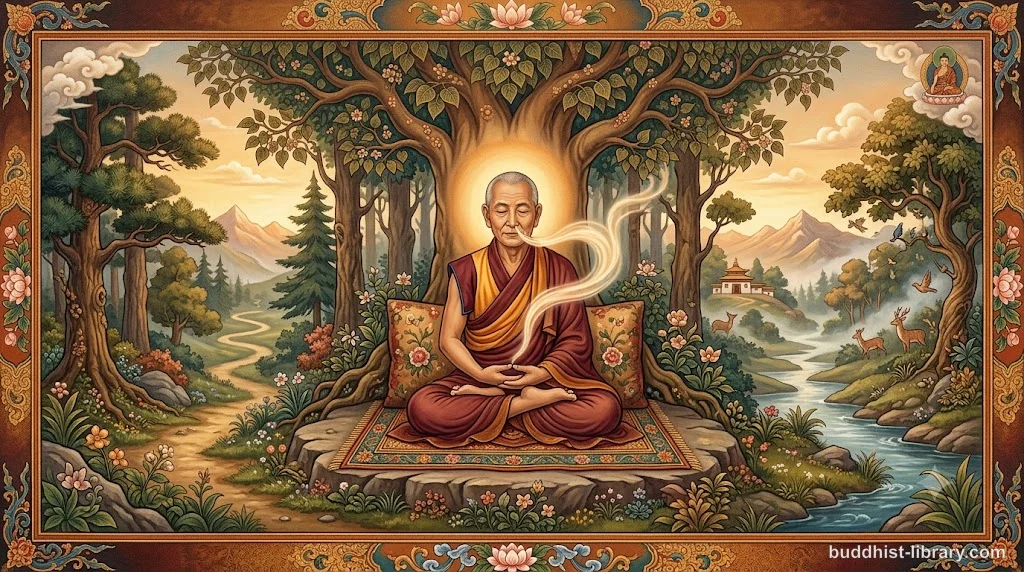
The Ānāpānasati Sutta (MN 118) is the Buddha’s most complete teaching on mindfulness of breathing meditation—a systematic sixteen-step practice that begins with simple breath awareness and culminates in full awakening. Found in the Pali Canon’s Majjhima Nikāya, it remains one of the most practiced meditation instructions in Buddhism today.
This isn’t relaxation technique rebranded as meditation. The sutta maps a complete contemplative path—sixteen steps organized into four groups, each building on the last. You start with body awareness, move through feelings and mind states, and arrive at the liberating insights of the Four Noble Truths.
What is the Ānāpānasati Sutta?
The term “ānāpānasati” combines three Pali words: ānāpāna (breathing in and out), and sati (mindfulness). The Ānāpānasati Sutta is Discourse 118 in the Majjhima Nikāya (Middle Length Discourses), delivered by the Buddha during a rains retreat when many senior monks had gathered to practice intensively.
According to the sutta, the Buddha began teaching after emerging from a period of seclusion. He praised the monks’ practice and then revealed the method he himself used both before and after his awakening: mindfulness of breathing developed through sixteen contemplations.
What makes this discourse stand out is its precision. Many suttas offer general principles. This one gives you step-by-step instructions—arguably the most practical meditation manual in the early Buddhist canon.
The Sixteen Contemplations: A Complete Map
The heart of the sutta is the sixteen-step sequence, organized into four tetrads (groups of four). Each tetrad corresponds to one of the four foundations of mindfulness (satipaṭṭhāna).
First Tetrad: Contemplation of the Body
The practice begins with the body and breath:
- Long breath awareness: “Breathing in long, one knows ‘I breathe in long.’ Breathing out long, one knows ‘I breathe out long.’”
- Short breath awareness: “Breathing in short, one knows ‘I breathe in short.’ Breathing out short, one knows ‘I breathe out short.’”
- Whole-body awareness: “One trains thus: ‘I shall breathe in experiencing the whole body.’ One trains thus: ‘I shall breathe out experiencing the whole body.’”
- Calming the bodily formation: “One trains thus: ‘I shall breathe in calming the bodily formation.’ One trains thus: ‘I shall breathe out calming the bodily formation.’”
These four steps establish stable attention. You’re not controlling the breath. You’re observing it as it naturally occurs, whether long or short.
The “whole body” here can be confusing. According to the commentaries and teachers like Ajahn Brahmavamso, it refers to the entire breath body—the complete sensation of breathing from start to finish. By step four, the breath becomes subtle and the body calms.
Second Tetrad: Contemplation of Feelings
With a stable foundation, attention shifts to the affective tone of experience:
- Experiencing rapture (pīti): “One trains thus: ‘I shall breathe in experiencing rapture…’”
- Experiencing pleasure (sukha): “One trains thus: ‘I shall breathe in experiencing pleasure…’”
- Experiencing mental formations: “One trains thus: ‘I shall breathe in experiencing the mental formation…’”
- Calming the mental formation: “One trains thus: ‘I shall breathe in calming the mental formation…’”
Here the practice deepens. Rapture and pleasure often arise naturally with concentrated breath meditation. These steps teach you to recognize them clearly without grasping.
“Mental formations” (cittasaṅkhāra) means the feelings and perceptions that shape your mental states. By step eight, even pleasant formations are calmed. What emerges is profound equanimity.
Third Tetrad: Contemplation of Mind
Now awareness turns to the mind itself:
- Experiencing the mind: “One trains thus: ‘I shall breathe in experiencing the mind…’”
- Gladdening the mind: “One trains thus: ‘I shall breathe in gladdening the mind…’”
- Concentrating the mind: “One trains thus: ‘I shall breathe in concentrating the mind…’”
- Liberating the mind: “One trains thus: ‘I shall breathe in liberating the mind…’”
This tetrad cultivates samādhi. You observe the quality of mind moment by moment. Contracted or expansive? Dull or bright?
You gladden it when it’s sluggish, steady it when scattered, release it from whatever binds it. This isn’t suppression—it’s skillful encouragement of wholesome states.
Fourth Tetrad: Contemplation of Mental Objects (Dhammas)
The final tetrad turns toward wisdom:
- Contemplating impermanence: “One trains thus: ‘I shall breathe in contemplating impermanence…’”
- Contemplating fading away: “One trains thus: ‘I shall breathe in contemplating fading away…’”
- Contemplating cessation: “One trains thus: ‘I shall breathe in contemplating cessation…’”
- Contemplating relinquishment: “One trains thus: ‘I shall breathe in contemplating relinquishment…’”
These are the insight (vipassanā) steps. With the mind calm and concentrated, you observe directly. All formations are impermanent (anicca). They arise. They fade. They cease. Clinging to them is suffering.
This contemplation, maintained breath by breath, leads to dispassion and liberation.
How Ānāpānasati Leads to Awakening
The sutta doesn’t stop at listing the sixteen steps. It explains the causal sequence:
- Ānāpānasati → Four Foundations of Mindfulness: The sixteen steps fulfill (paripūreti) the four satipaṭṭhānas—body, feelings, mind, and dhammas.
- Four Foundations → Seven Factors of Awakening: When the foundations are developed, they fulfill the seven bojjhaṅgas—mindfulness, investigation, energy, rapture, tranquility, concentration, and equanimity.
- Seven Factors → True Knowledge and Liberation: When the awakening factors mature, they fulfill true knowledge (vijjā) and liberation (vimutti).
This is the Buddha’s explicit promise: mindfulness of breathing, when fully developed, is not a preliminary practice but a complete path to the end of suffering.
Practical Guidance from the Commentaries
The Pali commentaries (especially the Visuddhimagga) and living teachers provide practical clarifications:
- Where to place attention: Traditionally at the nostrils or upper lip, where the breath is most clearly felt.
- Progression through the steps: Beginners often spend months or years working with the first tetrad before the later ones become accessible. There’s no rush.
- Natural development: The later steps (rapture, concentration, insight) arise naturally from sustained practice of the earlier ones. They’re discovered, not manufactured.
- Flexibility: The sixteen steps are not a rigid checklist. On some days, step three is vivid; on others, you rest in step one. The instructions guide exploration, not performance.
What Makes This Sutta Unique?
Several features distinguish the Ānāpānasati Sutta:
- Comprehensiveness: Unlike brief meditation instructions scattered elsewhere, this sutta offers a complete systematic framework.
- Integration: It explicitly connects breath practice with satipaṭṭhāna, the bojjhaṅgas, and liberation—showing how a single method fulfills the entire path.
- Precision: Each step is clearly stated with the formula “one trains thus” (sikkhati), emphasizing intentional development.
- Universal application: The Buddha taught this method to laypeople and monastics, beginners and arahants. It’s both accessible and inexhaustible.
Common Questions
Can I practice ānāpānasati without a teacher?
The sutta itself is an instruction, so it’s possible to begin on your own. However, because the later stages involve subtle mind states and insights, most practitioners benefit from guidance, especially when moving beyond the first tetrad. Teachers help identify what’s actually happening versus what we think should be happening.
Do I need to reach deep jhānas to complete the sixteen steps?
This is debated. Some teachers (like Pa Auk Sayadaw) emphasize developing full absorption before moving to the fourth tetrad. Others (like Ajahn Buddhadāsa and some Western Insight teachers) interpret the sequence as compatible with lighter concentration. The sutta itself doesn’t explicitly require jhāna, but the second and third tetrads clearly involve concentrated states.
Is counting breaths part of ānāpānasati?
Breath-counting is not mentioned in the sutta. It appears in some later meditation manuals as a preliminary tool to stabilize attention, but the sutta’s method is continuous awareness of the breath’s qualities, not counting.
How long does it take to complete all sixteen steps?
This varies enormously. Some practitioners report experiencing all sixteen contemplations in a single intensive retreat; others work with the first few steps for years before the later ones become clear. The Buddha didn’t specify a timeline. What matters is the quality of understanding, not speed.
Influence Across Traditions
Ānāpānasati is practiced across Buddhist schools:
- Theravāda: Central to both samatha (concentration) and vipassanā (insight) approaches. Burmese, Thai, and Sri Lankan lineages all include it, though they interpret the sixteen steps somewhat differently.
- Mahāyāna/Zen: Breath awareness is foundational in Zen meditation (zazen), though often without the explicit sixteen-step structure.
- Tibetan Buddhism: Śamatha practice frequently uses breath as the object, and some Tibetan teachers teach the sixteen steps directly from the sutta.
The method’s adaptability is part of its genius. Whether you follow it as a precise technical map or use it as a flexible contemplative guide, the core insight remains: the breath, observed with clear continuous mindfulness, reveals the nature of all conditioned phenomena.
The Sutta’s Opening Scene
The Ānāpānasati Sutta begins with a vivid image: the Buddha surrounded by an “assembly of bhikkhus” during the full-moon night ending the rains retreat. He praises the monks’ practice, then announces he will continue sitting in seclusion for another month. The senior disciples then teach the newer monks, and “this Bhikkhu Sangha became even more resolute.”
When the Buddha emerges, he describes what he’s seen: monks practicing the four foundations of mindfulness, developing concentration, gaining direct knowledge. Then he teaches ānāpānasati as the unifying practice behind it all.
This framing matters. The Buddha is not introducing a beginner’s exercise but revealing the method that he himself uses—even after full awakening—as the most direct and pleasant way to dwell. It’s both means and end.
Starting Where You Are
If you want to practice ānāpānasati as taught in the sutta, begin simply:
- Sit comfortably with an upright, relaxed posture.
- Bring attention to the breath at the nostrils, chest, or abdomen—wherever you feel it most clearly.
- Notice whether the breath is long or short—not to judge it, just to know it. This is step one and two.
- When the mind wanders (it will), gently return to the breath. No self-criticism needed. Just recognize the wandering and come back.
- Stay with this foundation until it feels stable—days, weeks, or months. The later steps will become accessible naturally as concentration deepens.
The sutta records the Buddha teaching this practice because it is “peaceful and sublime… a pleasant way of living… and it dispels at once unwholesome states.”
That’s the real test. Not how quickly you tick off sixteen steps, but whether the practice actually brings calm, clarity, and insight into the nature of experience.
Read more:
- What Is Mindfulness (Sati) in Buddhism? — Mindfulness is the foundation of ānāpānasati; this article explains what sati actually means beyond modern pop psychology.
- The Satipaṭṭhāna Sutta: Foundations of Mindfulness Explained — The Ānāpānasati Sutta explicitly fulfills the four satipaṭṭhānas; read this to understand their full scope and how breathing practice develops each one.
- What Are the Jhānas? Understanding Meditative Absorption in Buddhism — The second and third tetrads of ānāpānasati cultivate states that resemble or lead to jhāna; explore what these absorptions are and how they fit into the path.
📖 Source / license: Majjhima Nikāya 118 (trans. Bhikkhu Ñāṇamoli & Bhikkhu Bodhi)
Frequently asked questions
What is the Ānāpānasati Sutta about?
The Ānāpānasati Sutta (MN 118) is the Buddha's comprehensive teaching on mindfulness of breathing meditation. It presents sixteen contemplations organized into four tetrads, covering the entire path from basic breath awareness to complete awakening.
How many steps are in ānāpānasati meditation?
The sutta presents sixteen steps organized into four groups of four (tetrads): contemplation of the body, contemplation of feelings, contemplation of mind, and contemplation of mental objects. Each tetrad builds on the previous one.
Is ānāpānasati suitable for beginners?
Yes, the practice begins with simple breath awareness accessible to anyone. The Buddha taught it to both new students and advanced practitioners. Beginners typically work with the first tetrad before progressing to the more subtle contemplations.
What's the difference between ānāpānasati and other breathing meditation?
Ānāpānasati as taught in the sutta is not merely breath-counting or relaxation. It's a complete contemplative system that systematically develops the four foundations of mindfulness and leads directly to insight and the seven factors of awakening.
How does breathing meditation lead to awakening?
The sutta shows how mindfulness of breathing, when developed through all sixteen steps, fulfills the four foundations of mindfulness, which in turn fulfill the seven factors of awakening, which lead to true knowledge and liberation.