The Sigālovāda Sutta: The Buddha's Code of Ethics for Laypeople
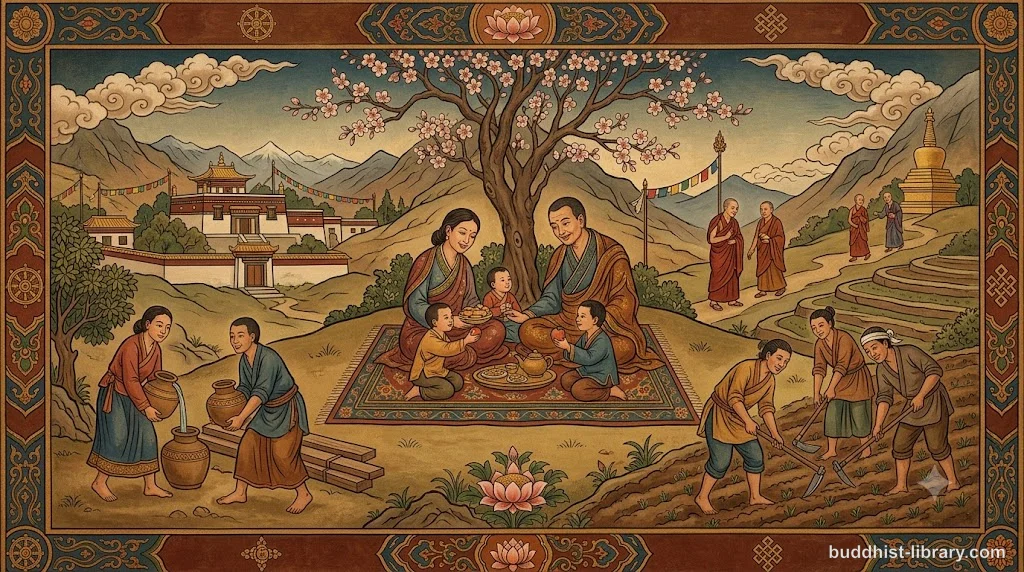
The Buddha rarely gave detailed instructions on how laypeople should live. The Sigālovāda Sutta is the exception—a complete code of ethics covering family, work, friendship, and spiritual life. Six ritual directions become six relationships, each with reciprocal duties that create harmony and well-being.
What Is the Sigālovāda Sutta?
The Sigālovāda Sutta appears as the 31st discourse in the Dīgha Nikāya (Long Discourses) of the Pali Canon. You’ll also see it called the “Discourse to Sigāla” or the “Layperson’s Code of Discipline.”
Unlike most suttas that focus on monastic practice or deep meditation, this one addresses household life. Practical ethics for people raising families, working jobs, maintaining friendships.
The Buddha encountered Sigāla, a young householder, performing a ritual his father had taught him: worshipping the six directions with wet clothes and joined palms. East, south, west, north, above, below.
When asked about this practice, the Buddha acknowledged the good intention. Then he reinterpreted everything. The six directions represent six crucial relationships. True “worship” means fulfilling your duties within them.
What Are the Six Directions and Their Corresponding Relationships?
The Buddha explained each direction as a metaphor for a relationship requiring care and respect:
- East: Parents and Children — The east, where the sun rises, symbolizes the relationship from which we arise.
- South: Teachers and Students — The direction of growth represents the transmission of knowledge.
- West: Spouse and Partner — The setting sun represents the partnership that completes the day.
- North: Friends and Companions — Steady like the north star, true friendship provides constancy.
- Below: Employers and Employees — The foundation on which livelihood rests.
- Above: Householders and Spiritual Guides — The direction of aspiration toward the sacred.
Each relationship involves reciprocal duties—not one-sided obligations, but mutual responsibilities that create social harmony.
What Duties Does a Child Owe to Parents?
The sutta outlines five specific duties children should fulfill:
- Support them — Provide material care, especially in old age, as they supported you in youth.
- Perform duties for them — Help with tasks they can no longer manage themselves.
- Maintain the family lineage — Preserve the family’s honor and good name.
- Be worthy of inheritance — Live in a way that honors what they’ve built.
- Offer alms on their behalf — Make merit in their name, especially after death.
In return, parents should restrain their children from evil, encourage them toward good, train them in a craft or profession, arrange a suitable marriage when appropriate, and hand over the inheritance at the proper time.
Notice the reciprocal model. Both sides have clear responsibilities.
This differs sharply from hierarchical models that demand blind obedience without parental accountability. The Buddha’s vision is mutual, not one-way.
What Does the Sutta Say About Friendship?
The Buddha’s teaching on friendship is remarkably practical. A true friend:
- Helps when you’re in need — Not just in good times, but when it counts.
- Stays constant in misfortune — Doesn’t abandon you when things get difficult.
- Gives good counsel — Offers honest advice, not flattery.
- Sympathizes with your welfare — Genuinely wants what’s best for you.
You should reciprocate by being generous, speaking kindly, acting for their benefit, treating them as equals, and being truthful.
The sutta also warns against four types of false friends:
The taker who only wants something. The talker who offers empty words but no action. The flatterer who praises you to your face but criticizes behind your back. And the companion in ruin who encourages drinking, gambling, late-night carousing—activities that drag you down.
The Buddha’s psychology cuts deep here.
How Should Employers and Employees Treat Each Other?
The relationship between employer and employee receives detailed treatment, showing the Buddha’s concern for fair labor practices:
An employer’s duties:
- Assign work according to ability—don’t burden someone beyond their capacity.
- Provide adequate food and wages—compensation should be just.
- Care for them when sick—healthcare as a moral duty.
- Share special treats or bonuses—generosity beyond the minimum.
- Grant leave and rest at proper times—recognize the need for recovery.
An employee’s duties:
- Start work before the employer and finish after—show dedication.
- Take only what is given—maintain honesty.
- Do work well—take pride in quality.
- Speak well of the employer—loyalty when deserved.
This mutual obligation creates dignity.
Not exploitation. Not servitude. A relationship where both sides matter.
The Buddha anticipated modern labor ethics by over two millennia. Fair wages, healthcare, rest periods—all here in a text from ancient India.
What Vices Should a Householder Avoid?
Before outlining positive duties, the Buddha warned Sigāla against six channels through which wealth is squandered:
- Intoxication — drinking and taking drugs that cloud the mind.
- Roaming the streets at inappropriate times — late-night carousing that invites trouble.
- Frequenting shows and entertainment excessively — constant distraction from responsibilities.
- Gambling — risking livelihood on chance.
- Bad company — associating with those who encourage harm.
- Laziness — avoiding work and duty.
Each of these brings six specific dangers. For example, intoxication leads to immediate loss of wealth, increased quarrels, susceptibility to illness, bad reputation, shameless behavior, and weakened intelligence.
The Buddha’s psychology is sharp here. These aren’t merely “sins” in some abstract sense.
They’re behaviors with concrete, observable consequences. Drink away your wages, you lose your house. Gamble away your security, you destroy your family. Keep bad company, they pull you under.
Cause and effect, not divine punishment.
What About Spousal Relationships?
The sutta presents marriage as a partnership of equals with reciprocal duties:
A husband should:
- Honor his wife—treat her with respect, not as property.
- Not disparage her—avoid contempt and put-downs.
- Be faithful—maintain sexual fidelity.
- Hand over authority to her—share decision-making power.
- Provide adornments—offer gifts and appreciation.
A wife should:
- Organize household work well—manage the home competently.
- Be hospitable to relatives and employees—create a welcoming environment.
- Be faithful—maintain sexual fidelity.
- Protect accumulated wealth—be a good steward of resources.
- Be skillful and diligent—take initiative and work effectively.
This model balances traditional division of labor with mutual respect and shared authority.
Neither exploitation nor rigid hierarchy. Partnership.
Key Points to Remember
- The Sigālovāda Sutta is the Buddha’s most comprehensive teaching on lay ethics and relationships.
- True “worship” of the six directions means fulfilling duties in six key relationships: parents/children, teachers/students, spouses, friends, employers/employees, and householders/spiritual guides.
- Each relationship involves reciprocal duties—both sides have clear responsibilities that create harmony.
- The sutta warns against six ways wealth is wasted: intoxication, late-night roaming, excessive entertainment, gambling, bad company, and laziness.
- The Buddha’s model emphasizes mutual respect, fairness, and practical consequences rather than rigid hierarchy or abstract morality.
- This teaching remains remarkably relevant for modern questions about work ethics, friendship, marriage, and family duty.
Frequently Asked Questions
Is the Sigālovāda Sutta only for Buddhists?
No. While the Buddha delivered this teaching, its ethical guidance is universal. You don’t need to accept rebirth, karma, or Buddhist metaphysics to benefit from reciprocal respect in relationships, fair treatment of employees, or caution about gambling and intoxication. The sutta’s wisdom applies across cultures and belief systems.
Does the sutta’s model of marriage reflect outdated gender roles?
The text reflects the social structure of ancient India, where roles were divided along traditional lines. However, the core principle—reciprocal duties and mutual respect—transcends specific role assignments. Modern couples can apply the underlying ethic (partnership, fidelity, shared authority, hospitality) while adapting specific duties to their own context.
What if my parents or employer don’t fulfill their duties—do I still have to fulfill mine?
The sutta presents an ideal of reciprocal virtue, not a transactional contract.
Your ethical conduct doesn’t depend on others’ behavior. You act rightly because that’s who you choose to be, not as payment for others’ virtue.
That said, the Buddha also counseled right livelihood. If an employer consistently violates fair treatment, seeking better work isn’t betrayal. It’s wisdom.
Why does the sutta focus so much on avoiding waste and intoxication?
The Buddha’s concern was practical well-being.
He observed that people suffer from cosmic ignorance, yes. But also from poor daily choices. Drinking away wages. Gambling away security. Keeping company that drags them down.
The path to freedom requires a stable foundation. You can’t meditate if you’re homeless from gambling debts. You can’t cultivate wisdom if your mind is perpetually clouded by intoxication.
Ethics and practice support each other.
How does this sutta relate to the Five Precepts?
The Five Precepts offer a foundational ethical framework—refraining from killing, stealing, sexual misconduct, lying, and intoxication. The Sigālovāda Sutta expands this into positive duties within specific relationships. While the precepts tell you what to avoid, this sutta tells you what to cultivate—generosity to parents, loyalty to friends, fairness to employees. They work together: precepts as boundaries, relational duties as active care.
Read more:
- Right Livelihood (Sammā Ājīva): Buddhist Ethics in Work and Profession — explores the Buddha’s teaching on ethical work, complementing the employer-employee duties in this sutta.
- The Five Precepts: Buddhist Ethics in Daily Life — the foundational moral code that underlies all the relational duties described in the Sigālovāda Sutta.
- Right Action (Sammā Kammanta): Buddhist Ethics in Body and Deed — examines ethical conduct in the Noble Eightfold Path, the framework within which lay ethics operate.
📖 Source / license: Sigālovāda Sutta (DN 31), translated by Maurice Walshe in The Long Discourses of the Buddha (Wisdom Publications) and available at Access to Insight
Frequently asked questions
What is the Sigālovāda Sutta about?
The Sigālovāda Sutta (DN 31) is the Buddha's discourse to a young householder named Sigāla, offering practical ethical guidance for laypeople across six key relationships: parents and children, teachers and students, spouses, friends, employers and employees, and householders and spiritual guides.
Who was Sigāla and why did the Buddha teach him?
Sigāla was a young man performing a ritual of worshipping the six directions as his father had instructed. The Buddha reinterpreted this practice, showing that true 'worship' of the six directions means fulfilling ethical duties in six key relationships, not performing empty rituals.
How is the Sigālovāda Sutta relevant today?
The sutta's guidance on relationships, work ethics, friendship, and family duties remains remarkably practical for modern life. Its emphasis on reciprocal respect, honesty, and care applies across cultures and time periods.