The Fire Sermon: The Buddha's Teaching on Burning and Liberation
The Fire Sermon — the Ādittapariyāya Sutta — is one of the Buddha’s most dramatic early teachings. Delivered to 1,000 former fire-worshippers shortly after his awakening, it uses the image of fire to show how craving, aversion, and delusion burn through our senses, and how liberation comes through seeing this burning clearly and letting it go.
What Is the Fire Sermon?
The Fire Sermon appears in the Pali Canon as the Ādittapariyāya Sutta (SN 35.28), part of the Saṃyutta Nikāya’s Saḷāyatana Saṃyutta — the collection on the six sense bases. It’s considered the Buddha’s third major discourse, following the First Sermon on the Four Noble Truths and the teaching on non-self.
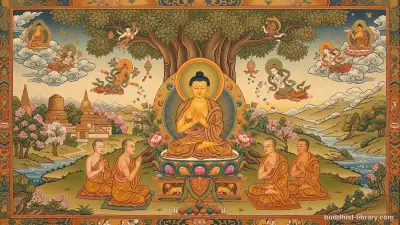
The setting is striking: the Buddha had just converted Uruvela Kassapa and his brothers — charismatic fire-worshipping ascetics — along with their 1,000 followers. These were people who revered fire as sacred, who performed elaborate fire rituals. The Buddha met them on their own ground, using fire not as an object of worship but as a teaching tool.
The sermon is short — less than 500 words in English translation — but its impact was immediate. According to the text, all 1,000 listeners became arahants on the spot.
Why Did the Buddha Choose Fire as a Metaphor?
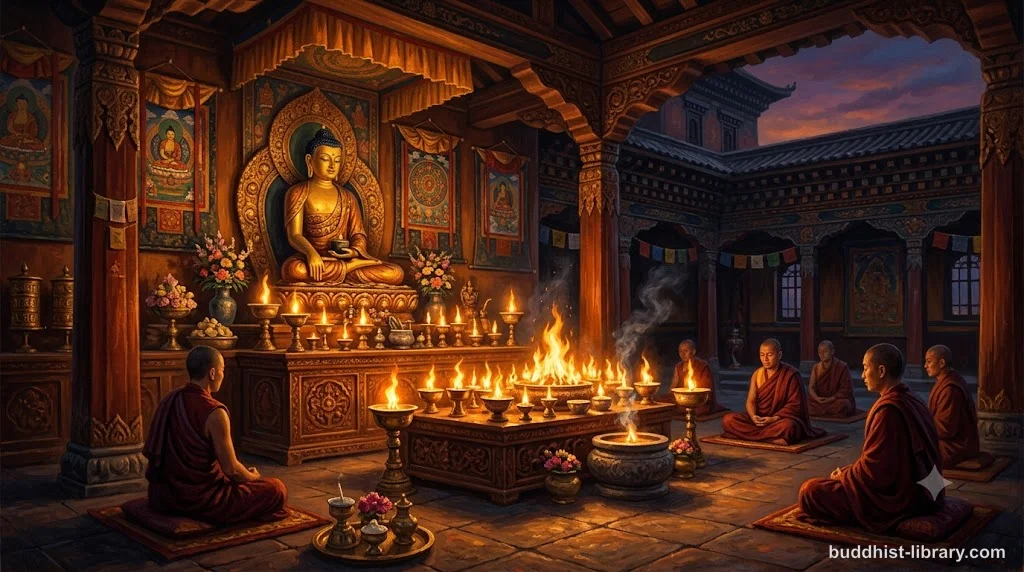
Fire wasn’t a random choice. The Buddha was speaking to an audience that had spent years — perhaps lifetimes — tending sacred flames, believing fire to be a path to purity and the divine.
He turned that understanding inside out.
Instead of fire as purification, the Buddha showed fire as affliction. The flames they’d been worshipping externally were burning internally — in their eyes, ears, nose, tongue, body, and mind. Every moment of sensory contact was fuel for the fires of craving (rāga), aversion (dosa), and delusion (moha).
This wasn’t metaphor for metaphor’s sake. The Buddha was pointing to something visceral: that raw, restless, burning quality of desire. The heat of anger. The smolder of wanting what you don’t have and rejecting what you do.
Fire-worshippers understood fire. The Buddha showed them where the real fire was.
What Does “All Is Burning” Mean?
The sermon opens with one of the most quoted lines in Buddhist scripture:
“All is burning.”
Then the Buddha unpacks it systematically, using the framework of the six sense bases:
- The eye is burning. Forms are burning. Eye-consciousness is burning. Eye-contact is burning. Whatever feeling arises from eye-contact — pleasure, pain, or neither — that too is burning.
- The ear is burning. Sounds are burning. Ear-consciousness is burning…
- The nose, tongue, body, and mind — all burning.
Each sense door — each point of contact between consciousness and the world — is aflame with craving, aversion, and delusion. The fires burn through pleasant feelings (we cling), through painful feelings (we resist), and through neutral feelings (we drift in ignorance).
This isn’t poetic exaggeration. If you sit quietly and pay attention to your experience, you can feel it: the reaching, the pushing away, the restlessness, the dissatisfaction. The sense of something missing. That’s the burning.
The Buddha wasn’t teaching metaphysics. He was teaching phenomenology — the direct observation of experience as it actually is.
The Six Sense Bases and the Fires That Burn Them
The Fire Sermon is built on the teaching of the six sense bases (saḷāyatana):
- Eye and forms — visual experience
- Ear and sounds — auditory experience
- Nose and odors — olfactory experience
- Tongue and tastes — gustatory experience
- Body and tactile sensations — somatic experience
- Mind and mental objects — cognitive and emotional experience
For each base, the Buddha identifies four elements that burn:
- The sense organ itself (eye, ear, etc.)
- The object (form, sound, etc.)
- Consciousness (seeing, hearing, thinking)
- Contact (the meeting of organ, object, and consciousness)
- Feeling (the pleasant, painful, or neutral tone that arises from contact)
All five are on fire with the three root defilements: greed, hatred, and delusion.
This is the anatomy of suffering. Not abstract theology, but the moment-to-moment mechanics of how we create dukkha for ourselves.
For more on how the sense bases function in dependent origination, see What Is Dependent Origination (Paṭiccasamuppāda)?
How Does the Burning Stop?
The Buddha doesn’t leave his listeners in the flames. He shows the way out:
“Seeing thus, the instructed noble disciple grows disenchanted with the eye, disenchanted with forms, disenchanted with eye-consciousness, disenchanted with eye-contact, disenchanted with feeling…”
The Pali word here is nibbidā — often translated as “disenchantment” or “dispassion.”
Not hatred or rejection, but a clear-eyed seeing through the illusion that sensory pleasure can ever be fully satisfying.
When you see clearly — through direct experience, not belief — that chasing pleasure through the senses is like trying to hold fire in your bare hands, craving naturally falls away. Not through suppression, but through understanding.
Disenchantment leads to dispassion (virāga). Dispassion leads to liberation (vimutti). Liberation is the cooling of the fires — nibbāna, which literally means “extinguishing” or “unbinding.”
The fires go out not because you pour water on them, but because you stop feeding them fuel.
The Fire Sermon and the Noble Eightfold Path
Though the Fire Sermon doesn’t explicitly mention the Noble Eightfold Path, it’s teaching the same liberation. The path is the how — the method for seeing clearly and developing dispassion.
- Right View sees the burning for what it is
- Right Intention turns away from craving and toward renunciation
- Right Mindfulness observes the sense doors without adding fuel
- Right Concentration stabilizes the mind so it can see the fires clearly
The Fire Sermon is the diagnosis. The Eightfold Path is the treatment.
Historical and Textual Context
The Ādittapariyāya Sutta is found in:
- Saṃyutta Nikāya 35.28 (Saḷāyatana Saṃyutta)
- Vinaya Piṭaka (Mahāvagga I.21), in the context of the Buddha’s early teaching career
It was delivered at Gayāsīsa (modern Gaya, in Bihar, India), a hill where fire rituals were traditionally performed. The timing is significant: this was early in the Buddha’s ministry, shortly after his first conversions. The rapid spread of the teaching — 1,000 new arahants — gave the young Buddhist community immediate momentum.
The sermon’s rhetorical power comes from its simplicity. No complex doctrine, no lengthy argument. Just a vivid, immediate image that anyone can verify in their own experience.
T.S. Eliot famously echoed the Fire Sermon in The Waste Land, weaving its imagery into his modernist exploration of spiritual desolation. The teaching has resonated across cultures and centuries because the burning it describes is universal.
Practicing with the Fire Sermon Today
You don’t need to be a fire-worshipper to practice with this teaching. The fires are burning right now — in your eyes as you read this, in your ears if you’re listening to something, in your mind as thoughts and reactions arise.
Try this:
- Pause and notice a sense door. Pick one — sight, sound, thought.
- Observe the contact. Notice the moment when consciousness meets object.
- Feel the feeling. Pleasant, unpleasant, or neutral?
- Watch for the fire. Is there reaching? Pushing away? Restlessness?
- Don’t add fuel. Just see it clearly. Notice that the burning happens on its own.
This is mindfulness of the sense bases, one of the four foundations of mindfulness. When you see the burning clearly, without getting caught in it, the fires begin to cool.
It’s not about eliminating sensory experience. It’s about experiencing it without the overlay of craving and clinging.
Key Points
- The Fire Sermon uses fire as a metaphor for the burning of craving, aversion, and delusion through the six sense doors
- “All is burning” refers to the eye, ear, nose, tongue, body, and mind being aflame with defilement
- The teaching is grounded in direct observation of sensory experience, not abstract theory
- Liberation comes through clear seeing, disenchantment, and dispassion — not suppression
- The fires go out when we stop feeding them the fuel of craving and ignorance
- The sermon was delivered to 1,000 fire-worshippers and led to their immediate awakening
Frequently Asked Questions
What is the Fire Sermon in Buddhism?
The Fire Sermon (Ādittapariyāya Sutta) is one of the Buddha’s most famous early discourses, delivered to 1,000 former fire-worshippers. It uses fire as a metaphor to show how craving, aversion, and delusion burn through the six sense doors — seeing, hearing, smelling, tasting, touching, and thinking.
Why is it called the Fire Sermon?
It’s called the Fire Sermon because the Buddha used the image of fire — something his audience revered — to illustrate how craving and defilement “burn” us. He declared that “all is burning” through contact with sense objects, consumed by the fires of greed, hatred, and delusion.
What did the Buddha mean by “all is burning”?
When the Buddha said “all is burning,” he meant that every aspect of sensory experience — the eye, forms, eye-consciousness, contact, feeling — is aflame with craving, aversion, and ignorance. This burning is the source of suffering, and liberation comes through seeing this process clearly and developing dispassion.
How do you practice the teaching of the Fire Sermon?
Practice the Fire Sermon’s teaching by observing your six sense doors with mindfulness. Notice how craving arises when you see, hear, smell, taste, touch, or think. Recognize the “burning” of desire and aversion. Through clear seeing and dispassion, the fires cool, leading to freedom.
Is the Fire Sermon only for monastics?
No. The teaching is universal. Anyone experiencing craving, aversion, or restlessness — which is everyone — can observe the burning in their own senses and work toward dispassion. You don’t need to renounce the world; you need to see it clearly.
How does the Fire Sermon relate to nibbāna?
Nibbāna literally means “extinguishing” or “unbinding” — the cooling of the fires. The Fire Sermon shows what’s burning (craving, aversion, delusion through the senses) and points to liberation as the natural result of seeing that burning clearly and ceasing to feed it.
Conclusion
The Fire Sermon is a masterpiece of skillful teaching. The Buddha took a concept his audience held sacred — fire — and used it to show them the truth of suffering and the path to freedom. He met them where they were and led them to liberation.
The teaching remains as immediate today as it was 2,500 years ago. You don’t need to understand dependent origination or the intricacies of Abhidhamma to work with it. Just notice the burning in your own experience: the restlessness, the reaching, the pushing away. See it clearly. Stop adding fuel.
That’s the practice. That’s the path.
Read more:
- The First Sermon: The Dhammacakkappavattana Sutta Explained — the Buddha’s first teaching after his awakening, introducing the Four Noble Truths and the Noble Eightfold Path, delivered shortly before the Fire Sermon according to the traditional account.
- The Satipaṭṭhāna Sutta: Foundations of Mindfulness Explained — the comprehensive guide to mindfulness practice, including contemplation of the sense bases that the Fire Sermon points to.
- What Is Dependent Origination (Paṭiccasamuppāda)? — understand the deeper mechanics of how craving arises through contact with the sense bases and perpetuates the cycle of suffering.
📖 Source / license: Ādittapariyāya Sutta (SN 35.28), translated by Ṭhānissaro Bhikkhu (Access to Insight) and Bhikkhu Bodhi (The Connected Discourses of the Buddha)
Frequently asked questions
What is the Fire Sermon in Buddhism?
The Fire Sermon (Ādittapariyāya Sutta) is one of the Buddha's most famous early discourses, delivered to 1,000 former fire-worshippers. It uses fire as a metaphor to show how craving, aversion, and delusion burn through the six sense doors — seeing, hearing, smelling, tasting, touching, and thinking.
Why is it called the Fire Sermon?
It's called the Fire Sermon because the Buddha used the image of fire — something his audience revered — to illustrate how craving and defilement 'burn' us. He declared that 'all is burning' through contact with sense objects, consumed by the fires of greed, hatred, and delusion.
What did the Buddha mean by 'all is burning'?
When the Buddha said 'all is burning,' he meant that every aspect of sensory experience — the eye, forms, eye-consciousness, contact, feeling — is aflame with craving, aversion, and ignorance. This burning is the source of suffering, and liberation comes through seeing this process clearly and developing dispassion.
How do you practice the teaching of the Fire Sermon?
Practice the Fire Sermon's teaching by observing your six sense doors with mindfulness. Notice how craving arises when you see, hear, smell, taste, touch, or think. Recognize the 'burning' of desire and aversion. Through clear seeing and dispassion, the fires cool, leading to freedom.