The Ānāpānasati Sixteen Steps: A Complete Practice Guide
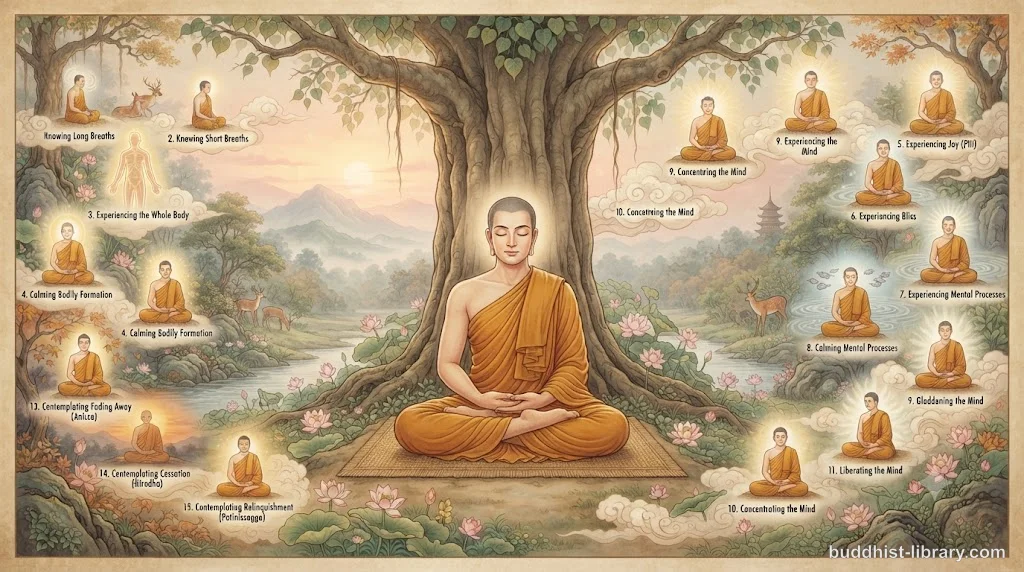
The Buddha taught sixteen progressive contemplations using the breath as foundation—moving systematically from calming the body to liberating the mind through direct insight into impermanence and relinquishment.
Most meditators know the basic instruction: “observe the breath.” But the Ānāpānasati Sutta (MN 118) offers far more—a complete sixteen-step framework that takes practitioners from initial body awareness straight through to liberation itself.
This isn’t about relaxation. The sixteen steps form a systematic training that integrates the four foundations of mindfulness (satipaṭṭhāna) while developing both calm (samatha) and insight (vipassanā). Done properly, this single practice contains everything needed for awakening.
What makes the sixteen steps a complete practice?
The Buddha organized the sixteen contemplations into four tetrads—groups of four steps—each corresponding to one of the four foundations of mindfulness:
First tetrad (steps 1–4): Body contemplation
These steps establish stable awareness of the breathing body and develop calm concentration.
Second tetrad (steps 5–8): Feeling contemplation
Here practice shifts to observing and regulating the pleasant and painful feelings that arise in meditation.
Third tetrad (steps 9–12): Mind contemplation
These steps bring direct awareness to mental states themselves—their quality, stability, and liberation.
Fourth tetrad (steps 13–16): Dhamma contemplation
The final four steps develop penetrating insight into impermanence, fading of craving, cessation, and relinquishment.
Work through all sixteen steps and you cover the complete range of Buddhist meditation. No supplementary practices needed—the map is already whole.
The First Tetrad: Calming the Body (Steps 1–4)
Step 1: Knowing long and short breaths
“Breathing in long, one knows ‘I breathe in long’; breathing out long, one knows ‘I breathe out long.’ Breathing in short, one knows ‘I breathe in short’; breathing out short, one knows ‘I breathe out short.’”
Simple, clear recognition.
You’re not controlling the breath or forcing it to be long or short. You’re just knowing what’s happening. Long breath? You know it’s long. Short breath? You know it’s short. Direct knowing, no elaboration, no judgment—this is where mindfulness starts.
Step 2: Experiencing the whole body of breath
“One trains thus: ‘I shall breathe in experiencing the whole body’; one trains thus: ‘I shall breathe out experiencing the whole body.’”
The “whole body” here refers to the entire breath-body—the complete process of inhalation and exhalation from beginning to end. Some teachers interpret this as whole-body awareness (the entire physical body breathing), while others understand it as the whole breath process. Both interpretations lead to fuller, more continuous awareness.
Step 3: Calming the bodily formation
“One trains thus: ‘I shall breathe in calming the bodily formation’; one trains thus: ‘I shall breathe out calming the bodily formation.’”
The “bodily formation” (kāya-sankhāra) is the breath itself—it conditions and forms the body’s state. As concentration deepens, the breath naturally becomes more refined, subtle, and peaceful. You’re not forcing calm; you’re allowing the breath to settle as mindfulness stabilizes.
Step 4: (Transition to second tetrad)
By step four, the meditator has established a calm, collected state with the breath as a stable anchor. The body is experienced as peaceful, the mind unified. This sets the foundation for investigating feelings.
The Second Tetrad: Understanding Feelings (Steps 5–8)
Step 5: Experiencing rapture (pīti)
“One trains thus: ‘I shall breathe in experiencing rapture’; one trains thus: ‘I shall breathe out experiencing rapture.’”
Rapture (pīti) is the energetic joy that arises when the mind becomes concentrated. It can manifest as tingles, waves of energy, or pervasive lightness. This step trains you to recognize and sustain rapture without getting lost in it or pushing it away.
Step 6: Experiencing pleasure (sukha)
“One trains thus: ‘I shall breathe in experiencing pleasure’; one trains thus: ‘I shall breathe out experiencing pleasure.’”
Sukha is the deeper happiness and ease that follows rapture. Where pīti is energetic, sukha is calm and contented. Recognizing this pleasant feeling clearly prevents you from clinging to it unconsciously.
Step 7: Experiencing mental formations
“One trains thus: ‘I shall breathe in experiencing the mental formation’; one trains thus: ‘I shall breathe out experiencing the mental formation.’”
Mental formations (citta-sankhāra) include feelings and perceptions—the processes that condition the mind’s state. You’re now observing not just the content of feelings but the feeling-process itself.
Step 8: Calming mental formations
“One trains thus: ‘I shall breathe in calming the mental formation’; one trains thus: ‘I shall breathe out calming the mental formation.’”
Just as step three calmed the bodily formation (breath), step eight calms the mental formation (feelings and perceptions). The mind becomes quieter, more refined, less reactive to pleasant and painful sensations.
The Third Tetrad: Liberating the Mind (Steps 9–12)
Step 9: Experiencing the mind
“One trains thus: ‘I shall breathe in experiencing the mind’; one trains thus: ‘I shall breathe out experiencing the mind.’”
Now awareness turns to the mind itself—not its contents, but the quality and state of consciousness. Is the mind contracted or expansive? Dull or bright? Agitated or calm? You’re knowing the mind directly.
Step 10: Gladdening the mind
“One trains thus: ‘I shall breathe in gladdening the mind’; one trains thus: ‘I shall breathe out gladdening the mind.’”
If the mind is dull, sluggish, or discouraged, this step involves bringing up skillful joy through recollection of virtuous actions, the Dhamma, or wholesome states. You’re actively encouraging a bright, workable mental state.
Step 11: Concentrating the mind
“One trains thus: ‘I shall breathe in concentrating the mind’; one trains thus: ‘I shall breathe out concentrating the mind.’”
This is the deliberate cultivation of samādhi—unifying and stabilizing the mind on the breath. Distractions are gently released, and attention becomes increasingly steady and collected.
Step 12: Liberating the mind
“One trains thus: ‘I shall breathe in liberating the mind’; one trains thus: ‘I shall breathe out liberating the mind.’”
Liberation here means freedom from the five hindrances: sensual desire, ill will, sloth and torpor, restlessness and worry, doubt.
Each time one arises, you recognize it. Let it go. The mind rests in clarity again.
The Fourth Tetrad: Cultivating Wisdom (Steps 13–16)
Step 13: Contemplating impermanence
“One trains thus: ‘I shall breathe in contemplating impermanence’; one trains thus: ‘I shall breathe out contemplating impermanence.’”
Here practice shifts decisively toward vipassanā. You observe directly that every breath arises and passes away, every sensation changes, every mental state is impermanent. This isn’t philosophical thinking—it’s direct seeing of anicca.
Step 14: Contemplating fading away
“One trains thus: ‘I shall breathe in contemplating fading away’; one trains thus: ‘I shall breathe out contemplating fading away.’”
Fading away (virāga) is the natural result of seeing impermanence clearly. Craving loses its grip. The mind inclines less toward grasping at pleasant experiences or pushing away unpleasant ones. Things fade in their hold over you.
Step 15: Contemplating cessation
“One trains thus: ‘I shall breathe in contemplating cessation’; one trains thus: ‘I shall breathe out contemplating cessation.’”
Cessation (nirodha) points to the ending of formations—the possibility of release. You observe the ceasing of breath, the ceasing of feelings, the ceasing of mental states. This is a preview of nibbāna—the cessation of suffering.
Step 16: Contemplating relinquishment
“One trains thus: ‘I shall breathe in contemplating relinquishment’; one trains thus: ‘I shall breathe out contemplating relinquishment.’”
The final step is letting go (paṭinissagga). Having seen impermanence, fading, and cessation, you relinquish all clinging. The mind inclines toward release. This is the culmination of the practice—complete non-attachment.
How should I work with the sixteen steps?
Don’t rush through all sixteen as if checking boxes. That misses the point entirely.
Start with the first tetrad and stay there. Many practitioners work exclusively with steps 1–4 for months or even years. You need that solid foundation before moving on. Only when concentration is genuinely stable should you venture into the second tetrad.
Let the steps unfold naturally. As practice deepens, later steps often arise on their own. Rapture and pleasure (steps 5–6) appear when concentration strengthens. Insights into impermanence (step 13) can dawn while you’re still working the early steps.
Treat the framework as a map, not a checklist. Some days you’ll work primarily with step three (calming the body) but briefly touch step thirteen (seeing impermanence). The sixteen steps describe territory. You don’t walk it in a straight line.
Return to earlier steps whenever needed. Concentration wobbly during the fourth tetrad? Go back to the first to re-establish calm. The steps aren’t a ladder you climb once—they’re tools you return to again and again.
What’s the relationship between samatha and vipassanā here?
The sixteen steps integrate both naturally:
Steps 1–8 build samatha—calm, concentration, mental unification. The mind becomes stable, bright, workable.
Steps 9–12 bridge both modes—using concentration to observe mind states clearly, which starts revealing their impermanent, conditioned nature.
Steps 13–16 shift fully into vipassanā—direct insight into impermanence, relinquishment, liberation.
You don’t choose between samatha and vipassanā as separate practices. The sixteen steps demonstrate how concentration leads naturally to insight when guided by wise attention.
Key points to remember
- Four tetrads, four foundations—each group of four steps corresponds to one foundation of mindfulness (body, feelings, mind, dhammas).
- Start with the first tetrad and stay there—establish real concentration before moving on. Rushing through misses the depth each stage offers.
- Calm first, insight later—steps 1–8 build concentration; steps 9–16 cultivate insight and relinquishment.
- The framework flexes—touch multiple steps in one sitting, or spend months on a single step. Both work.
- This is complete—initial body awareness to final liberation, all through mindfulness of breathing.
Read more:
- The Ānāpānasati Sutta: The Buddha’s Teaching on Mindfulness of Breathing—the canonical source for the sixteen steps, with full sutta translation and context
- What Is Samādhi? Understanding Concentration in Buddhist Meditation—explains the role of concentration developed in the first two tetrads before insight practice begins
- The Satipaṭṭhāna Sutta: Foundations of Mindfulness Explained—shows how the sixteen steps map onto the four foundations of mindfulness framework
Conclusion
The sixteen steps aren’t just a meditation technique. They’re a complete training map—body awareness, emotional regulation, mental cultivation, liberating wisdom, all integrated. Working systematically through these contemplations, anchored in the breath, you develop both the calm needed for concentration and the insight that leads to freedom.
This is what the Buddha used the night of his awakening. Twenty-six centuries later, it still works.
📖 Source / license: Ānāpānasati Sutta (MN 118), translated by Bhikkhu Bodhi; Thanissaro Bhikkhu's commentary on MN 118
Frequently asked questions
What are the sixteen steps of ānāpānasati?
The sixteen steps are organized into four tetrads (groups of four): body contemplation (steps 1–4), feeling contemplation (steps 5–8), mind contemplation (steps 9–12), and dhamma contemplation (steps 13–16). Each tetrad progressively deepens awareness and insight.
Do I need to practice all sixteen steps in one sitting?
Not necessarily. Beginners often work with the first tetrad (body) for months or years before moving to later steps. The sixteen steps represent a complete map of practice that can unfold gradually over time, though experienced meditators may move through multiple tetrads in a single session.
How does ānāpānasati relate to the four satipaṭṭhānas?
The sixteen steps directly correspond to the four foundations of mindfulness: body (kāyānupassanā), feelings (vedanānupassanā), mind (cittānupassanā), and dhammas (dhammānupassanā). Ānāpānasati is thus a complete satipaṭṭhāna practice using breath as the anchor.
What's the difference between samatha and vipassanā in these sixteen steps?
The first tetrad (steps 1–4) develops primarily samatha—calm and concentration. The later tetrads increasingly emphasize vipassanā—direct seeing of impermanence, unsatisfactoriness, and not-self. By step sixteen, the practice culminates in relinquishment and letting go.