Avijjā: Understanding Ignorance as the Root of Suffering in Buddhism
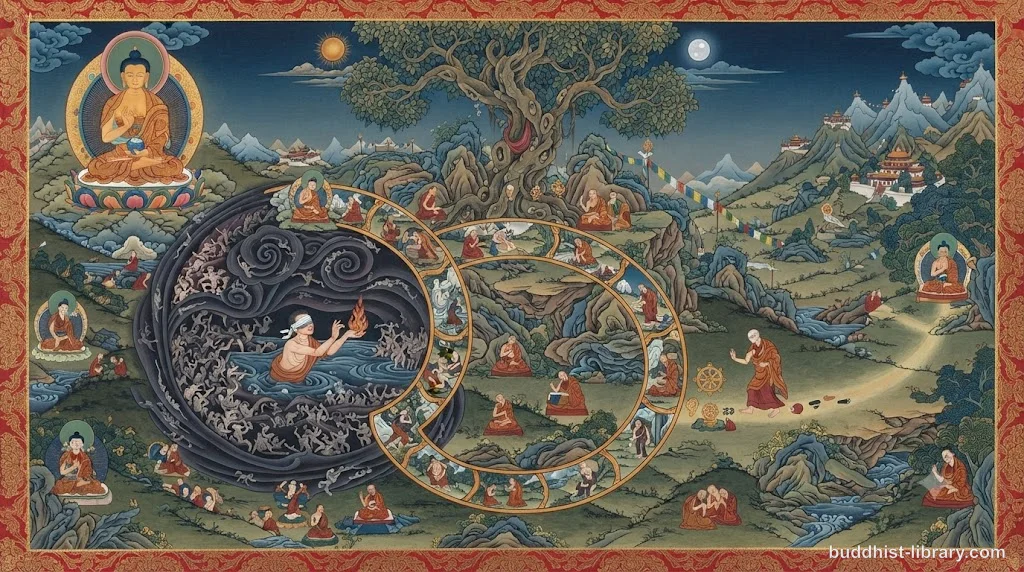
Avijjā—ignorance—sits at the very start of the Buddha’s teaching on dependent origination. It’s the first link in the twelve-fold chain that binds us to suffering, and it’s not what most people think. This isn’t about lacking information or failing to read enough books. Avijjā is an active, ongoing misperception: we mistake what’s constantly changing for something permanent, we expect lasting happiness from experiences that can only deliver temporary pleasure, and we identify with five aggregates that have no inherent self. This fundamental confusion drives everything that follows—craving, clinging, the endless round of rebirth.
What Exactly Is Avijjā?
In the Pali Canon, avijjā (Sanskrit: avidyā) literally means “without knowledge” or “not seeing.”
But the Buddha had something very specific in mind. Avijjā isn’t general ignorance—it’s not understanding four critical truths:
- The truth of suffering (dukkha) — the pervasive unsatisfactoriness inherent in conditioned existence
- The origin of suffering — craving (taṇhā) and clinging driven by ignorance itself
- The cessation of suffering — the possibility of nibbāna
- The path leading to cessation — the Noble Eightfold Path
As the Buddha explained in the Sammādiṭṭhi Sutta (MN 9), ignorance means “not knowing about suffering, not knowing about the origin of suffering, not knowing about the cessation of suffering, not knowing about the way leading to the cessation of suffering.”
And here’s what makes avijjā so insidious: it’s not passive. It actively warps how we see reality.
We look at our changing bodies, shifting moods, and flickering thoughts—and somehow conclude there’s a solid “I” running the show. We watch pleasures arise and fade, arise and fade, and still expect the next one to last. We build entire lives on the assumption that things will stay more or less as they are, despite constant evidence to the contrary.
How Does Ignorance Function in Dependent Origination?
In the Buddha’s teaching on dependent origination (paṭiccasamuppāda), avijjā occupies the crucial first position:
With ignorance as condition, volitional formations arise.
This means that when we don’t see things as they actually are, our intentions and actions (saṅkhāra) become conditioned by that fundamental misperception. These formations then condition consciousness, which conditions mind-and-body, and so on through the twelve links—culminating in the entire mass of suffering.
The Paṭiccasamuppāda Vibhaṅga Sutta (SN 12.2) makes this clear: ignorance doesn’t just sit passively at the beginning of the chain. It actively fuels the entire cycle. When we act from ignorance—believing “this is mine, this I am, this is my self”—we create karma that perpetuates existence within saṃsāra.
Importantly, the relationship runs both ways. While ignorance gives rise to craving, craving also reinforces ignorance. We don’t want to see clearly because seeing clearly would mean letting go of what we cling to. The cycle becomes self-sustaining.
What Are the Three Forms of Ignorance?
Buddhist texts sometimes analyze avijjā into three specific misperceptions, often called the three characteristics turned upside-down:
Mistaking the Impermanent for Permanent (Anicca)
Think about how you plan your life. You assume your health will hold, your relationships will endure, your job will be there next year. You’re building elaborate futures on foundations of sand.
Then change shows up—because it always does—and you’re shocked. Grief. Resistance. “This wasn’t supposed to happen.” But the problem wasn’t the change. The problem was expecting permanence in the first place. The whole strategy was built on ignoring impermanence.
Mistaking Suffering for Happiness (Dukkha)
The pleasure chase never ends, does it? One more achievement, one more purchase, one more perfect vacation—this will be the one that finally satisfies.
Except it never is. Conditioned phenomena can’t deliver unconditional fulfillment. The math doesn’t work. But we keep expecting it anyway.
Mistaking Non-Self for Self (Anattā)
This is perhaps the subtlest form of ignorance. We experience the five aggregates—form, feeling, perception, mental formations, and consciousness—as “I” and “mine.” We don’t recognize these as impersonal processes arising and passing based on conditions. This mistaken identification creates the very suffering we’re trying to escape. When we deeply understand non-self, the structure of suffering collapses.
How Does Ignorance Differ from Delusion?
Students often wonder about the relationship between avijjā (ignorance) and moha (delusion), one of the three poisons.
Moha is a mental factor (cetasika) that arises in unwholesome consciousness. It’s the confusion and clouding of judgment that prevents us from seeing clearly in any given moment. When moha is present, we can’t distinguish wholesome from unwholesome, beneficial from harmful.
Avijjā is deeper and more structural. It’s the underlying not-knowing of the Four Noble Truths that maintains the entire edifice of suffering. You could say moha is how ignorance manifests moment-to-moment in mental life, while avijjā is the fundamental condition that makes moha possible.
An enlightened being has completely uprooted avijjā—they’ve achieved perfect knowledge of the Four Noble Truths and can never again be bound by the fetters. But before that final breakthrough, moha may still arise temporarily even in advanced practitioners, though with decreasing frequency and force.
What Is the Opposite of Ignorance?
The direct antidote to avijjā is vijjā—knowledge or clear seeing. More specifically, it’s sammā-diṭṭhi (right view), the first factor of the Noble Eightfold Path and the foundation of all Buddhist practice.
Right view means understanding:
- The Four Noble Truths
- The law of karma—that actions have ethical consequences
- The three characteristics—impermanence, suffering, and non-self
- Dependent origination—how phenomena arise interdependently
Here’s the critical distinction: vijjā isn’t something you learn from books.
The Pali word paññā (wisdom) captures what’s needed—lived, experiential knowledge. Direct insight. You can memorize the Four Noble Truths. That’s useful. But it’s not wisdom until you see them operating in your actual experience. That seeing arises through concentration and mindfulness in meditation practice.
As Thanissaro Bhikkhu often emphasizes, the Buddha’s path is essentially a process of replacing ignorance with knowledge through training the mind. The three trainings—virtue, concentration, and wisdom—work together to gradually erode avijjā and establish vijjā in its place.
How Do We Overcome Ignorance in Practice?
The Buddha offered a systematic path for uprooting ignorance:
1. Study and Right View
Begin by learning the Dhamma. Read the suttas, study with qualified teachers, contemplate the teachings. This establishes theoretical right view—understanding the framework intellectually before experiencing it directly.
2. Ethical Conduct (Sīla)
Practice the five precepts and cultivate wholesome actions. Ethical behavior calms the mind and creates conditions favorable for seeing clearly. When we’re caught in harmful actions, the mind is too agitated to penetrate ignorance.
3. Mental Training (Samādhi)
Develop concentration through practices like mindfulness of breathing or loving-kindness meditation. A concentrated mind has the steadiness and brightness to see subtle truths that scattered attention misses.
4. Insight Meditation (Vipassanā)
Use concentrated awareness to investigate reality directly. Observe the arising and passing of phenomena. See for yourself—not as philosophy but as lived experience—that all conditioned things are impermanent, unsatisfactory, and not-self.
5. Gradual Erosion Through the Stages
As practice matures, ignorance is progressively weakened at each stage of awakening. The stream-enterer has eliminated doubt about the teachings. The once-returner has weakened craving. The non-returner has eliminated it entirely. The arahat has completely uprooted avijjā.
Here’s what matters: you can’t think your way out of ignorance.
More analysis doesn’t dissolve it. More philosophy doesn’t touch it. What works is direct seeing—and that only comes from sustained meditation practice combined with ethical living and study. Patient work. No shortcuts.
Key Points About Avijjā
Avijjā isn’t just not knowing things. It’s actively misperceiving reality—specifically, not understanding the Four Noble Truths.
It occupies the first position in dependent origination, conditioning everything that follows in the chain of suffering.
The three classic forms: mistaking impermanent for permanent, suffering for happiness, non-self for self.
Don’t confuse it with moha (delusion). Moha is the moment-to-moment mental fog. Avijjā is the deeper structural ignorance that keeps the whole system of saṃsāra running.
The antidote is paññā (wisdom), developed through the threefold training: ethics, concentration, insight.
Overcoming it happens gradually. Each stage of awakening weakens it further, until it’s completely uprooted at arahatship.
Intellectual understanding helps—but it’s not enough. Ignorance dissolves through direct seeing, not through belief or analysis.
Conclusion
Avijjā explains the paradox at the heart of human experience: we want happiness but create suffering. We know things change but still cling. We have no fixed self yet spend our lives defending one.
The Buddha didn’t just diagnose the problem—he mapped the way out. The entire Noble Eightfold Path is essentially a systematic replacement: ignorance for knowledge, delusion for clarity, bondage for freedom.
And it works gradually. Each moment of mindfulness, each ethical choice, each meditation session weakens ignorance a little more. You start seeing things as they actually are instead of how you wish they were. What looked solid shows itself as fluid. What you defended as “me” reveals itself as an impersonal process.
The root of suffering doesn’t vanish overnight. But it does wither. That’s the promise—and the practice.
Read more:
- What Is Dependent Origination (Paṭiccasamuppāda)? — Explore the twelve-link chain where avijjā serves as the first condition, showing how ignorance initiates the entire cycle of suffering and rebirth.
- The Three Poisons: Greed, Hatred, and Delusion in Buddhism — Learn how delusion (moha) relates to avijjā and works together with greed and hatred to perpetuate suffering.
- What Is Paññā? Understanding Wisdom in Buddhism — Discover the direct antidote to ignorance: wisdom developed through ethical conduct, concentration, and insight meditation.
📖 Source / license: Samyutta Nikāya 12.2 (Paṭiccasamuppāda Vibhaṅga Sutta), Majjhima Nikāya 9 (Sammādiṭṭhi Sutta), translations by Bhikkhu Bodhi
Frequently asked questions
What does avijjā mean in Buddhism?
Avijjā (Sanskrit: avidyā) means 'ignorance' or 'not knowing.' It refers specifically to not understanding the Four Noble Truths, the three characteristics of existence, and the true nature of reality. It's the first link in the chain of dependent origination.
How is ignorance different from simply not knowing something?
In Buddhism, avijjā is not about lacking information. It's an active misperception of reality—mistaking the impermanent for permanent, suffering for happiness, and non-self for self. It's a fundamental delusion about the nature of existence that drives craving and clinging.
How do you overcome ignorance in Buddhist practice?
Ignorance is overcome through developing wisdom (paññā) via the threefold training: ethical conduct (sīla), mental concentration (samādhi), and wisdom (paññā). Practices like meditation, study of the Dhamma, and cultivating right view gradually erode ignorance and lead to direct insight into reality.
Is avijjā the same as the delusion (moha) in the three poisons?
They're closely related but not identical. Moha refers to the mental factor of delusion that clouds judgment in each moment. Avijjā is the deeper, structural ignorance of the Four Noble Truths that sustains the entire cycle of suffering. Moha is a symptom; avijjā is the underlying condition.