What Is Vicikicchā? Understanding and Overcoming Doubt in Buddhism
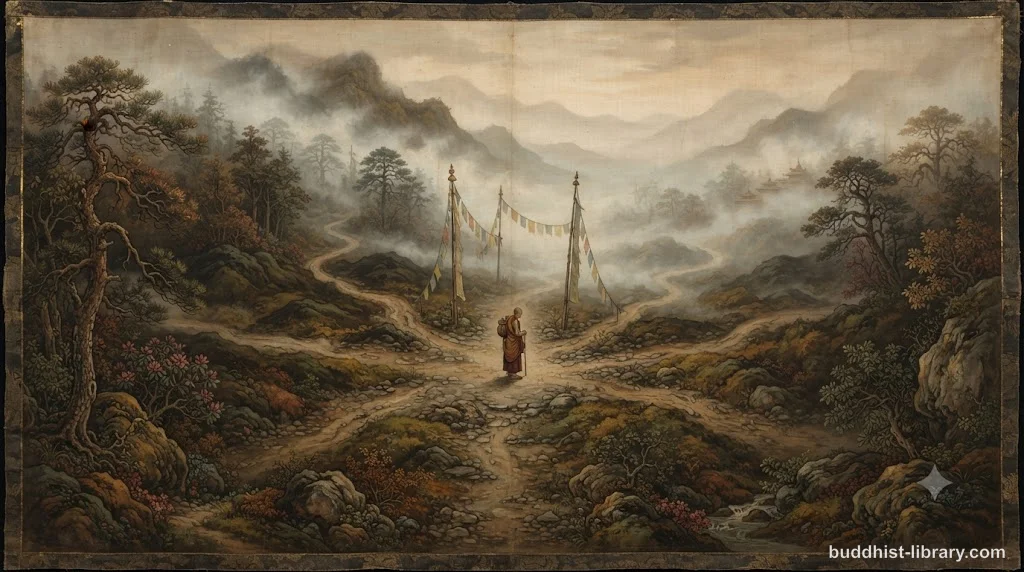
Vicikicchā is skeptical doubt that paralyzes spiritual practice—uncertainty not about details but about whether the path itself works, whether awakening is real, or whether you’re capable of progress. Unlike healthy inquiry, which investigates to find answers, vicikicchā freezes you at the crossroads. The Buddha identified it as both a hindrance to meditation and a fetter binding beings to continued suffering.
The word comes from Pali: vici- (wavering, indecision) + kicchā (difficulty, trouble). It’s the mental state of being stuck in “maybe yes, maybe no”—and never taking the next step.
What Exactly Is Vicikicchā? The Nature of Paralyzing Doubt
Vicikicchā is not intellectual curiosity. The Buddha praised investigation (vīmaṃsā) as essential to the path and encouraged his followers to test teachings rather than accept them on authority. The Kālāma Sutta makes this explicit: don’t believe something just because a teacher said it, because it’s written in scripture, or because it’s traditional. Verify it through your own experience.
Vicikicchā is what happens when investigation stalls. It’s doubt that doesn’t seek resolution—doubt that becomes an identity, a comfortable excuse to avoid commitment. In the Sabbāsava Sutta (MN 2), the Buddha lists vicikicchā among the mental taints (āsava) that must be abandoned “by seeing”—meaning they dissolve when you clearly perceive reality, not by suppressing them.
The classical commentaries describe vicikicchā as doubt specifically about eight things:
- The Buddha (was he genuinely awakened?)
- The Dhamma (does the teaching actually lead to liberation?)
- The Saṅgha (are the monastics real practitioners or just performers?)
- The training (will these precepts and practices actually work?)
- The past (did I exist before? what was I?)
- The future (will I exist after death? what will I become?)
- Both past and future together
- Dependent origination (is this cause-and-effect description of suffering accurate?)
Notice that these aren’t abstract philosophical puzzles—they’re doubts that directly undermine practice. If you’re uncertain whether the path works, why meditate daily? If awakening might be a myth, why undergo the discomfort of renunciation? Vicikicchā is the voice that says, “Maybe later. Maybe this isn’t for me. Maybe there’s nothing to find.”
How Does Vicikicchā Differ from Healthy Skepticism?
The line between wise investigation and paralyzing doubt can blur, especially in a tradition that values direct experience over blind faith. Here’s the distinction:
Healthy skepticism (vīmaṃsā, yoniso manasikāra):
- Asks questions to find answers
- Tests teachings through practice
- Leads to exploration, experimentation, refinement
- Resolves through investigation and experience
- Energizes: “I don’t know yet—let me find out”
Vicikicchā (paralyzing doubt):
- Asks questions to avoid commitment
- Circles the same uncertainties endlessly
- Leads to procrastination, analysis paralysis, abandoning practice
- Doesn’t resolve—it feeds itself
- Enervates: “I’ll never know, so why try?”
The Buddha gave a pragmatic test in the Vīmaṃsaka Sutta (MN 47): observe a teacher’s conduct over time. Do they show signs of greed, hatred, delusion? Do their students become wiser and kinder? If the evidence points toward genuine attainment, then provisionally trust the method and practice it sincerely. Doubt dissolves through direct verification, not through more thinking.
Ven. Thanissaro Bhikkhu puts it plainly: “The Buddha didn’t ask for faith in unknowable metaphysics. He asked for faith enough to try the experiment—to practice as if the path works, and see what happens.”
Why Is Vicikicchā Dangerous? The Cost of Perpetual Hesitation
Vicikicchā appears on two critical lists in early Buddhist psychology:
- The five hindrances (pañca nīvaraṇa): obstacles that block concentration and insight during meditation (alongside sensory desire, ill-will, sloth-torpor, and restlessness-worry).
- The ten fetters (saṃyojana): bonds that tie beings to cyclic existence. Vicikicchā is the third fetter, abandoned at stream-entry.
As a hindrance, vicikicchā disrupts meditation by pulling attention into an endless loop: Is this technique right? Am I doing it correctly? Will it lead anywhere? The meditator never settles because the ground itself feels uncertain. It’s like trying to build a house while constantly questioning whether the foundation is real.
As a fetter, its danger is even clearer. The Saṅgīti Sutta (DN 33) explains that vicikicchā keeps beings trapped in wrong view about the path. Without confidence that liberation is possible and that the method is sound, a practitioner may abandon the effort entirely—wasting a human birth, which the suttas describe as rare and precious.
The Cūḷavedalla Sutta (MN 44) offers a vivid image: someone standing at a crossroads, unable to choose which road to take. Every path looks uncertain. Meanwhile, time passes, and they arrive nowhere.
What Causes Vicikicchā? The Roots of Doubt
The Sammādiṭṭhi Sutta (MN 9) points to ignorance (avijjā) as the ultimate root of vicikicchā, but several proximate causes feed it:
1. Lack of direct experience
When practice remains purely theoretical—reading books, listening to talks, but never meditating or observing precepts—there’s no experiential verification. The teachings remain abstractions, and doubt naturally arises.
2. Comparison and second-guessing
The modern seeker faces an overwhelming buffet of spiritual paths. “Should I practice Zen or Theravāda? Insight or concentration? This teacher or that one?” Each choice spawns meta-doubt about the choice itself. The ancient world had this too, but our access to alternatives amplifies it.
3. Unrealistic expectations
If you expect meditation to deliver permanent bliss within a week, and it doesn’t, doubt surges: “This isn’t working.” The path requires patience, and vicikicchā exploits every gap between expectation and reality.
4. Weak association with wise companions
The Buddha repeatedly emphasized kalyāṇa-mittatā (friendship with the wise) as essential. Practicing alone, or in a community that doesn’t model genuine progress, leaves you without living proof that the path works. Doubt thrives in isolation.
5. Avoidance of discomfort
Spiritual practice confronts you with unpleasant truths—about your habits, your selfishness, the instability of everything you cling to. Vicikicchā can be a defense mechanism: “Maybe I don’t need to look that closely. Maybe this teaching is extreme.”
How Do You Overcome Vicikicchā? The Path Through Doubt
The Buddha offered multiple strategies, tailored to the cause and intensity of the doubt.
1. Wise attention (yoniso manasikāra)
Attend carefully to what actually arises in your experience when you practice. Don’t ask, “Will this lead to nibbāna someday?”—you can’t verify future outcomes. Ask instead, “When I observe the breath, does the mind settle? When I practice generosity, do I feel lighter?” Vicikicchā dissolves when you shift focus from abstract outcomes to observable present results.
2. Association with the wise (kalyāṇa-mittatā)
Spend time with people who embody the qualities the path promises—calm, clarity, kindness. Their presence is evidence. The Upaddha Sutta (SN 45.2) records the Buddha saying that good friendship is the entire holy life, not just half of it. This isn’t exaggeration: seeing someone further along the path collapses doubt in a way no book can.
3. Learning the Dhamma (sutavā)
Study the teachings not as dogma but as a map. The more clearly you understand why a practice is structured a certain way, the less room there is for doubt. The Sabbāsava Sutta says some taints are abandoned “by seeing”—meaning intellectual clarity about the Four Noble Truths and dependent origination cuts through confusion.
4. Provisional faith (saddhā) as a starting point
The Pali word saddhā is often translated as “faith,” but it’s closer to “confidence” or “trust”—confidence enough to try. You don’t need certainty that the path works; you need enough trust to practice as if it works, and let the results speak. Ven. Anālayo calls this “operational confidence.”
5. Direct verification through practice
Ultimately, vicikicchā is abandoned through experience, not argument. The fetter breaks at stream-entry because the practitioner has directly seen for themselves that the Dhamma is real, the path is sound, and progress is possible. Until then, the remedy is consistent practice: meditate daily, keep precepts, observe results. Doubt about whether meditation reduces suffering cannot survive three months of actual meditation.
6. Asking a teacher directly
The Vīmaṃsaka Sutta encourages interrogating a teacher. If something is unclear, ask. Many doubts persist simply because we’re too shy or proud to admit confusion. A skilled teacher can often resolve a conceptual knot in one conversation, freeing you to practice rather than spin.
Key Points: What to Remember About Vicikicchā
- Vicikicchā is skeptical doubt that paralyzes, not the healthy inquiry (vīmaṃsā) the Buddha praised.
- It’s classified as both a hindrance to meditation and a fetter binding beings to suffering.
- The doubt centers on whether the path works, the Buddha was awakened, or you’re capable—not on peripheral details.
- It dissolves through direct experience, not more thinking. Practice is the antidote.
- Stream-enterers permanently abandon vicikicchā because they’ve verified the Dhamma through insight.
- Before awakening, it’s managed by wise attention, good friendship, study, and provisional trust.
- The cost of vicikicchā is high: a human life wasted at the crossroads, never stepping onto the path.
How Vicikicchā Shows Up in Daily Practice
You’re sitting in meditation. Five minutes in, the thought arises: Am I doing this right? Maybe I should try a different technique. Maybe mindfulness isn’t my thing. What if there’s nothing to find and I’m just wasting time?
That’s vicikicchā. It masquerades as self-reflection, but notice the pattern: the questions don’t lead anywhere. They circle. They drain motivation.
Or you’re considering a meditation retreat. Part of you is drawn to it. But then: A whole week? That’s extreme. Maybe I’m not ready. Maybe this is cult-like. What if I have a panic attack? I’ll sign up next year when I’m more experienced.
That’s vicikicchā protecting you from commitment—and from the breakthrough that might come because you committed.
The Relationship Between Vicikicchā and the Other Fetters
Vicikicchā is the third of the ten fetters, abandoned at stream-entry along with:
- Identity view (sakkāya-diṭṭhi): the belief in a permanent, independent self.
- Clinging to rites and rituals (sīlabbata-parāmāsa): the belief that external observances alone lead to liberation.
Notice the pattern: all three are view-related fetters. They concern what you believe about reality rather than how you react to pleasant or unpleasant experiences (which are addressed by the later fetters like sensory desire and ill-will).
Vicikicchā specifically undermines confidence in the teaching. Even if you’ve intellectually understood non-self and recognized that rituals aren’t magic, if you still doubt whether this practice will actually work, you won’t commit. The fetter acts as a safety lock: it keeps you from fully entering the stream.
At stream-entry, the practitioner has a direct, unshakable knowing: The Dhamma is true. This path leads out of suffering. I am capable of walking it. That knowing isn’t blind faith—it’s verified insight. Vicikicchā cannot coexist with it.
Vicikicchā in Modern Context: Why Doubt May Be Stronger Now
Ancient practitioners faced fewer options. If you were born in a Buddhist culture, you practiced Buddhism—or you didn’t practice at all. The modern seeker, by contrast, can sample Zen on Monday, Vipassanā on Wednesday, Advaita on Friday, and neuroscience-based mindfulness on Sunday. Each tradition claims results. How do you choose?
This abundance creates meta-doubt: not just “Does meditation work?” but “Which meditation? Which teacher? Which lineage?” Vicikicchā feeds on this.
Add to that the erosion of traditional authority structures, the prevalence of spiritual charlatans, and a culture that valorizes perpetual optimization (“Is there a better path?”), and you have ideal conditions for doubt to flourish.
The remedy remains the same: pick one method, one teacher, one lineage—and practice it sincerely for a defined period. Not forever. Just long enough to verify results. Three months of daily sitting. Six months of precepts. The Buddha’s invitation wasn’t “believe me.” It was “come and see” (ehipassiko). But you can’t see if you never stop shopping and start walking.
FAQ: Common Questions About Vicikicchā
Is all doubt bad in Buddhism?
No. The Buddha encouraged investigation (vīmaṃsā) and testing teachings. Vicikicchā is specifically paralyzing skeptical doubt that prevents practice—uncertainty that locks you in place. Healthy questioning leads to exploration; vicikicchā leads to stagnation.
How is vicikicchā different from the other hindrances?
While sensory desire and ill-will pull the mind toward or away from objects, and sloth-torpor or restlessness-worry affect energy, vicikicchā specifically attacks confidence in the path itself. It whispers “this might not work” or “maybe there’s nothing to find,” undermining the motivation to practice at all.
Can doubt ever completely disappear?
Yes. When someone reaches stream-entry (sotāpanna), the first stage of awakening, vicikicchā is permanently abandoned as one of the three fetters. Before that point, it can be temporarily suppressed through practice and understanding, but full eradication comes with verified insight into the Dhamma.
What if my doubt is legitimate—what if Buddhism really isn’t true?
The Buddha’s response was pragmatic: test it. In the Kālāma Sutta, he said don’t accept teachings on authority alone. Practice sincerely for a defined period—say, three months of daily meditation and ethical conduct—and observe the results in your own experience. Vicikicchā is dissolved not by blind faith but by direct verification.
How long does it take to overcome vicikicchā?
It varies. Some practitioners resolve doubt within months through consistent practice and good teachers. For others, it lingers for years. The fetter is fully abandoned only at stream-entry, but even before that, doubt can be drastically weakened. The key factor is sincerity of practice—not intensity, but regularity and honesty.
Conclusion: From the Crossroads to the Path
Vicikicchā keeps you standing at the intersection, weighing roads, imagining destinations, never departing. The Buddha’s teaching offers a way through: don’t demand proof before you walk—walk, and let the walking be the proof.
This doesn’t mean abandon all critical thinking. It means recognize the difference between investigation that seeks clarity and doubt that seeks comfort in non-commitment. One asks questions to find the way forward. The other asks questions to justify staying put.
The path to overcoming vicikicchā is the path itself. Sit. Observe precepts. Cultivate generosity. Spend time with practitioners whose presence refutes your doubt. Let the results accumulate. One day—perhaps suddenly, perhaps gradually—the question “Does this work?” will be replaced by the direct knowing: I am walking. The road is real. I see where it leads.
And the crossroads will be far behind.
Read more:
- The Five Hindrances (Nīvaraṇa): Overcoming Obstacles to Meditation — vicikicchā is one of the five mental obstacles the Buddha identified; this article explains how all five work together and practical strategies to weaken them during meditation practice.
- What Is Stream Entry (Sotāpanna)? The First Stage of Buddhist Awakening — stream-entry is the point at which vicikicchā is permanently destroyed as a fetter; understanding what this attainment entails clarifies why doubt cannot survive direct insight into the Dhamma.
- The Kālāma Sutta: The Buddha on Independent Inquiry and Free Thinking — the Buddha’s famous teaching on testing the Dhamma through experience rather than authority addresses the legitimate skepticism that vicikicchā distorts into paralysis.
📖 Source / license: Sabbāsava Sutta (MN 2), Sammādiṭṭhi Sutta (MN 9), Cūḷavedalla Sutta (MN 44), Saṅgīti Sutta (DN 33) — translations by Bhikkhu Bodhi; commentary from Bhikkhu Thanissaro (dhammatalks.org)
Frequently asked questions
Is all doubt bad in Buddhism?
No. The Buddha encouraged investigation (vīmaṃsā) and testing teachings. Vicikicchā is specifically paralyzing skeptical doubt that prevents practice—uncertainty that locks you in place. Healthy questioning leads to exploration; vicikicchā leads to stagnation.
How is vicikicchā different from the other hindrances?
While sensory desire and ill-will pull the mind toward or away from objects, and sloth-torpor or restlessness-worry affect energy, vicikicchā specifically attacks confidence in the path itself. It whispers 'this might not work' or 'maybe there's nothing to find,' undermining the motivation to practice at all.
Can doubt ever completely disappear?
Yes. When someone reaches stream-entry (sotāpanna), the first stage of awakening, vicikicchā is permanently abandoned as one of the three fetters. Before that point, it can be temporarily suppressed through practice and understanding, but full eradication comes with verified insight into the Dhamma.
What if my doubt is legitimate—what if Buddhism really isn't true?
The Buddha's response was pragmatic: test it. In the Kālāma Sutta, he said don't accept teachings on authority alone. Practice sincerely for a defined period—say, three months of daily meditation and ethical conduct—and observe the results in your own experience. Vicikicchā is dissolved not by blind faith but by direct verification.