What Is Sakkāya-diṭṭhi? Understanding Personality View in Buddhism
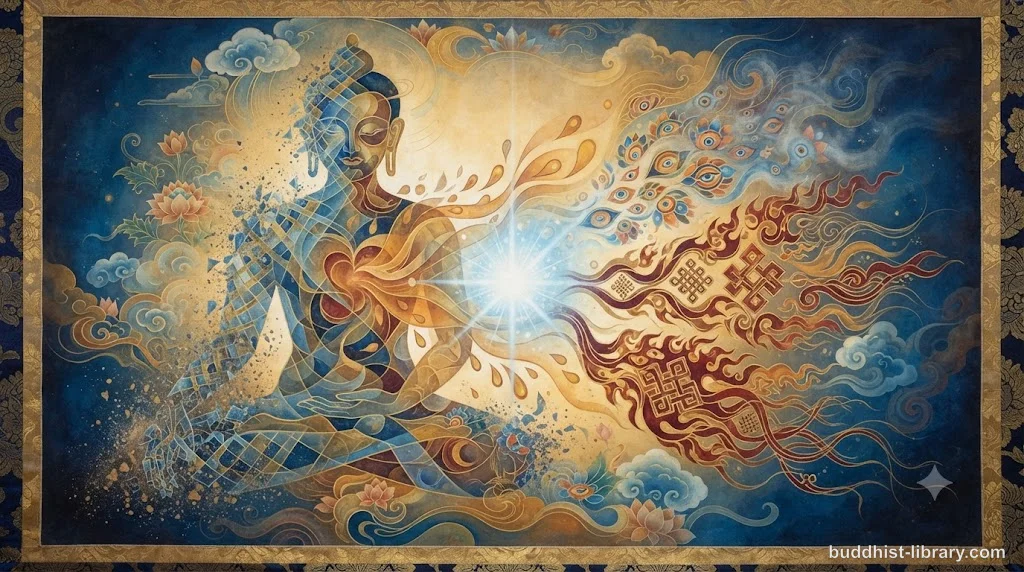
Sakkāya-diṭṭhi (personality view) is the deeply ingrained wrong view that the five aggregates—form, feeling, perception, mental formations, and consciousness—constitute a permanent, independent self. It’s one of the three lower fetters (saṃyojana) that binds beings to the cycle of rebirth, and the first fetter broken when a practitioner attains stream entry (sotāpanna), the first stage of awakening in early Buddhism.
This view is so fundamental to unawakened experience that most people never question it—it’s the invisible interpretive lens through which suffering arises and perpetuates itself.
What does “sakkāya-diṭṭhi” mean?
The Pali term sakkāya-diṭṭhi breaks down as:
- Sakkāya: “existing body” or “personality” (from sat-kāya, “own body” or “group of aggregates that exist”)
- Diṭṭhi: “view” or “belief”
It’s often translated as “personality view,” “identity view,” or “self-view.” The Buddha defined it precisely in the Mahāvedalla Sutta (MN 44):
“What, friend, is personality view? Here, an untaught ordinary person… regards form as self, or self as possessing form, or form as in self, or self as in form. He regards feeling as self… perception as self… formations as self… consciousness as self, or self as possessing consciousness, or consciousness as in self, or self as in consciousness. This is called personality view.”
That gives us twenty possible permutations of wrong view—four ways to misidentify each of the five aggregates as self. In practice, most beings hold several of these simultaneously without examining them.
Why is sakkāya-diṭṭhi a fetter?
A fetter (saṃyojana) is a mental bond that chains beings to saṃsāra (the cycle of rebirth and suffering). Sakkāya-diṭṭhi is the first of ten fetters because it’s the foundational delusion—all other fetters depend on it.
If you believe “I am this body,” “I am this feeling,” or “consciousness is my true self,” then naturally you’ll cling to pleasant experiences (sensual desire), push away unpleasant ones (ill will), grasp at meditative states (attachment to form and formless realms), and build entire systems of thought to defend your position (conceit, restlessness, ignorance).
The view is insidious precisely because it masquerades as common sense. Of course you’re you—who else would you be? Of course your body is yours, your thoughts belong to someone. The whole thing feels self-evident.
Questioning it seems absurd. Until you actually look closely at what “you” are and find… only aggregates. Arising and passing. None of which can be grasped as “mine.”
How does sakkāya-diṭṭhi manifest in daily life?
Most people don’t walk around consciously thinking “form is my self.” The view operates as a background assumption—an unquestioned interpretive framework. Here’s how it shows up:
In reactive emotions: When someone insults you, the immediate inner response is personal affront—“I have been wronged.” The insult lands on a sense of self that feels real, solid, worth defending. That sting? Sakkāya-diṭṭhi in action.
In existential anxiety: The fear of death goes beyond the body stopping. It’s the terror of annihilation—“I will cease to exist.” But who is this “I” that will be annihilated? Personality view assumes there’s a real entity to lose.
In identifying with moods and thoughts: “I am depressed.” “I am an anxious person.” “I am a thinker.” These statements treat transient mental states as essential identity, making aggregates feel like “me” rather than impersonal processes unfolding.
In grasping at experiences: The belief “this pleasant feeling is happening to me” creates the urge to prolong it. The belief “this pain is happening to me” creates aversion. Both depend on a self who possesses the experience—a self that, under investigation, cannot be found.
The view is so pervasive that even intellectually understanding non-self (anattā) doesn’t dislodge it—direct insight is required.
What breaks sakkāya-diṭṭhi?
Sakkāya-diṭṭhi is abandoned at stream entry, the first irreversible stage of awakening. The stream-enterer sees directly—not conceptually, but through penetrative insight—that all five aggregates are impermanent (anicca), unsatisfactory (dukkha), and not-self (anattā).
This insight is called sammā-diṭṭhi (right view) in its supramundane form. According to the Khandha Saṃyutta (SN 22.126), the noble disciple reflects:
“Form is not mine, this I am not, this is not my self. Feeling is not mine… Perception is not mine… Formations are not mine… Consciousness is not mine, this I am not, this is not my self.”
But this isn’t mere intellectual repetition—it’s a direct seeing, a shift in perception where the aggregates are clearly seen as they are: conditioned, dependently arisen, empty of selfhood.
Once seen, the view cannot be reinstated. Ever.
The stream-enterer may still have subtle conceit—that residual sense of “I am”—but the metaphysical delusion is permanently severed. They’re guaranteed to reach full awakening within seven lifetimes at most. And they cannot, under any circumstance, fall back into views that assert a permanent self.
How does this relate to the teaching on non-self (anattā)?
Sakkāya-diṭṭhi is the opposite of understanding anattā. Where personality view says “this is mine, this I am, this is my self,” the teaching on non-self reveals that nowhere in the five aggregates can a permanent, independent, controllable self be found.
The Buddha’s second sermon, the Anattālakkhaṇa Sutta (SN 22.59), systematically deconstructs each aggregate:
- If form were self, it wouldn’t lead to affliction, and you could command it: “Let my form be thus; let my form not be thus.” But you can’t—form arises and passes according to conditions, not according to will.
- The same applies to feeling, perception, formations, and consciousness.
Sakkāya-diṭṭhi is what the teaching on anattā is aimed at—it’s the target. Intellectual acceptance of non-self helps, but only direct insight into the aggregates’ impermanence and suffering can uproot the view entirely.
For a deep dive into the nature of non-self, see our guide on Anattā (Non-Self): What the Buddha Really Meant.
The twenty modes of sakkāya-diṭṭhi
The Buddha didn’t leave the teaching abstract. He enumerated exactly how personality view can operate—four ways for each of the five aggregates, giving twenty permutations:
- Regarding the aggregate as self (“Form is me”)
- Regarding self as possessing the aggregate (“I possess form”)
- Regarding the aggregate as in self (“Form is in me”)
- Regarding self as in the aggregate (“I am in form”)
Applied to all five aggregates (form, feeling, perception, formations, consciousness), this yields twenty views. Most unawakened beings don’t hold all twenty consciously, but several operate simultaneously depending on the situation.
For example:
- A bodybuilder might view form as self (“I am this muscular body”).
- A philosopher might view consciousness as self (“I am this observing awareness”).
- Someone in chronic pain might view feeling as in self (“This pain is happening to me”).
Each mode is a different way the illusion of self solidifies around the aggregates.
What happens after sakkāya-diṭṭhi is abandoned?
Breaking personality view doesn’t mean losing functionality or becoming a passive observer. Stream-enterers:
- Still use conventional language (“I went to the store,” “my hand hurts”)
- Still have preferences, personalities, and memories
- Still make decisions and act in the world
What’s gone is the deep metaphysical conviction that any of this is truly “mine” or constitutes a permanent entity. The aggregates are seen clearly as impermanent processes, dependently arisen, devoid of intrinsic selfhood.
This brings profound relief—the existential anxiety of defending a self dissipates. Suffering still arises (until full arahantship), but the interpretation “this is happening to me” no longer has purchase. The mechanism of suffering is laid bare.
The stream-enterer also becomes incapable of:
- Holding fixed views about self and world (all wrong views rooted in identity are severed)
- Relying on rites and rituals as paths to liberation (the third lower fetter, sīlabbata-parāmāsa, is also broken)
- Falling into states of rebirth that would prevent further progress
For more on the stream entry attainment, see What Is Stream Entry (Sotāpanna)? The First Stage of Buddhist Awakening.
How to recognize sakkāya-diṭṭhi in your own experience
The view is usually invisible because it’s the framework through which you see, not something you see directly. But you can catch glimpses of it:
Notice the feeling of “mine”: When you think “my body,” “my thoughts,” “my life”—what exactly is the “my”? Is there a separate owner, or just the aggregate itself plus a claim of ownership?
Observe reactions to praise and blame: Why does praise feel good and blame feel bad? Because there’s an implicit self to be enhanced or diminished. If the aggregates were clearly seen as impersonal, praise and blame would be like wind passing through an empty house—nothing to stick to.
Watch the contraction around pain: Physical or emotional pain naturally triggers a sense of “this is happening to me.” That sense of a sufferer in addition to the suffering itself—that’s personality view at work.
Investigate the fear of death: Not the biological survival instinct (which is natural), but the existential dread—“I will cease to exist.” Who is the “I” that fears annihilation? Can you find it apart from the aggregates?
The Buddha recommended contemplating the five aggregates as impermanent, unsatisfactory, and not-self—this is the direct antidote. As insight deepens, personality view loosens its grip.
The relationship between sakkāya-diṭṭhi and the other two lower fetters
The three lower fetters broken at stream entry are:
- Sakkāya-diṭṭhi (personality view)
- Vicikicchā (doubt about the Buddha, Dhamma, Saṅgha, and the path)
- Sīlabbata-parāmāsa (grasping at rites and rituals as sufficient for liberation)
These three are interconnected. Personality view is foundational—when you deeply believe in a self, you doubt the teaching on non-self (vicikicchā arises). And you seek external rituals to purify or protect that self (sīlabbata-parāmāsa).
Once personality view is broken through direct insight, doubt about the teaching collapses—you’ve seen what the Buddha was pointing to. And grasping at rituals becomes absurd—you know firsthand that liberation comes through insight, not ceremony.
Breaking these three fetters marks the point of no return on the path.
Key points to remember
- Sakkāya-diṭṭhi is the wrong view that the five aggregates constitute a permanent self—the fundamental delusion keeping beings bound to suffering.
- It manifests as the unquestioned sense of “I” and “mine” pervading experience, rarely recognized because it’s the lens through which we interpret reality.
- The Buddha identified twenty modes of this view—four ways to misidentify each of the five aggregates as self.
- It’s broken at stream entry through direct insight into impermanence, unsatisfactoriness, and non-self—not through intellectual understanding alone.
- Abandoning personality view doesn’t eliminate conventional identity or functionality—it severs the metaphysical delusion underlying existential suffering.
- Contemplating the aggregates as impermanent, unsatisfactory, and not-self is the direct practice that undermines this view over time.
Conclusion
Sakkāya-diṭṭhi is the invisible prison of selfhood. The fundamental misperception binding beings to the wheel of suffering.
Most people never question it because it feels self-evident: of course you exist, of course “you” are the one reading these words, of course there’s someone behind the aggregates pulling the levers. The whole edifice of ordinary experience rests on this assumption.
The Buddha’s radical insight? This sense of self is a construct. A convenient fiction useful for navigating daily life—“please pass the salt,” “I’ll be there at noon”—but with zero metaphysical reality. When investigated closely, the aggregates reveal themselves as impermanent, conditioned, empty of inherent selfhood.
Breaking personality view is the watershed moment on the path—the point where the practitioner crosses from the “worldling” (puthujjana) to the “noble one” (ariya), assured of ultimate liberation. Until that insight arises, the work is to keep seeing through the illusion—watching the aggregates arise and pass, noticing the subtle claim of ownership, and asking over and over: Where is the self I take myself to be?
If you cannot find it in form, feeling, perception, formations, or consciousness—then where is it?
Read more:
- The Five Aggregates (Khandhas): What We Mistake for ‘Self’ — A detailed exploration of the five aggregates and how they’re mistaken for a permanent self, the foundation for understanding personality view.
- Anattā (Non-Self): What the Buddha Really Meant — The Buddha’s teaching on non-self directly counters sakkāya-diṭṭhi by revealing that no permanent self exists in the aggregates.
- What Is Stream Entry (Sotāpanna)? The First Stage of Buddhist Awakening — Stream entry is the irreversible attainment that breaks personality view and the other two lower fetters.
📖 Source / license: Mahāvedalla Sutta (MN 44), translated by Bhikkhu Bodhi; Khandha Saṃyutta (SN 22), Access to Insight
Frequently asked questions
What is the difference between sakkāya-diṭṭhi and the concept of 'I'?
Sakkāya-diṭṭhi is the deep metaphysical view that one of the five aggregates (or all of them together) IS a permanent self, while the conventional 'I' is simply a useful linguistic convention. The Buddha didn't deny the conventional use of 'I' in everyday life—he denied the underlying metaphysical belief that there's a real, unchanging entity behind it.
How is sakkāya-diṭṭhi different from attachment to self (attavādupādāna)?
Sakkāya-diṭṭhi is the wrong view—the intellectual position that 'this is mine, this I am, this is my self.' Attavādupādāna (clinging to doctrines of self) is the emotional attachment and grasping based on that view. The view is broken at stream entry; the clinging is gradually weakened and fully abandoned at arahantship.
Can you have sakkāya-diṭṭhi without realizing it?
Absolutely. For most unawakened beings, sakkāya-diṭṭhi operates unconsciously—it's the default interpretive framework through which experience is filtered. You don't consciously think 'I believe form is my self'—you simply experience everything through the lens of 'me' and 'mine' without questioning the assumption.
Does breaking sakkāya-diṭṭhi mean you lose your sense of identity entirely?
No. Stream-enterers still use conventional identity (name, role, preferences) in daily life. What's broken is the metaphysical delusion—the deep conviction that any of the five aggregates constitute a real, permanent self. They see clearly that all phenomena are impermanent, unsatisfactory, and not-self, even while functioning normally in the world.