Buddhānussati: Recollection of the Buddha in Meditation Practice
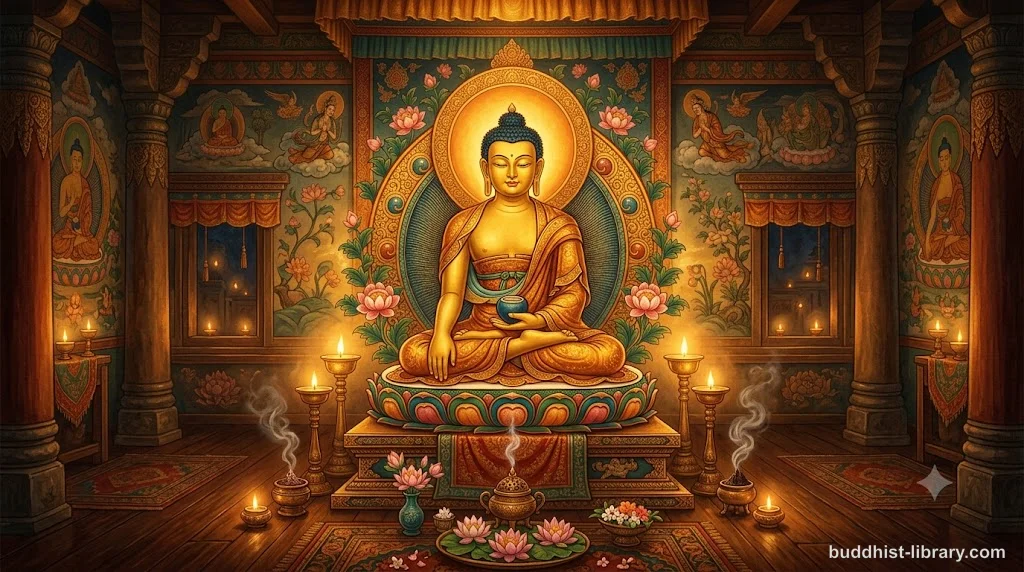
Buddhānussati — recollection of the Buddha — is a meditation practice where you bring to mind the noble qualities of the Buddha: his perfect wisdom, boundless compassion, moral purity, and complete awakening. By contemplating these attributes, you cultivate faith, inspiration, mental calm, and deep concentration. This is not worship in the theistic sense; it’s a skillful use of the mind to align yourself with the highest human potential.
The Buddha never asked to be worshipped. But he did teach his followers to recollect him — to remember what he accomplished, what he embodied, and what he pointed toward. Buddhānussati is one of the six classical recollections (anussati) found throughout the Pali Canon, designed to strengthen confidence in the path and generate the joy and calm needed for deeper meditation.
What does Buddhānussati mean?
The Pali term buddhānussati breaks down as:
- Buddha — the Awakened One
- Ānussati — recollection, mindful remembrance, bringing repeatedly to mind
So Buddhānussati literally means “recollection of the Buddha” — the deliberate practice of calling to mind the Buddha’s qualities, achievements, and teachings. It’s not thinking about the Buddha as a historical figure or deity; it’s contemplating the specific virtues that made him awakened, and letting those qualities inspire and calm your own mind.
This practice appears prominently in the Anguttara Nikāya (AN 6.10, the Mahānāma Sutta), where the Buddha tells a lay disciple that recollecting the Tathāgata is a way to “dwell happily in the present life” and attain states of concentration.
What qualities of the Buddha do you recollect?
The traditional formula for Buddhānussati is found across the Canon. It’s the same phrase chanted daily in Theravāda monasteries and lay devotional practice:
“Itipi so Bhagavā arahaṃ sammāsambuddho vijjācaraṇasampanno sugato lokavidū anuttaro purisadammasārathi satthā devamanussānaṃ Buddho Bhagavā ti.”
In English:
“The Blessed One is:
- Arahaṃ — worthy, accomplished, pure (free from all defilements)
- Sammāsambuddho — perfectly self-enlightened
- Vijjācaraṇasampanno — perfect in knowledge and conduct
- Sugato — well-gone, one who has gone to a good destination
- Lokavidū — knower of the worlds
- Anuttaro purisadammasārathi — unsurpassed trainer of persons to be tamed
- Satthā devamanussānaṃ — teacher of gods and humans
- Buddho — awakened
- Bhagavā — blessed, fortunate”
Each epithet points to a different dimension of awakening — moral purity (arahaṃ), intellectual perfection (sammāsambuddho), skillful teaching (satthā), and liberative understanding (lokavidū). The practice is to contemplate these qualities one by one, or as a whole, until a sense of confidence, joy, or calm arises.
How do you practice Buddhānussati meditation?
Buddhānussati can be practiced as a standalone meditation or as a preliminary to other practices (like mindfulness of breathing or loving-kindness). Here’s how to do it:
1. Settle your posture and intention
Sit comfortably in a quiet place. Close your eyes or soften your gaze. Take a few breaths to settle. Then set the intention: “I will recollect the qualities of the Buddha to inspire confidence and calm in my practice.”
2. Bring the Buddha’s qualities to mind
You can use the traditional nine epithets listed above, or focus on specific qualities:
- His compassion for all beings
- His wisdom that saw through suffering to liberation
- His patience and restraint even when insulted or threatened
- His moral purity — never acting from greed, hatred, or delusion
- His teaching skill — able to guide beings of all capacities
Choose one quality or recite the full formula. Repeat it mentally, slowly, with attention to what each word means.
3. Let the contemplation generate an emotional response
This is not intellectual analysis. Let the recollection affect you. When you contemplate the Buddha’s compassion, do you feel moved? When you remember his perfect wisdom, does confidence arise? When you think of his purity, does your own intention to practice strengthen?
The emotional response — faith, joy, serenity — becomes the meditation object. Rest in that feeling. Let it stabilize.
4. Sustain the recollection
If the mind wanders, gently bring it back to the quality you’re contemplating. You’re not trying to visualize the Buddha or create a mental image; you’re simply holding his qualities in awareness and allowing them to inspire calm and concentration.
5. Transition or deepen
If concentration becomes strong, you can let go of the words and rest in the feeling of confidence and calm — this can lead to jhāna. Or you can use the settled mind as a foundation for insight practice.
What are the benefits of Buddhānussati?
The Visuddhimagga (VII.67) lists specific benefits of recollecting the Buddha:
- Faith strengthens — you feel connected to a lineage of awakening
- Mindfulness and concentration develop — the recollection becomes an anchor
- Joy and inspiration arise — thinking of the Buddha’s achievement is uplifting
- Fear and doubt diminish — confidence in the path counters uncertainty
- You “dwell happily” — even without attaining jhāna, the practice brings peace
- The mind inclines toward the noble — your own intentions align with virtue
Importantly, the Canon says Buddhānussati can lead to upacāra samādhi (access concentration) and even appanā samādhi (full absorption / jhāna), though this is rarer with devotional practices than with breath or mettā.
Is this practice devotional or meditative?
Both.
Western students sometimes resist devotional practices, fearing they’re “religious” rather than “meditative.” In early Buddhism, though, the distinction is artificial. Devotion (saddhā, faith) and concentration (samādhi) work together.
Recollecting the Buddha is not prayer or worship in a theistic sense. You’re not asking the Buddha for help (he’s gone to final Nibbāna). You’re using his example to train your own mind. The practice is:
- Devotional in that it involves reverence, gratitude, and emotional connection
- Meditative in that it develops concentration and insight
- Pragmatic in that it’s a tool for mental training, not dogma
As Thanissaro Bhikkhu notes, faith in Buddhism is “confidence in the triple gem based on experience” — not blind belief. Buddhānussati deepens that confidence by repeatedly contemplating why the Buddha is worthy of respect.
Who is this practice for?
Buddhānussati is accessible to everyone — monastics and laypeople, beginners and advanced practitioners. It’s especially helpful:
- For beginners who need inspiration and confidence to keep practicing
- During times of doubt — when you question whether the path works
- When feeling discouraged or isolated — connecting to the Buddha’s example lifts the heart
- As a balance to dry analytical practice — it brings warmth and devotion
- For laypeople who may find renunciation practices difficult but can easily appreciate the Buddha’s qualities
The Mahānāma Sutta (AN 6.10) was taught to a lay disciple, specifically showing that Buddhānussati is appropriate for householders.
Key points
- Buddhānussati is the meditation practice of recollecting the Buddha’s noble qualities — wisdom, compassion, purity, awakening
- The traditional formula lists nine epithets — arahaṃ, sammāsambuddho, vijjācaraṇasampanno, etc.
- The practice blends devotion and concentration — you contemplate the qualities, let faith or joy arise, then rest in that feeling
- Benefits include strengthened faith, mental calm, reduced doubt, and potential jhāna
- It’s taught for both monastics and laypeople in the Pali Canon (AN 6.10, DN 16)
- This is not worship — it’s using the Buddha’s example as a tool for training the mind
FAQ
What is Buddhānussati?
Buddhānussati is the meditation practice of recollecting or bringing to mind the noble qualities of the Buddha — his wisdom, compassion, purity, and awakening. It’s one of the six recollections taught in early Buddhism to develop faith, inspiration, and mental calm.
How do you practice Buddhānussati meditation?
Start by finding a quiet place and settling your posture. Then mentally recite the traditional formula: “The Blessed One is accomplished, fully enlightened, perfect in knowledge and conduct…” — or contemplate specific qualities like the Buddha’s compassion or wisdom. Let each quality resonate emotionally, not just intellectually.
What are the benefits of recollecting the Buddha?
Buddhānussati strengthens faith and confidence in the path, generates joy and mental calm, counters doubt and fear, deepens concentration (samādhi), and can lead to jhāna. It’s especially helpful during times of doubt, discouragement, or when you need inspiration to continue practicing.
Is Buddhānussati devotional or analytical meditation?
It blends both. While it involves devotional respect and reverence for the Buddha, it’s also an analytical practice — you actively contemplate the specific qualities that made him awakened. The emotional response (faith, joy, inspiration) then becomes the object of concentration.
Can laypeople practice Buddhānussati, or is it only for monastics?
Buddhānussati is for everyone. The Buddha taught it to both monastics and laypeople. It’s particularly accessible for laypeople because it doesn’t require renunciation or deep analytical insight — just sincere appreciation of the Buddha’s qualities and the willingness to bring them to mind.
Conclusion
Buddhānussati — recollection of the Buddha — is a practice of bringing to mind the qualities that made Siddhattha Gotama awakened: his wisdom, compassion, moral perfection, and complete liberation. It’s not worship; it’s a skillful mental training that generates faith, joy, and concentration by contemplating the highest human potential.
Whether you’re a beginner needing inspiration, a seasoned practitioner seeking to balance analytical practice with devotion, or someone going through doubt and discouragement, Buddhānussati offers a way to reconnect with why you practice. The Buddha may have passed into final Nibbāna 2,600 years ago, but his qualities remain — and by recollecting them, you invite those same qualities into your own mind.
Read more:
- What Is Mindfulness (Sati) in Buddhism? — Explore the foundational quality that supports all meditation practices, including Buddhānussati.
- Mettā: The Practice of Loving-Kindness — Another devotional-concentration practice that cultivates goodwill and calm, often practiced alongside Buddhānussati.
- What Are the Jhānas? Understanding Meditative Absorption in Buddhism — Learn about the deep states of concentration that Buddhānussati can lead to when practiced skillfully.
📖 Source / license: Anguttara Nikāya 6.10 (Mahānāma Sutta), Visuddhimagga VII
Frequently asked questions
What is Buddhānussati?
Buddhānussati is the meditation practice of recollecting or bringing to mind the noble qualities of the Buddha — his wisdom, compassion, purity, and awakening. It's one of the six recollections taught in early Buddhism to develop faith, inspiration, and mental calm.
How do you practice Buddhānussati meditation?
Start by finding a quiet place and settling your posture. Then mentally recite the traditional formula: 'The Blessed One is accomplished, fully enlightened, perfect in knowledge and conduct…' — or contemplate specific qualities like the Buddha's compassion or wisdom. Let each quality resonate emotionally, not just intellectually.
What are the benefits of recollecting the Buddha?
Buddhānussati strengthens faith and confidence in the path, generates joy and mental calm, counters doubt and fear, deepens concentration (samādhi), and can lead to jhāna. It's especially helpful during times of doubt, discouragement, or when you need inspiration to continue practicing.
Is Buddhānussati devotional or analytical meditation?
It blends both. While it involves devotional respect and reverence for the Buddha, it's also an analytical practice — you actively contemplate the specific qualities that made him awakened. The emotional response (faith, joy, inspiration) then becomes the object of concentration.
Can laypeople practice Buddhānussati, or is it only for monastics?
Buddhānussati is for everyone. The Buddha taught it to both monastics and laypeople. It's particularly accessible for laypeople because it doesn't require renunciation or deep analytical insight — just sincere appreciation of the Buddha's qualities and the willingness to bring them to mind.