The Four Nutriments (Āhāra): What Sustains Existence in Buddhism
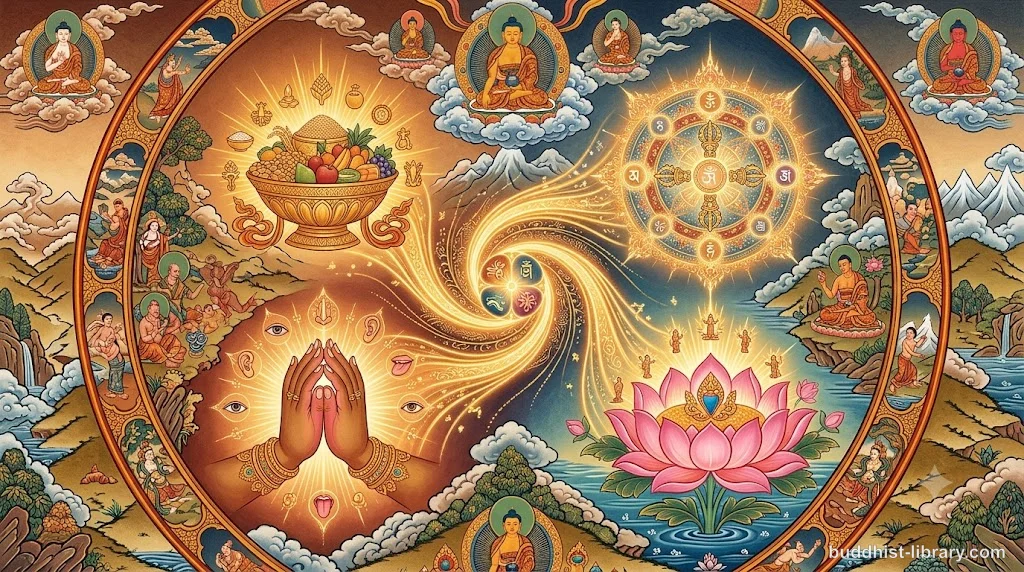
The Buddha identified four nutriments (āhāra) that sustain both physical life and the entire cycle of existence. Understanding these four—physical food, sense contact, mental volition, and consciousness—reveals what keeps beings bound to suffering and how to cut off the fuel that perpetuates rebirth.
What Are the Four Nutriments in Buddhism?
The Puttamaṃsa Sutta (SN 12.63) and the Sammādiṭṭhi Sutta (MN 9) present a deceptively simple framework. Four nutriments sustain existence:
- Physical food (kabaḷīkārāhāra) — edible food consumed in morsels
- Contact (phassāhāra) — sensory contact through the six sense bases
- Mental volition (manosañcetanāhāra) — intention and will
- Consciousness (viññāṇāhāra) — the consciousness that arises at the six sense doors
These four sustain the five aggregates and perpetuate birth, aging, and death.
The term āhāra means “that which is taken up.” Physical food sustains the body. These four nutriments—taken together—sustain the entire process of becoming (bhava) and rebirth.
Why Did the Buddha Teach About Nutriments?
This teaching is a practical framework for understanding dependent origination—the causal chain that binds beings to saṃsāra.
The Puttamaṃsa Sutta opens with a harrowing simile. A couple crosses a desert with their young son. Their food runs out. To survive, they kill and eat the child, weeping at each mouthful. The Buddha asks: “Would they eat that food for enjoyment or intoxication?”
No. Only to cross the desert and survive.
This parable cuts to the bone. The four nutriments should be regarded not as sources of pleasure, but as bare necessities—fuel to sustain the body and practice until liberation is reached.
Once you understand what sustains existence, you can investigate how craving for these nutriments perpetuates suffering. And how to abandon that craving.
The Four Nutriments Explained
1. Physical Food (Kabaḷīkārāhāra)
The most obvious nutriment. Edible food taken in morsels sustains the physical body—the form aggregate.
The Buddha instructs meditators to reflect on food without greed or attachment. In the gradual training, monks contemplate food “wisely, not for fun, not for pleasure, not for fattening, not for beautification, but only to sustain this body, to avoid harm, and to assist the holy life.”
When craving for food is abandoned, the body is sustained minimally. At death, there is no fuel for a new physical form to arise.
2. Contact (Phassāhāra)
Contact refers to the meeting of sense organ, sense object, and consciousness at the six sense bases: eye and forms, ear and sounds, nose and odors, tongue and tastes, body and tangibles, mind and mental objects.
This contact conditions feeling (vedanā), which in turn conditions craving (taṇhā). The entire sensory process becomes fuel for clinging and further becoming.
Understanding contact as a nutriment means seeing how sensory experience—when met with ignorance and craving—perpetuates the cycle. Mindfulness of the six sense bases breaks this automatic reaction.
3. Mental Volition (Manosañcetanāhāra)
Mental volition—intention, will, cetanā—is the kammic force that drives rebirth. The Buddha states it plainly: “Intention, I say, is kamma” (AN 6.63).
Every intentional action plants a seed for future becoming. Wholesome or unwholesome, each intention carries momentum. When a being dies with unfulfilled desires and intentions, those volitions fuel rebirth into a new existence.
Eliminating craving for mental volition means ceasing to generate new kammic formations. This is why Right Intention stands as the second factor of the Noble Eightfold Path, steering the mind away from greed, ill will, and harm.
4. Consciousness (Viññāṇāhāra)
Consciousness here refers to the six types of consciousness (eye-consciousness, ear-consciousness, etc.) that arise dependent on contact at the sense doors.
In dependent origination, consciousness and name-and-form (nāma-rūpa) are mutually dependent: consciousness conditions name-and-form, and name-and-form conditions consciousness. This reciprocal relationship sustains the continuity of experience and, at death, the descent of consciousness into a new womb.
When craving for consciousness ceases—when there is no desire for sensory or mental experience—the fuel for rebirth is exhausted.
How the Four Nutriments Sustain Saṃsāra
The four nutriments collectively sustain the cycle of birth and death:
- Physical food sustains the body during life.
- Contact at the sense doors produces feelings, which—when met with craving—lead to clinging.
- Mental volition generates kammic momentum that propels rebirth.
- Consciousness descends into a new existence, linking one life to the next.
This is an alternative presentation of the same process described in the twelve links of dependent origination. Where the twelve-link formula emphasizes sequential causation (ignorance → formations → consciousness → …), the four nutriments emphasize sustaining conditions.
Both frameworks point to the same truth: suffering arises dependently, sustained by conditions, and ceases when those conditions are removed.
Abandoning Craving for the Nutriments
The Buddha teaches that the path to liberation involves abandoning craving (taṇhā) for each of the four nutriments:
“When one abandons and eliminates desire and lust for the nutriment of physical food, contact, mental volition, and consciousness, consciousness has no footing there… One thus liberated does not go anywhere, does not come from anywhere, and does not remain anywhere.” (Atthirāga Sutta, SN 12.64)
This is not about rejecting food or sensory experience while alive, but about removing the underlying craving that turns these conditions into fuel for future becoming.
Key practices to weaken craving for the nutriments:
- Mindful eating and reflection on food as mere sustenance (not pleasure)
- Mindfulness of feeling (vedanānupassanā) to observe sensory contact without reactivity
- Wise attention (yoniso manasikāra) to intention, steering it toward wholesomeness and eventually toward the ending of becoming
- Insight into the impermanent, unsatisfactory, and non-self nature of consciousness
As craving diminishes, the nutriments cease to sustain new becoming. At full enlightenment (arahatship), all four nutriments are “cut off,” and upon the death of the body, there is no rebirth—only the unconditioned peace of nibbāna.
The Four Nutriments and the Path
This teaching is practical, not abstract philosophy. It offers a lens for investigating experience moment by moment.
When eating: “Am I eating with craving, or with wisdom?”
When sense contact occurs: “Is craving arising here?”
When forming an intention: “Does this volition lead toward becoming, or toward release?”
When consciousness arises: “Am I clinging to this experience?”
The framework integrates naturally with the Four Foundations of Mindfulness. Observing the body includes mindful eating. Observing feelings tracks the fuel of contact. Observing mind reveals volition and consciousness at work. Observing dhammas (mental objects) exposes the dependent arising of all four nutriments.
The four nutriments teaching is about seeing the conditions that sustain suffering—and cutting them off at the root.
Conclusion
The Buddha’s teaching on the four nutriments reveals the hidden mechanics of existence. Physical food, sensory contact, mental volition, and consciousness—these are the fuel that sustains the five aggregates and keeps beings wandering in saṃsāra.
Understanding the nutriments is understanding dependent origination from a different angle. Dependent origination shows the chain of causation. The nutriments show the sustaining conditions. Both point to the same truth: remove craving, cut off the fuel, and suffering ceases.
For practitioners, this teaching transforms daily life. Every bite of food. Every sensory encounter. Every intention. Every moment of consciousness. All of these are opportunities to practice with wisdom rather than craving.
The Buddha taught it simply: when craving for these nutriments is abandoned, “consciousness has no footing,” and liberation is realized.
Read more:
- What Is Dependent Origination (Paṭiccasamuppāda)? — The twelve-link chain of causation that the four nutriments sustain, showing how ignorance and craving perpetuate the cycle of rebirth.
- What Is Taṇhā? Understanding Craving in Buddhism — A deep dive into craving, the force that turns the four nutriments into fuel for suffering and rebirth.
- The Five Aggregates (Khandhas): What We Mistake for ‘Self’ — The nutriments sustain these five aggregates; understanding them reveals the absence of a permanent self.
📖 Source / license: Saṃyutta Nikāya 12.63 (Puttamaṃsa Sutta), SN 12.64 (Atthirāga Sutta), Majjhima Nikāya 9 (Sammādiṭṭhi Sutta) — Bhikkhu Bodhi translation (Wisdom Publications); Access to Insight (dhammatalks.org)
Frequently asked questions
What are the four nutriments in Buddhism?
The four nutriments are: physical food (kabaḷīkārāhāra), sense contact (phassāhāra), mental volition (manosañcetanāhāra), and consciousness (viññāṇāhāra). These sustain both physical life and the cycle of rebirth.
Why did the Buddha teach about nutriments?
The Buddha taught about nutriments to show what sustains existence and suffering. By understanding what feeds the cycle of birth and death, practitioners can cut off that fuel and move toward liberation.
How do the four nutriments relate to dependent origination?
The nutriments are an alternative way of explaining dependent origination. They show the causal conditions that sustain the five aggregates and keep beings bound to saṃsāra—the same cycle described in the twelve links.
Can we eliminate all four nutriments completely?
An arahat who has attained full enlightenment has eliminated craving for all four nutriments. At death, with no fuel remaining, they enter parinibbāna and are not reborn. For those still in training, the goal is to gradually reduce craving for these nutriments through practice.