Karma and Rebirth in Buddhism: How They Actually Work
Karma (kamma) is intentional action, and rebirth (punabbhava) is the continuation of the causal process those intentions set in motion. The Buddha taught that our deliberate choices—mental, verbal, and physical—create conditions shaping this life and future experiences across lifetimes. This isn’t about belief. It’s about recognizing how intention drives consequences.
The Buddha’s teaching on karma and rebirth gets distorted constantly. Fatalism. Cosmic scorekeeping. Reincarnation of a soul. None of these capture what the suttas actually describe.
This guide clarifies the mechanics as taught in the Pāli Canon, grounded in canonical sources.
What Is Karma? (Kamma)
Karma literally means “action.” But the Buddha clarified what counts.
In the Nibbedhika Sutta (AN 6.63), he states:
“It is intention (cetanā) that I call karma. Having intended, one acts by body, speech, or mind.”
Intention is everything. Three points clarify this:
-
Intention is the heart of karma — Accidental actions don’t carry the same karmic weight. A surgeon cutting tissue and a murderer stabbing someone perform similar physical acts, but the intentions differ radically.
-
Karma operates through three doors — body (physical actions), speech (words), and mind (thoughts and volitions). Mental karma can be as potent as physical karma.
-
Karma is a natural process, not divine judgment — There’s no cosmic judge tallying good and bad deeds. Karma functions like gravity: natural, impersonal, lawful.
How Karma Ripens
The Cūḷakammavibhaṅga Sutta (MN 135) describes how specific intentions lead to corresponding results:
- Harming others → experiencing harm
- Generosity → receiving support and resources
- Developing anger → being unattractive or repulsive to others
- Cultivating equanimity → experiencing beauty and pleasant circumstances
This isn’t magic. It’s a description of how mental habits shape personality, relationships, circumstances, and eventually rebirth conditions.
Karma doesn’t ripen mechanically or immediately. Some ripens in this life (diṭṭhadhamma-vedanīya). Some in the next rebirth (upapajja-vedanīya). Some much later (aparāpariya-vedanīya).
Timing depends on the potency of the intention and the conditions present.
What Is Rebirth? (Punabbhava)
Rebirth in Buddhism is not reincarnation.
There’s no unchanging soul (ātman) transmigrating from body to body. The Buddha explicitly rejected the soul doctrine in the Anattalakkhaṇa Sutta (SN 22.59) and throughout the Anattā (Non-Self) teachings.
So what continues if there’s no self?
The Candle Analogy
Imagine lighting one candle from another. The new flame arises dependent on the old flame, but it’s not the same flame—no substance passed from one to the other.
Rebirth works similarly. A new life arises conditioned by the previous life’s karma, but no permanent entity travels between them.
The Milindapañha (Questions of King Milinda) uses this exact analogy.
Dependent Origination and Rebirth
Rebirth is embedded in the Buddha’s teaching of Dependent Origination (Paṭiccasamuppāda):
Ignorance → formations → consciousness → name-and-form → six sense bases → contact → feeling → craving → clinging → becoming → birth → aging and death
This twelve-linked chain shows how ignorance and craving fuel the process that leads to rebirth. When craving ceases, the cycle stops—this is nibbāna.
The key links for rebirth are:
- Formations (saṅkhāra) — intentional actions, karma
- Becoming (bhava) — the process that leads to a new existence
- Birth (jāti) — the arising of a new life
Rebirth isn’t imposed from outside. It’s the natural continuation of a process you’ve been feeding with craving and ignorance.
How Do Karma and Rebirth Work Together?
Karma provides the conditions. Rebirth is the result.
Think of karma as seeds and rebirth as the crops. Not all seeds sprout immediately.
The Buddha described different “weights” of karma:
-
Weighty karma (garuka-kamma) — extremely wholesome or unwholesome acts; these ripen first and can determine the next rebirth (e.g., developing deep meditative absorption or committing one of the five heinous acts).
-
Habitual karma (āciṇṇa-kamma) — repeated patterns of thought and behavior; what you consistently do shapes your character and future tendencies.
-
Death-proximate karma (maraṇāsanna-kamma) — intentions present at the moment of death; these can have a significant influence on the next rebirth.
-
Stored karma (kaṭattā-kamma) — past actions waiting for conditions to ripen.
Rebirth reflects the quality of accumulated karma. Wholesome intentions (generosity, compassion, wisdom) lead to favorable rebirths; unwholesome intentions (greed, hatred, delusion) lead to suffering states.
The Six Realms
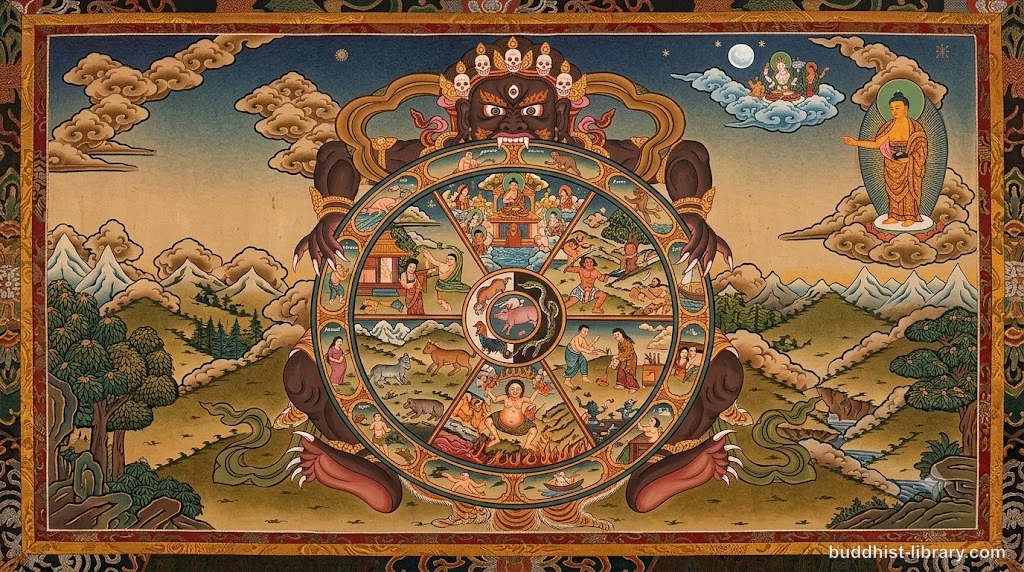
Traditional Buddhist cosmology describes six realms of rebirth:
- Deva (heavenly beings) — experiencing great pleasure due to wholesome karma
- Asura (titans) — jealous beings in conflict
- Human — a mix of pleasure and pain, uniquely suited for spiritual practice
- Animal — driven by instinct
- Preta (hungry ghosts) — tormented by insatiable craving
- Hell beings — experiencing intense suffering
Whether you interpret these literally or symbolically, they represent states conditioned by karma.
The human realm is considered precious. Why? It offers the balance of suffering and ease necessary for awakening.
Key Points
- Karma means intentional action, not fate or predetermined destiny.
- Intention (cetanā) is what makes an action karmic—accidents and unconscious acts have minimal karmic weight.
- Rebirth is not reincarnation—there’s no soul; it’s a causal process continuing across lifetimes.
- The process is natural and impersonal—no deity judges or assigns rebirth; karma ripens according to conditions.
- Craving and ignorance fuel rebirth; when they cease, the cycle stops (nibbāna).
- Understanding karma and rebirth changes how you live now—your intentions today shape tomorrow and beyond.
Why Does This Matter for Practice?
Understanding karma and rebirth isn’t about believing in past lives or worrying about future ones.
It’s about recognizing the power of intention right now.
The Buddha emphasized this in the Kalama Sutta (AN 3.65), where he describes how living with wholesome intentions, actions, and speech brings well-being in this life regardless of whether rebirth exists.
When you see how intentions shape consequences—how anger poisons relationships, how generosity creates connection, how mindfulness brings clarity—motivation to train the mind follows naturally.
Karma and rebirth also address suffering’s apparent injustice. Why do children suffer? Why do harmful people prosper?
The teaching points to causes beyond this single lifetime. But it emphasizes present actions matter most.
Breaking the Cycle
The ultimate goal isn’t a better rebirth. It’s ending rebirth entirely.
As the Buddha taught in the Four Noble Truths, suffering arises from craving, and the path to its end is the Noble Eightfold Path.
By cultivating wisdom, ethical conduct, and mental concentration, you uproot the ignorance and craving fueling karma and rebirth. This is the purpose of practice—not accumulating good karma for a better next life, but transcending the entire process.
Frequently Asked Questions
Is karma punishment or reward from a deity?
No. Karma is not divine judgment. It’s a natural law of cause and effect—intentional actions create conditions that ripen into future experiences, without any external judge or cosmic bookkeeper.
Does rebirth mean the same person is reborn?
Not exactly. There’s no unchanging soul that transmigrates. Rebirth is the continuation of a causal process—like one candle lighting another. The flame continues, but it’s not the same flame.
Can you remember past lives in Buddhism?
The Buddha described recollecting past lives as a skill developed through deep meditation. However, memory isn’t necessary for understanding karma and rebirth—what matters is seeing how present actions shape future consequences.
What happens to karma when someone reaches nibbāna?
At nibbāna, the process stops. Since there’s no more craving or ignorance fueling new intentions, no new karma is created, and the cycle of rebirth ceases. Previous karma may still ripen, but it no longer leads to rebirth.
Conclusion
Karma and rebirth aren’t beliefs to adopt blindly. They’re observations about how intention shapes experience across time.
The Buddha taught them to empower practitioners. Your choices matter. You have the capacity to change the trajectory of your life and future lives.
Understanding that your intentions today create the conditions for tomorrow brings both responsibility and freedom. The cycle continues as long as ignorance and craving persist. When wisdom arises and craving ceases, the cycle ends.
This is liberation.
The teaching is ultimately practical: cultivate wholesome intentions, reduce harmful ones, walk the path toward freedom.
Read more:
- Anattā (Non-Self): What the Buddha Really Meant — Understanding non-self clarifies why rebirth isn’t reincarnation and what actually continues across lifetimes.
- What Is Dependent Origination (Paṭiccasamuppāda)? — Karma and rebirth are embedded in the twelve-linked chain that explains how suffering arises and ceases.
- What Is Nirvana (Nibbāna)? Meaning and Misconceptions — The ultimate goal isn’t better rebirth but the cessation of the entire cycle—nibbāna ends karma and rebirth.
📖 Source / license: Majjhima Nikāya 43, 135, 136; Aṅguttara Nikāya 3.33, 6.63; Saṃyutta Nikāya 12.2; Cūḷakammavibhaṅga Sutta (MN 135); translations by Bhikkhu Bodhi and Ṭhānissaro Bhikkhu; Access to Insight (dhammatalks.org)
Frequently asked questions
Is karma punishment or reward from a deity?
No. Karma is not divine judgment. It's a natural law of cause and effect—intentional actions create conditions that ripen into future experiences, without any external judge or cosmic bookkeeper.
Does rebirth mean the same person is reborn?
Not exactly. There's no unchanging soul that transmigrates. Rebirth is the continuation of a causal process—like one candle lighting another. The flame continues, but it's not the same flame.
Can you remember past lives in Buddhism?
The Buddha described recollecting past lives as a skill developed through deep meditation. However, memory isn't necessary for understanding karma and rebirth—what matters is seeing how present actions shape future consequences.
What happens to karma when someone reaches nibbāna?
At nibbāna, the process stops. Since there's no more craving or ignorance fueling new intentions, no new karma is created, and the cycle of rebirth ceases. Previous karma may still ripen, but it no longer leads to rebirth.