The Life of the Buddha: From Prince Siddhārtha to Awakening
Prince Siddhārtha Gotama lived behind palace walls for twenty-nine years, shielded from every form of suffering. Four chance encounters—an elderly person, a sick person, a corpse, and a wandering ascetic—demolished that illusion in a single day. He abandoned his throne, spent six brutal years practicing self-mortification, then discovered a middle path that led to complete awakening under a tree. That moment transformed him into the Buddha and changed the course of human history.
His life story isn’t just biography. It’s a verified map—tested by millions across twenty-five centuries—showing that liberation from suffering is real and achievable.
Who Was Prince Siddhārtha Before His Awakening?
Siddhārtha Gotama was born into the Sakyan clan in Lumbinī (present-day Nepal) around the 5th or 6th century BCE. His father, King Suddhodana, ruled the small republic, and his mother, Queen Māyā, died seven days after his birth. He was raised by his maternal aunt and stepmother, Mahāpajāpatī Gotāmī.
A prophecy at birth declared the infant would become either a great emperor or a supreme spiritual teacher. Determined to keep his son in the palace, Suddhodana surrounded Siddhārtha with every luxury and pleasure—beautiful palaces for each season, constant entertainment, and complete isolation from suffering.
Siddhārtha married Yasodharā and fathered a son, Rāhula. He lived immersed in sensual pleasures, shielded from the harsh realities of human existence. The Ariyapariyesanā Sutta (MN 26) records the Buddha later describing this period: “I was delicate, most delicate, supremely delicate… and yet, while I had such power and good fortune, I thought: ‘When an untaught ordinary person… sees another who is old… sick… or dead, he is shocked, humiliated, and disgusted, forgetting that he himself is no exception.’”
What Were the Four Sights That Changed Everything?
Despite his father’s efforts, Siddhārtha eventually ventured beyond the palace walls. Traditional accounts describe four encounters—the Four Sights—that shattered his sheltered worldview:
- An old person, bent and frail, revealing the inevitability of aging
- A sick person, suffering from disease, showing vulnerability
- A corpse, demonstrating the certainty of death
- A wandering ascetic, serene and purposeful, suggesting liberation was possible
These weren’t casual observations. They were existential shocks.
Siddhārtha saw the truth instantly: wealth and power are worthless against aging, illness, and death. But the fourth sight—the serene ascetic—offered a radical possibility. Maybe suffering could be transcended entirely.
This realization catalyzed what became Buddhism’s central question: Is liberation from suffering possible? And if so, how?
Why Did He Renounce His Kingdom?
At age twenty-nine, Siddhārtha made the radical decision historians call the Great Renunciation. One night, he left his sleeping wife and infant son, rode his horse Kaṇṭhaka to the forest edge, cut off his hair with his sword, and exchanged his royal robes for the simple cloth of a wandering seeker.
Was he abandoning his family? No. He was racing against death itself.
The Ariyapariyesanā Sutta preserves his own words: “Being myself subject to birth, aging, illness, death, sorrow, and defilement, seeing danger in what is subject to these things, I sought the unborn, unaging, unailing, deathless, sorrowless, undefiled supreme security from bondage—nibbāna.”
He studied under two renowned meditation teachers:
- Āḷāra Kālāma, who taught the “sphere of nothingness” (ākiñcaññāyatana)
- Uddaka Rāmaputta, who taught the “sphere of neither-perception-nor-non-perception” (nevasaññānāsaññāyatana)
Siddhārtha mastered both states in weeks. His teachers offered him co-leadership of their schools.
He declined. These were refined meditative attainments, impressive and peaceful—but they weren’t liberation. Suffering would return the moment concentration faded.
What Happened During His Six Years of Asceticism?
Unsatisfied with meditation alone, Siddhārtha joined a group of five ascetics in Uruvelā forest and practiced extreme self-mortification. For six years, he pushed his body to the brink—eating single grains of rice, holding his breath until he fainted, sitting motionless for days.
The Mahāsaccaka Sutta (MN 36) preserves his own vivid description: “Because of eating so little, my limbs became like the jointed segments of vine stems or bamboo stems… My backside became like a camel’s hoof… My spine stood out like a corded string… My ribs jutted out like the jutting rafters of an old roofless barn… The gleam of my eyes sank down in their sockets…”
Yet even at death’s edge, enlightenment eluded him.
He saw the pattern. Self-torture was just self-indulgence inverted. Both were forms of clinging—one to pleasure, the other to the holiness of suffering. Neither touched the root.
How Did the Buddha Discover the Middle Way?
Weakened and near death, Siddhārtha remembered a childhood experience—spontaneous joy and concentration arising while sitting beneath a rose-apple tree during a festival. He realized that pleasant feeling wasn’t inherently an obstacle to awakening. Harsh asceticism had been another form of clinging—to the idea that suffering itself was holy.
He accepted milk-rice offered by a village woman named Sujātā, regaining his strength. His five ascetic companions, disgusted by what they saw as backsliding, abandoned him.
Alone, abandoned by his companions, Siddhārtha saw what would become Buddhism’s core insight: the Middle Way.
This wasn’t compromise. It was precision. The path required a strong body, a clear mind, and balanced effort—not because moderation is virtuous, but because extremes burn energy without producing insight.
What Happened on the Night of Enlightenment?
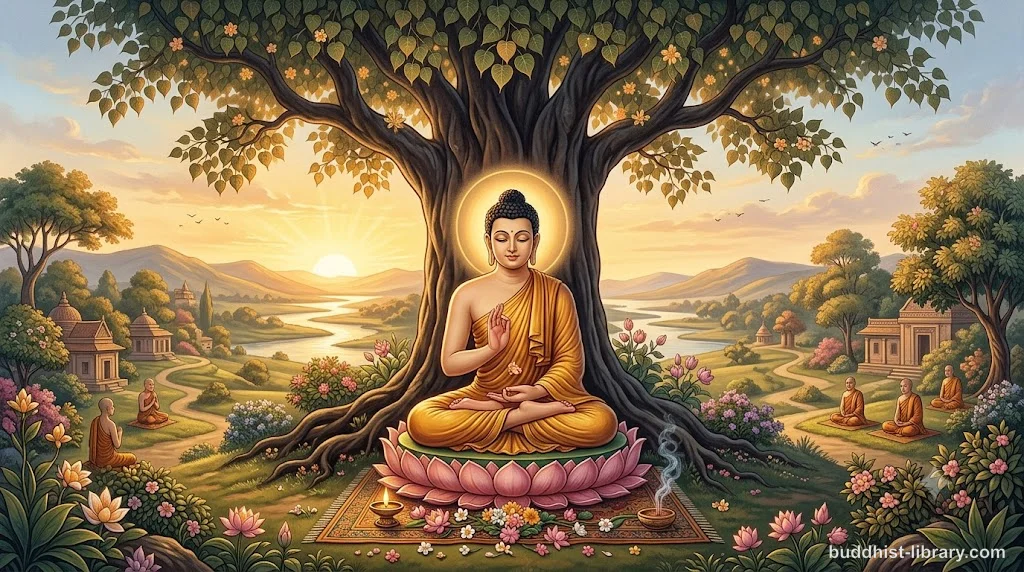
With renewed vigor, Siddhārtha sat beneath a pipal tree (later called the Bodhi Tree) in Bodh Gayā, vowing not to rise until he had achieved complete awakening. Traditional accounts describe a night of profound meditation divided into three watches.
First watch: He developed the ability to recall countless past lives in detail, seeing the entire cycle of birth, death, and rebirth stretching back eons.
Second watch: He developed the “divine eye,” perceiving how beings are reborn according to their karma—actions rooted in greed, hatred, and delusion leading to suffering; actions rooted in generosity, loving-kindness, and wisdom leading to happiness.
Third watch: He comprehended dependent origination (paṭiccasamuppāda)—the twelve-linked chain showing how ignorance leads to formations, consciousness, name-and-form, sense bases, contact, feeling, craving, clinging, becoming, birth, and finally aging and death. Understanding this process in both arising and cessation, he realized how suffering originates and how it can be permanently ended.
At dawn, the last fetter snapped.
He had achieved sammāsambodhi—perfect, complete enlightenment. Every chain binding consciousness to the cycle of birth and death dissolved. Siddhārtha Gotama was gone. The Buddha—“the Awakened One”—had taken his place.
What Are the Key Lessons From the Buddha’s Life?
The Buddha’s biography isn’t mythology—it’s a spiritual roadmap:
- Wealth and pleasure don’t prevent suffering: Siddhārtha had everything material comfort could offer, yet remained unfulfilled
- Suffering is universal: Aging, illness, and death spare no one, regardless of status
- Extremes fail: Both self-indulgence and self-torture are dead ends
- The Middle Way works: Balance, mindfulness, and ethical conduct create conditions for awakening
- Awakening is possible: The Buddha’s achievement demonstrates that liberation isn’t theoretical—it’s attainable through practice
- Direct experience over doctrine: The Buddha tested his teachers’ methods, abandoned what didn’t work, and verified truth through personal realization
How Did His Awakening Transform Into a Teaching Movement?
After enlightenment, the Buddha initially hesitated to teach. The Ariyapariyesanā Sutta records his thought: “This Dhamma that I have attained is profound, hard to see, hard to realize, peaceful and sublime, beyond the sphere of reasoning, subtle, comprehensible only to the wise.”
The tradition states that Brahmā Sahampati, a divine being, appeared and pleaded: “There are beings with little dust in their eyes who are falling away through not hearing the Dhamma. There will be those who will understand the Dhamma.”
Moved by compassion, the Buddha agreed to teach. He sought out his five former ascetic companions in the Deer Park at Isipatana (modern-day Sarnath) and delivered his first sermon—the Dhammacakkappavattana Sutta—setting in motion “the wheel of Dhamma” that continues turning today.
Over forty-five years, he walked across northern India, teaching kings and beggars, men and women, establishing the monastic Saṅgha, and guiding thousands to various stages of awakening. He died at age eighty in Kusināra, entering parinibbāna—final liberation without remainder.
Why Does the Buddha’s Life Story Still Matter?
Most spiritual teachers claim authority through revelation or divine appointment. The Buddha offered something different: a tested methodology.
His life is proof of concept. He started where most people start—comfortable, sheltered, afraid of death. He made the same mistakes earnest seekers make—chasing extreme practices, expecting quick results, doubting whether liberation was real. Then he found a method that worked, documented it, and taught it to others who verified it independently.
That’s why his biography matters. The obstacles he faced—attachment to comfort, attraction to extremes, doubt, discouragement—haven’t changed in 2,500 years.
The teachings aren’t abstract philosophy. The Four Noble Truths emerged from his confrontation with the Four Sights. The Noble Eightfold Path crystallized from his discovery of the Middle Way. Every meditation instruction reflects a method he tested personally and refined based on results.
Complete liberation from suffering is possible. That’s the claim. Not through faith, not through ritual, but through systematic practice that transforms understanding. The Buddha’s life is the first successful test case. Millions since have replicated the experiment.
Read more:
- The Four Noble Truths: The Heart of the Buddha’s Teaching — The Buddha’s first teaching after enlightenment, explaining the truth of suffering and the path to its cessation
- The Noble Eightfold Path: A Complete Guide — The practical framework the Buddha taught for achieving liberation, developed from his own awakening experience
- What Is Dependent Origination (Paṭiccasamuppāda)? — The profound insight into causation that the Buddha realized on the night of his enlightenment
📖 Source / license: Bhikkhu Ñāṇamoli & Bhikkhu Bodhi, trans., *The Middle Length Discourses of the Buddha* (Majjhima Nikāya 26); Access to Insight, *The Life of the Buddha*
Frequently asked questions
When and where was the Buddha born?
According to tradition, Siddhārtha Gotama was born around the 5th–6th century BCE in Lumbinī (modern-day Nepal), in the Sakyan republic. His father was King Suddhodana and his mother was Queen Māyā.
What were the Four Sights that led the Buddha to renounce his royal life?
The Four Sights were an old person (showing aging), a sick person (showing illness), a corpse (showing death), and a wandering ascetic (showing the possibility of spiritual liberation). These encounters revealed the universal nature of suffering and inspired his spiritual quest.
How long did the Buddha practice asceticism before his awakening?
The Buddha practiced extreme asceticism for approximately six years before realizing it was not the path to liberation. He then adopted a Middle Way approach, which led to his awakening under the Bodhi tree.
What did the Buddha realize at the moment of his enlightenment?
At enlightenment, the Buddha comprehended the Four Noble Truths, understood dependent origination (paṭiccasamuppāda), saw his past lives, understood the workings of karma and rebirth, and realized the complete cessation of all defilements (āsavas).