The Mahāparinibbāna Sutta: The Buddha's Final Teaching and Passing
The Mahāparinibbāna Sutta (DN 16) is the Pali Canon’s longest and most poignant discourse, chronicling the final three months of the Buddha’s life — his last journey through northern India, his final teachings to disciples and laypeople, and his peaceful passing into Parinibbāna at age 80. More than a historical account, this sutta delivers profound teachings on impermanence, self-reliance, and the enduring power of the Dhamma.
What is the Mahāparinibbāna Sutta?
The Mahāparinibbāna Sutta is the sixteenth discourse of the Dīgha Nikāya (Long Discourses) in the Pali Canon. Spanning six chapters, it is one of the most detailed biographical accounts of the Buddha’s final days, preserved by the monastic community and recited at the First Council shortly after his passing.
The sutta opens with the Buddha at Rājagaha (modern-day Rajgir). It closes with his cremation and the distribution of his relics at Kusinārā (modern-day Kushinagar in Uttar Pradesh, India). Every Buddhist tradition — Theravāda, Mahāyāna, Vajrayāna — reveres this text as foundational scripture that delivers both historical context and timeless spiritual guidance.
The narrative structure interweaves travel episodes with teachings, making it both a biography and a Dhamma manual. The Buddha’s physical decline and death serve as the ultimate teaching on anicca (impermanence), while his final instructions establish the framework for the Sangha to continue after his passing.
Why did the Buddha decide to pass away?
The sutta reveals that the Buddha made a deliberate choice regarding the timing of his Parinibbāna. At Vesālī, the Buddha — already 80 years old and weakened by severe illness — told his attendant Ānanda that a Buddha or any person who has developed the four bases of spiritual power (iddhipāda) could, if they wished, live for an eon or until the end of the eon.
Ānanda, distracted by Māra (the personification of delusion), failed to ask the Buddha to remain. Three times the Buddha gave this hint; three times Ānanda remained silent. Only after Māra appeared and urged the Buddha to pass away — arguing that the Dhamma was now well-established — did the Buddha formally relinquish his will to live, stating: “In three months’ time, the Tathāgata will pass away.”
This episode is not about supernatural longevity. It is about the Buddha’s intentional acceptance of death.
He had completed his mission. The Dhamma was taught. The Sangha was established. The path to liberation was clear. His passing would serve as the final, undeniable demonstration that all conditioned things — even the body of a fully enlightened being — are subject to decay.
What were the Buddha’s final teachings?
Throughout his last journey, the Buddha delivered several key teachings that remain central to Buddhist practice today:
The Mirror of the Dhamma
At Nādikā, the Buddha taught the “Mirror of the Dhamma” — a teaching allowing practitioners to verify their own spiritual progress. Anyone possessing unwavering confidence in the Buddha, Dhamma, and Sangha, and who possesses the virtues dear to the noble ones, can be certain they will not be reborn in the lower realms and are assured of eventual enlightenment.
This was radical. Practitioners could self-assess their spiritual standing without external validation. Spiritual knowledge, democratized.
The Four Great References
Concerned that false teachings might arise after his death, the Buddha established the Mahāpadesa (Four Great References) as criteria for determining authentic Dhamma. A teaching is genuine if it accords with:
- The Suttas (discourses)
- The Vinaya (monastic discipline)
- The spirit of the Dhamma
- The nature of things as they are
This framework remains the Theravāda tradition’s primary method for evaluating doctrinal authenticity.
”Be islands unto yourselves”
At Vesālī, the Buddha gave perhaps his most famous final instruction:
“Therefore, Ānanda, be islands unto yourselves, refuges unto yourselves, seeking no external refuge; with the Dhamma as your island, the Dhamma as your refuge, seeking no other refuge.”
This teaching — often translated as “be a lamp unto yourself” — emphasizes self-reliance in spiritual practice. The Buddha was not establishing himself as an eternal savior but pointing his disciples to the Dhamma as their true guide. The instruction anticipates his physical absence and shifts responsibility for liberation squarely onto each practitioner.
The unimportance of external authority
When Ānanda asked who would lead the Sangha after the Buddha’s death, the Buddha replied that he had taught the Dhamma openly, holding nothing back in a “teacher’s fist.” He had not appointed a successor because the Dhamma itself — not any individual — is the teacher. The Sangha should be guided by the Dhamma-Vinaya, not by hierarchical authority.
This principle has shaped Theravāda Buddhism’s relatively decentralized structure, contrasting with more hierarchical systems in some Mahāyāna and Vajrayāna schools.
What happened at the Buddha’s final meal?
At the village of Pāvā, a blacksmith named Cunda offered the Buddha a meal that included sūkaramaddava — a term whose translation is debated. Traditionally interpreted as “pig’s delight” (possibly pork or a mushroom delicacy pigs enjoy), this meal triggered severe dysentery that further weakened the Buddha’s already frail body.
Significantly, the Buddha instructed that only he should eat the sūkaramaddava, protecting his disciples from the tainted food. He then told Cunda not to feel remorse, assuring him that offering the final meal to a Tathāgata before his Parinibbāna generates immense merit — equal to the merit of offering the meal before his enlightenment.
This episode highlights the Buddha’s compassion even in his final hours and reinforces the teaching that intention, not outcome, determines the kammic weight of an action.
How did the Buddha pass away?
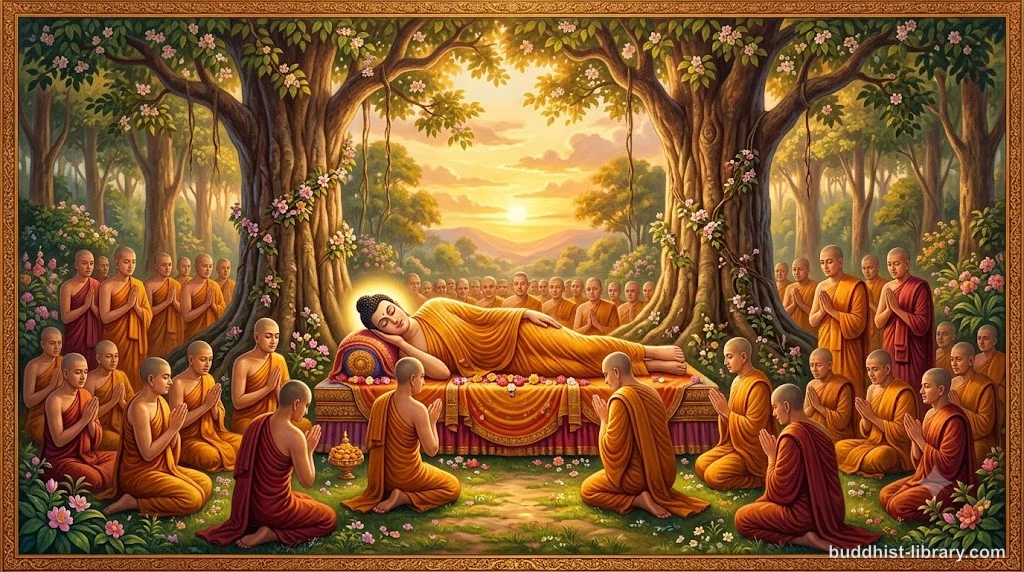
The Buddha walked to Kusinārā, a small, unremarkable town. Between two sal trees, he lay down on his right side in the “lion’s posture” and entered Parinibbāna during the early hours of the morning on the full-moon day of Vesākha (April–May).
The sutta describes the progression through meditative absorptions (jhānas) and formless attainments before the final cessation:
“And the Blessed One, passing from the first jhāna to the second… from the second to the third… from the third to the fourth… from the base of infinite space to the base of infinite consciousness… to the base of nothingness… to the base of neither-perception-nor-non-perception… to the cessation of perception and feeling. Then, emerging from cessation and reversing the process… he entered the fourth jhāna. Emerging from the fourth jhāna, he immediately passed into Parinibbāna.”
This systematic progression demonstrates that the Buddha’s passing was not passive death but a fully conscious, intentional release. He died as he lived — with perfect mindfulness and mastery over his own mind.
What were the Buddha’s last words?
The Buddha’s final utterance was:
“Behold, O monks, this is my last advice to you. All conditioned things are subject to decay. Strive on with diligence.”
(Vayadhammā saṅkhārā appamādena sampādetha)
These words hold the entire teaching:
All conditioned things are subject to decay — the truth of impermanence (anicca).
Strive on with diligence — the call to heedfulness (appamāda), the quality the Buddha repeatedly identified as the path to the Deathless.
Even in his final breath, he taught. His last words were not personal farewells or comforting reassurances. They were Dhamma, distilled.
What happened after the Buddha’s death?
The sutta details the events following the Parinibbāna:
Immediate aftermath: Ānanda and many monks wept, while the arahants — those fully enlightened — remained composed, understanding impermanence deeply. The elder Anuruddha reminded the grieving monks: “Enough, friends! Do not grieve, do not lament! Has not the Blessed One already declared that all things dear and beloved must change, separate, and become otherwise?”
Cremation: The Buddha’s body was cremated with the honors accorded to a universal monarch (cakkavatti). The funeral pyre ignited spontaneously only after the arrival of the elder Mahākassapa, who had traveled from afar to pay final respects.
Distribution of relics: The Buddha’s relics were divided into eight portions and distributed to various kingdoms and clans, who built stupas to enshrine them. This practice established the tradition of relic veneration in Buddhism, giving laypeople a tangible connection to the Buddha and creating pilgrimage sites that persist to this day.
Historical impact: The First Buddhist Council was convened at Rājagaha just three months after the Parinibbāna to preserve the Buddha’s teachings orally. The Mahāparinibbāna Sutta itself was likely compiled from eyewitness accounts and recited at this council, ensuring its preservation.
Key lessons from the Mahāparinibbāna Sutta
The sutta offers several enduring teachings:
- Impermanence is absolute: Even the Buddha’s body — the body of a perfectly enlightened being — was subject to aging, illness, and death. No conditioned phenomenon escapes anicca.
- Self-reliance in practice: The Buddha’s instruction to “be islands unto yourselves” reminds us that liberation depends on our own effort, not on a teacher’s presence.
- The Dhamma endures beyond the teacher: By refusing to appoint a successor and emphasizing the Dhamma-Vinaya as guide, the Buddha ensured that no cult of personality would replace genuine practice.
- Death as a teaching: The Buddha’s peaceful, mindful passing demonstrates that those who have eradicated craving face death without fear or suffering.
- Compassion to the end: The Buddha’s concern for Cunda’s feelings, his care in protecting disciples from tainted food, and his patient answers to final questions all exemplify unwavering compassion.
How does this sutta relate to other teachings?
The Mahāparinibbāna Sutta connects deeply to core Buddhist doctrines:
- The Three Marks of Existence: The Buddha’s death is the ultimate demonstration of anicca (impermanence), dukkha (unsatisfactoriness), and anattā (non-self). Even the Tathāgata’s form is impermanent and not-self.
- The Four Noble Truths: The sutta implicitly reinforces the First Noble Truth (dukkha) by showing that even enlightenment does not exempt one from the natural processes of aging and death — only from the suffering these processes ordinarily cause.
- Dependent Origination: The Buddha’s passing illustrates the cessation side of dependent origination — with the ending of craving and clinging, the aggregates cease to continue.
- The Satipaṭṭhāna practice: The Buddha’s mindful progression through jhānas before final cessation exemplifies perfect mindfulness applied to the death process itself.
What does Parinibbāna mean?
Parinibbāna (Sanskrit: Parinirvāṇa) literally means “complete Nibbāna” or “final Nibbāna.” While an arahant attains Nibbāna (the extinguishing of greed, hatred, and delusion) during life, Parinibbāna refers to the complete cessation that occurs at death — the ending of the five aggregates with no remainder.
Parinibbāna is not annihilation in the nihilistic sense; it is the cessation of all conditioned existence. The Buddha famously refused to answer whether a Tathāgata exists, does not exist, both, or neither after Parinibbāna, saying such questions do not lead to liberation. What matters is that Parinibbāna is the absolute end of suffering.
Frequently Asked Questions
What is the Mahāparinibbāna Sutta?
The Mahāparinibbāna Sutta (DN 16) is the longest discourse in the Pali Canon, chronicling the Buddha’s final journey, his last teachings, and his passing into Parinibbāna at age 80. It is a foundational text offering lessons on impermanence, self-reliance, and the importance of the Dhamma.
What were the Buddha’s last words?
The Buddha’s final words were: “Behold, O monks, this is my last advice to you. All conditioned things are subject to decay. Strive on with diligence” (appamādena sampādetha). This encapsulates his final teaching on impermanence and the importance of earnest practice.
What is Parinibbāna?
Parinibbāna (Parinirvāṇa in Sanskrit) refers to the “final Nibbāna” — the complete cessation of an enlightened being’s physical existence and aggregates. When the Buddha passed away, he entered Parinibbāna, ending the cycle of rebirth completely.
Why is the Mahāparinibbāna Sutta important?
This sutta is crucial because it contains the Buddha’s final instructions to his disciples, establishes guidelines for the Sangha after his death, clarifies what constitutes authentic Dhamma, and demonstrates impermanence through the passing of the fully enlightened Buddha himself.
Did the Buddha experience suffering when he died?
No. The sutta makes clear that the Buddha’s passing was peaceful and free from suffering. As a fully enlightened being, he had already eradicated the causes of suffering. His death was simply the natural cessation of the physical body, entered mindfully and with full awareness.
Where can I read the Mahāparinibbāna Sutta?
Authoritative English translations are available at SuttaCentral (Bhikkhu Sujato’s translation) and Access to Insight (Sister Vajirā and Francis Story’s translation). Maurice Walshe’s translation in The Long Discourses of the Buddha is also highly regarded.
Conclusion: The teaching that never ends
The Buddha’s physical passing was not the end. It was a continuation.
The Dhamma he taught endures, independent of his personal presence. His death was his final teaching: all things are impermanent, even the body of a Buddha. Yet impermanence itself points to liberation.
The sutta closes with an image — stupas rising over the Buddha’s relics. But those stupas are symbols, not the source. His teaching radiates outward through time and space, carried not by supernatural preservation of his body but by the practice of countless disciples who take his final words to heart.
Strive on with diligence.
Reading this sutta today, nearly 2,600 years after the events it describes, we verify its central claim. The Dhamma is timeless. The path to liberation remains open to all who walk it with heedfulness.
Read more:
- The Life of the Buddha: From Prince Siddhārtha to Awakening — understand the full arc of the Buddha’s life from birth to enlightenment, providing context for his final journey and teaching.
- What Is Nirvana (Nibbāna)? Meaning and Misconceptions — explore the meaning of Nibbāna and its relationship to Parinibbāna, clarifying what the Buddha’s final liberation entailed.
- Impermanence (Anicca): Why Everything Changes — dive deeper into the teaching of impermanence that the Buddha’s death so powerfully illustrates, and learn how to apply it in daily practice.
📖 Source / license: Dīgha Nikāya 16 (Mahāparinibbāna Sutta), translated by Maurice Walshe and Sister Vajirā & Francis Story; available at SuttaCentral and Access to Insight
Frequently asked questions
What is the Mahāparinibbāna Sutta?
The Mahāparinibbāna Sutta (DN 16) is the longest discourse in the Pali Canon, chronicling the Buddha's final journey, his last teachings, and his passing into Parinibbāna at age 80. It is a foundational text offering lessons on impermanence, self-reliance, and the importance of the Dhamma.
What were the Buddha's last words?
The Buddha's final words were: 'Behold, O monks, this is my last advice to you. All conditioned things are subject to decay. Strive on with diligence' (appamādena sampādetha). This encapsulates his final teaching on impermanence and the importance of earnest practice.
What is Parinibbāna?
Parinibbāna (Parinirvāṇa in Sanskrit) refers to the 'final Nibbāna' — the complete cessation of an enlightened being's physical existence and aggregates. When the Buddha passed away, he entered Parinibbāna, ending the cycle of rebirth completely.
Why is the Mahāparinibbāna Sutta important?
This sutta is crucial because it contains the Buddha's final instructions to his disciples, establishes guidelines for the Sangha after his death, clarifies what constitutes authentic Dhamma, and demonstrates impermanence through the passing of the fully enlightened Buddha himself.
Did the Buddha experience suffering when he died?
No. The sutta makes clear that the Buddha's passing was peaceful and free from suffering. As a fully enlightened being, he had already eradicated the causes of suffering. His death was simply the natural cessation of the physical body, entered mindfully and with full awareness.