Samatha and Vipassanā: The Two Wings of Buddhist Meditation
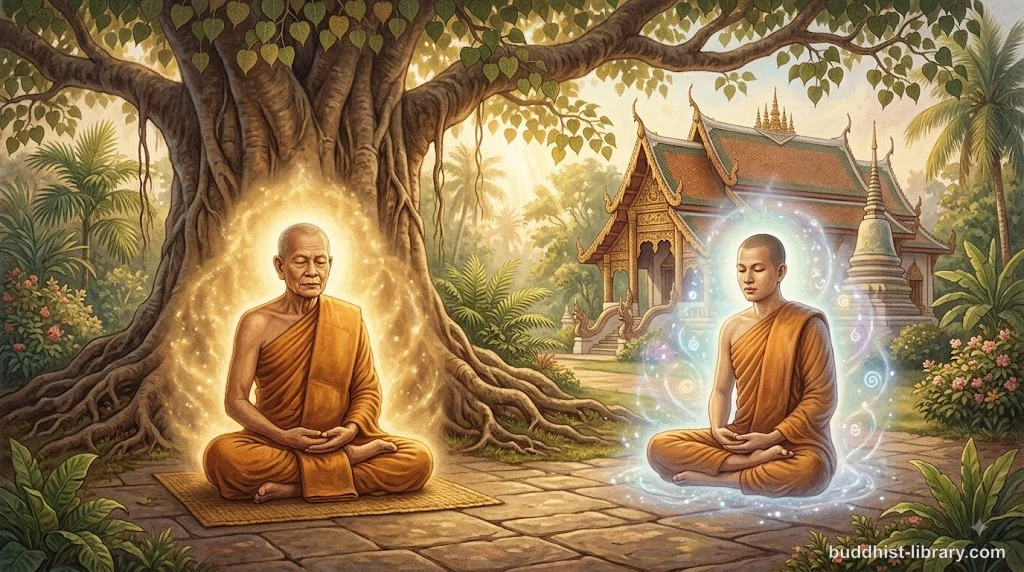
Samatha (calm, tranquility) and vipassanā (insight, clear-seeing) are the two essential wings of Buddhist meditation. Samatha develops concentration and mental stability by focusing on a single object, while vipassanā cultivates penetrative insight into the three characteristics of existence — impermanence, suffering, and non-self. Together, they form a complete path: concentration steadies the mind, insight liberates it.
Buddhist meditation is not a single technique but a family of practices organized around two complementary aims. Think of a bird: one wing represents the calm, focused power of samatha; the other, the discerning clarity of vipassanā. A bird needs both wings to fly. Similarly, a practitioner needs both qualities to reach awakening.
This distinction appears throughout the early Buddhist texts and later commentarial literature, most systematically in the Visuddhimagga (Path of Purification). Yet confusion persists. Some assume they must choose one over the other. Others practice one while dismissing the other as unnecessary. Understanding how they work together — and why both matter — is foundational to effective Buddhist practice.
What Is Samatha Meditation?
Samatha, often translated as “calm” or “tranquility,” refers to meditation that develops deep concentration (samādhi) by sustaining attention on a single object. This object might be the breath, a visual disc (kasiṇa), a color, or even a concept like loving-kindness.
The Visuddhimagga lists forty samatha objects, each suited to different temperaments. A restless person might use breath meditation to calm the mind. Someone prone to aversion might practice mettā (loving-kindness). The object itself is less important than the quality of attention it cultivates: steady, undistracted, absorbed.
When samatha deepens, it can lead to the jhānas — refined states of meditative absorption characterized by joy, bliss, equanimity, and single-pointed focus. The Buddha himself practiced and taught the jhānas, describing them as “pleasant abidings in this very life” (Majjhima Nikāya 66).
Key characteristics of samatha:
- Unifies the mind on a single object
- Calms mental proliferation and restlessness
- Develops the five jhāna factors: applied thought, sustained thought, joy, bliss, one-pointedness
- Produces temporary mental purity and tranquility
- Suppresses the hindrances (desire, aversion, sloth, restlessness, doubt)
Importantly, samatha alone does not lead to liberation. The Buddha distinguished his teaching from other contemplative traditions precisely on this point. Deep concentration, even jhāna, does not by itself uproot the underlying tendencies (anusaya) that fuel suffering. For that, insight is required.
What Is Vipassanā Meditation?
Vipassanā, meaning “clear-seeing” or “insight,” is meditation aimed at directly perceiving the true nature of phenomena. Rather than narrowing attention to a single object, vipassanā investigates the arising and passing of mental and physical events, seeing clearly their three characteristics (tilakkhaṇa):
- Anicca (impermanence) — all conditioned things arise and cease
- Dukkha (suffering, unsatisfactoriness) — clinging to what changes brings stress
- Anattā (non-self) — no phenomenon contains a permanent, independent self
The Satipaṭṭhāna Sutta (Majjhima Nikāya 10) is the foundational text for vipassanā practice. It describes mindfulness directed toward four domains: body (kāya), feelings (vedanā), mind (citta), and mental phenomena (dhamma). The practitioner observes these continuously, noting their impermanent, conditioned, and selfless nature.
Unlike samatha, which suppresses defilements temporarily, vipassanā aims to uproot them permanently by revealing the empty, constructed nature of the self and its objects. This insight (paññā) is what liberates.
Key characteristics of vipassanā:
- Investigates the nature of experience itself
- Observes arising and passing (impermanence)
- Sees the inherent unsatisfactoriness of conditioned phenomena
- Recognizes the absence of a stable self
- Leads to progressive stages of insight (ñāṇas)
- Culminates in path and fruition (magga-phala) and awakening
The Visuddhimagga describes a detailed map of insight stages, from initial “knowledge of arising and passing” through the difficult “dark night” stages to eventual equanimity and breakthrough to path. This progression is not merely philosophical but experiential — a lived transformation of perception.
How Do Samatha and Vipassanā Work Together?
The Buddha did not teach samatha and vipassanā as rival systems. He taught them as mutually supporting qualities, like the two wings of a bird or the two wheels of a cart.
Samatha prepares the ground. A scattered, agitated mind cannot see clearly. Concentration steadies attention, suppresses the five hindrances, and creates a stable platform for investigation. Even a modest level of access concentration (upacāra-samādhi) — the threshold before jhāna — provides enough clarity for insight work to begin.
Vipassanā deepens and purifies samatha. As insight matures, the mind becomes less entangled in craving and aversion. This natural purity supports deeper concentration. Advanced practitioners report that insight into non-self releases the subtle tension that limits absorption, allowing jhāna to stabilize effortlessly.
The Ānāpānasati Sutta (Majjhima Nikāya 118) shows how a single practice — mindfulness of breathing — can develop both. The sixteen steps progress from calming the body (samatha) to contemplating impermanence and relinquishment (vipassanā). The boundary between them is fluid, not rigid.
Three traditional approaches:
- Samatha-first vehicle (samatha-yānika) — develop jhāna, then emerge and apply insight to the jhāna factors themselves, seeing their constructed, impermanent nature.
- Vipassanā-first vehicle (vipassanā-yānika) — begin with direct investigation using only access concentration or momentary concentration (khaṇika-samādhi), bypassing full jhāna.
- Integrated approach — develop both in tandem, as in the Ānāpānasati Sutta or Satipaṭṭhāna Sutta.
None is superior. The Buddha tailored his instructions to individual dispositions. Some minds naturally incline toward absorption; others toward analytical clarity. What matters is that both qualities eventually mature.
Common Misconceptions About Samatha and Vipassanā
”Samatha is Hindu; vipassanā is uniquely Buddhist”
This is incorrect. Both are thoroughly Buddhist practices taught by the Buddha. The jhānas, often associated with samatha, appear in pre-Buddhist yogic traditions, but the Buddha redefined them as skillful supports for the path, not ends in themselves. Vipassanā is distinctively Buddhist in its focus on the three characteristics, but it builds on the concentration cultivated through samatha.
”You must master jhāna before starting vipassanā”
Not necessarily. While the Visuddhimagga describes a samatha-first sequence, the suttas show the Buddha teaching insight to practitioners with varying levels of concentration. The Satipaṭṭhāna Sutta does not require jhāna; it requires sustained, clear mindfulness. Some modern teachers, like Mahāsi Sayādaw and S.N. Goenka, emphasize “dry insight” — vipassanā with minimal formal samatha training.
That said, some stability is helpful. Completely scattered attention cannot sustain the continuity needed for insight to mature.
”Samatha is just relaxation; vipassanā is the real practice”
Samatha is far more than stress relief. It is a profound training in mental unification that the Buddha himself praised. The jhānas purify the mind of gross defilements and provide a taste of unconditioned happiness — a powerful motivator for practice. Dismissing samatha as “just concentration” misses its transformative potential.
At the same time, samatha without insight risks becoming mere absorption — blissful, but not liberating.
”Vipassanā and mindfulness are the same”
Not quite. Sati (mindfulness) is a mental factor present in both samatha and vipassanā. In samatha, mindfulness keeps attention anchored to the meditation object. In vipassanā, mindfulness observes the characteristics of phenomena. Mindfulness is the tool; vipassanā is the specific application of that tool toward liberating insight.
Practical Guidance: Balancing Samatha and Vipassanā
For beginners: Start with samatha to build a foundation. Even ten minutes of breath meditation daily will begin to calm the mental chaos that makes insight difficult. Learn to recognize when the mind is concentrated versus scattered. Notice the relief that comes when the hindrances quiet.
Once you can maintain continuous attention on the breath for several minutes without distraction, begin introducing vipassanā elements. Notice that the breath is not a solid thing but a process — rising, peaking, falling, pausing. Observe sensations in the body: tingling, warmth, pressure. See them arise and pass. This is the beginning of insight.
For intermediate practitioners: Experiment with different balances. Some sessions might be purely samatha — deepening jhāna or access concentration. Others might emphasize investigation — scanning the body, noting mental states, observing the three characteristics. Notice which quality is weaker and give it more attention. If your mind is restless and scattered, emphasize samatha. If you’re getting stuck in pleasant absorption without progress, lean toward vipassanā.
For advanced practitioners: At mature stages, samatha and vipassanā integrate naturally. Concentration arises effortlessly because craving has weakened. Insight deepens because the mind is stable and luminous. The Visuddhimagga describes practitioners who can enter jhāna, emerge, and immediately investigate its factors with vipassanā, seeing them disintegrate into impermanent processes. This is the unified path in action.
Key points for practice:
- Don’t rigidly separate the two. Let them inform each other.
- Use samatha when the mind is agitated or dull.
- Use vipassanā when concentration is stable but insight feels stagnant.
- Pay attention to the three characteristics in all states, including jhāna.
- Remember the goal: not just calm or clarity, but liberation through wisdom.
Read more:
- Right Concentration (Sammā Samādhi): The Eighth Factor of the Noble Path — a detailed exploration of concentration in the Eightfold Path and its role in awakening.
- What Are the Jhānas? Understanding Meditative Absorption in Buddhism — a complete guide to the jhānic states, their characteristics, and their place in practice.
- The Satipaṭṭhāna Sutta: Foundations of Mindfulness Explained — the foundational discourse on the four establishments of mindfulness and the development of insight.
Conclusion: Two Wings, One Path
Samatha and vipassanā are not rival methods competing for your allegiance. They’re complementary dimensions of a single transformative process. Concentration without insight becomes stagnation. Insight without concentration becomes intellectual speculation. Together, they form the path the Buddha walked and taught.
The Buddha’s image in the Dhammapada (verse 282) is apt: “From meditation arises wisdom; without meditation, wisdom wanes. Knowing this twofold path of progress and decline, one should so conduct oneself that wisdom grows.”
Whether you begin with calm or insight, whether you emphasize one more than the other, eventually both must mature. The mind that is both concentrated and wise — samādhi and paññā unified — is the mind that sees clearly, releases fully, and awakens completely.
Start where you are. Practice both. Let them support each other. And trust the process that countless practitioners before you have walked to freedom.
📖 Source / license: Visuddhimagga (Path of Purification) by Buddhaghosa; The Satipaṭṭhāna Sutta (MN 10); Access to Insight; Ṭhānissaro Bhikkhu's teachings
Frequently asked questions
Can I practice vipassanā without samatha?
While pure insight practice is possible, most teachers recommend developing some degree of concentration first. Even basic samatha provides the mental stability needed for effective insight work.
Are samatha and vipassanā completely separate practices?
No. They work together and support each other. Concentration stabilizes the mind for insight, while insight deepens and purifies concentration. The Buddha taught them as complementary, not competing.
Which should I practice first — samatha or vipassanā?
Traditionally, samatha comes first to establish a stable foundation. However, some teachers integrate both from the beginning. The Ānāpānasati Sutta shows how mindfulness of breathing can develop both simultaneously.
What is the difference between samatha jhāna and vipassanā jhāna?
Samatha jhānas are absorbed states of deep concentration on a single object. Vipassanā uses lighter concentration to examine the three characteristics of phenomena. Both lead to calm, but vipassanā specifically aims at liberating insight.