What Is the Tathāgata? Understanding the Buddha's Self-Reference
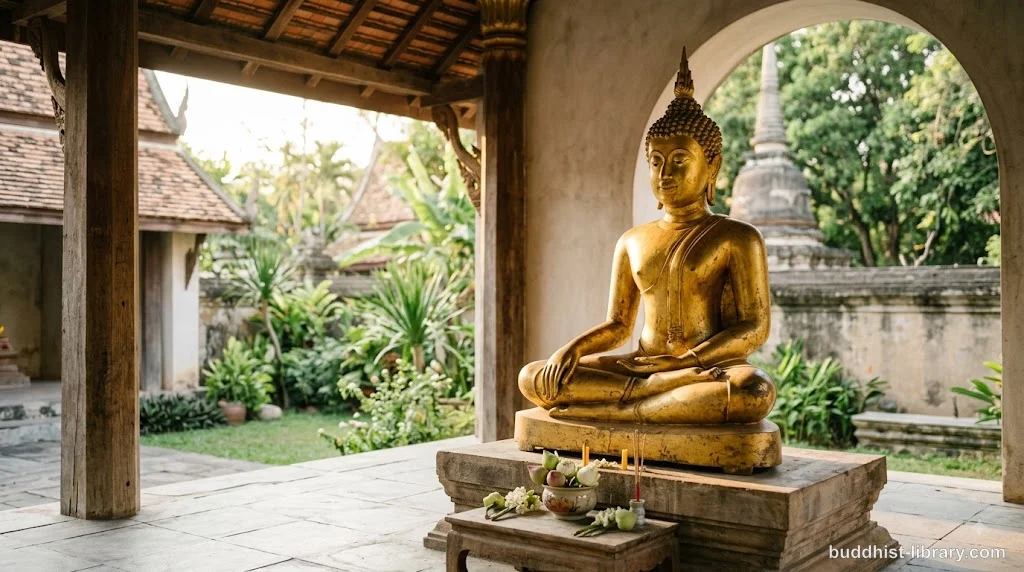
The term “Tathāgata” (Pāli: Tathāgata; Sanskrit: Tathāgata) is the Buddha’s most distinctive self-reference—a word that points beyond personal identity to the nature of awakening itself. It literally means “thus-gone” or “thus-come,” indicating one who has realized ultimate truth and crossed beyond the cycle of birth and death. Understanding this term reveals how the Buddha conceived of enlightenment not as a personal achievement but as the discovery of a timeless reality.
When you read the early Buddhist texts, you’ll notice something odd. The Buddha rarely says “I.”
Instead, he refers to himself as “the Tathāgata”—a peculiar third-person designation that has puzzled translators and practitioners for centuries. This isn’t humility. It’s not poetic license. It’s a precise teaching device embedded in language itself.
What Does Tathāgata Mean Literally?
The Pāli word Tathāgata is a compound that can be parsed two ways:
- Tathā-gata: “thus-gone” (from tathā = thus, such + gata = gone)
- Tathā-āgata: “thus-come” (from tathā = thus + āgata = come)
Both readings are grammatically valid, and the Buddha never resolved the ambiguity. Commentators have read it both ways. Many teachers see the double meaning as a linguistic kōan built into the Buddha’s self-designation.
“Thus-gone” emphasizes departure from saṃsāra, the cycle of rebirth. The awakened one has “gone” beyond craving, ignorance, and all conditioned states.
“Thus-come” suggests arrival at truth—realizing things “as they are” (yathābhūtaṃ). This reading fits passages where the Buddha describes seeing reality directly, without the distortions of craving and ignorance.
The genius? The term transcends the duality it seems to invoke. Neither coming nor going. A state beyond movement and stasis altogether.
Why Did the Buddha Use This Term?
In the Aggi-Vacchagotta Sutta (MN 72), the wanderer Vacchagotta asks the Buddha directly: “Where does the Tathāgata reappear after death?”
The Buddha’s response is striking. He refuses all four options: the Tathāgata reappears, does not reappear, both, or neither.
Why? Because every answer depends on clinging to concepts of existence and non-existence—the very clinging that awakening dissolves.
Traditional interpretations hold that by using “Tathāgata” instead of “I” or “Gotama,” the Buddha:
- Avoided reinforcing the illusion of self (attā). Personal pronouns imply a persistent “I” that the Dhamma denies.
- Pointed to the impersonal nature of awakening. Tathāgata is not a person but a state—anyone who fully awakens becomes “one who has thus gone.”
- Unified teaching and reality. The term itself enacts the teaching of non-self (anattā) and the ungraspability of Nibbāna.
In the Mahāparinibbāna Sutta (DN 16), the dying Buddha tells Ānanda: “The Tathāgata has no teacher’s fist”—keeping nothing secret. Here, “Tathāgata” emphasizes the transparency and completeness of his teaching, not the personality of Gotama.
Tathāgata in the Suttas: Key Passages
The Brahmajāla Sutta (DN 1)
The Buddha opens this foundational sutta by explaining that when people praise or criticize “the Tathāgata,” they focus on trivial details (his conduct, his renunciation) but miss the profound Dhamma he teaches. The term here creates distance between the historical person and the teaching itself—it’s the Dhamma that matters, not Gotama’s biography.
The Questions of Upasīva (Sutta Nipāta 1076)
Upasīva asks: “How should one regard the Tathāgata who has attained the goal?”
The Buddha replies: “There is no measure of one who has gone to peace. That by which they would speak of him exists for him no more. When all phenomena are removed, all ways of speaking are removed.”
Here, “Tathāgata” names the ineffable—what remains when all concepts, even existence and non-existence, fall away.
The Accharāsaṅghāta Sutta (MN 123)
The Buddha describes how the Tathāgata’s body is maintained by will even after he has abandoned the conditioned force of life. This shows the term applied to the living Buddha in a state of awakening that transcends ordinary biological life.
Tathāgata vs. Buddha: What’s the Difference?
Both terms refer to the same awakened being, but with different emphases:
| Term | Emphasis | Usage |
|---|---|---|
| Buddha | The awakened one; the teacher | Often used by others speaking about him |
| Tathāgata | The thus-gone/thus-come; the state of awakening | Often used by the Buddha speaking as the awakened state |
“Buddha” (from budh, to awaken) highlights the act of awakening and the role of teacher. “Tathāgata” highlights the nature of that awakening—its alignment with truth, its transcendence of personal identity.
In practice, the Buddha used both interchangeably. But notice where “Tathāgata” appears most: in contexts explaining the deepest aspects of Nibbāna, the limits of conceptual thought, the impossibility of grasping the awakened state with an unawakened mind. The term itself performs what it names—it points beyond the personal to the unconditioned.
Can Anyone Become a Tathāgata?
This question touches on the distinction between a Buddha (a fully self-awakened teacher) and an Arahant (one awakened by following the Buddha’s teaching).
In the strict sense, “Tathāgata” refers to a Sammāsambuddha—one who rediscovers the Dhamma without a teacher and teaches it to the world. By that definition, there is only one Tathāgata per era when the Dhamma is forgotten.
However, in a broader sense, the qualities of the Tathāgata—complete liberation, direct knowledge of reality, the end of craving—are not exclusive to Gotama. Any Arahant embodies the same freedom. The difference is pedagogical role, not depth of realization.
As Bhikkhu Bodhi notes in his translation of the Majjhima Nikāya: “The term Tathāgata underscores that awakening is not a personal possession but the realization of an impersonal truth.”
Why This Matters for Practice
Understanding “Tathāgata” is not academic. It has direct implications:
-
It models non-self in speech. If the fully awakened Buddha avoided “I,” practitioners can practice relinquishing personal pronouns in meditation, noticing how deeply identification with “I” runs.
-
It points to the goal without reifying it. The Tathāgata is not a being you become; it’s a state you realize by letting go of becoming. The term itself teaches the Middle Way between eternalism and annihilationism.
-
It reminds us the Dhamma is universal. Gotama is gone. But the truth the Tathāgata taught—the Four Noble Truths, the Eightfold Path—remains accessible. We practice to realize what he realized, not to worship who he was.
Key Points
- Tathāgata means “thus-gone” or “thus-come”—one who has realized ultimate truth.
- Many scholars understand this term as a way to avoid reinforcing the illusion of a permanent self. It’s a teaching device as much as a title.
- Tathāgata emphasizes the impersonal nature of awakening—a state, not a person.
- The term appears in contexts discussing Nibbāna and the limits of conceptual thought, pointing to what cannot be grasped by ordinary language.
- All Arahants share the Tathāgata’s liberation, though only a Buddha holds the role of rediscoverer and teacher of the Dhamma.
Conclusion
The Tathāgata is neither a person nor an absence.
It’s the mode of being that arises when clinging ceases. When the illusion of self is seen through. When reality is known “as it is.” The Buddha’s use of this term was his final teaching on non-self—enacted in every conversation, every sutta, every moment he refused to claim “I am.”
When we study the Dhamma, we’re not learning about a man named Gotama. We’re learning from the Tathāgata—the impersonal truth realized in that life and available in ours.
The path he walked is here. The freedom he found is possible. The “thus” he spoke from is waiting, not in some distant realm, but in the direct seeing of this very moment.
Read more:
- Anattā (Non-Self): What the Buddha Really Meant — Understand the foundational teaching that makes “Tathāgata” necessary: there is no unchanging self to awaken, only the awakening itself.
- What Is Nirvana (Nibbāna)? Meaning and Misconceptions — Explore the state the Tathāgata has “gone to”—the unconditioned, the deathless, beyond all concepts of coming and going.
- The Life of the Buddha: From Prince Siddhārtha to Awakening — See the historical context of the man who became the Tathāgata and why he chose this enigmatic self-reference.
📖 Source / license: Dīgha Nikāya (DN 1, DN 16), Majjhima Nikāya (MN 72), SuttaCentral, Access to Insight
Frequently asked questions
Why did the Buddha call himself Tathāgata instead of using 'I'?
Many Buddhist teachers understand 'Tathāgata' as a way to avoid reinforcing the notion of a permanent self. It emphasizes the impersonal nature of awakening—a state anyone can realize, not tied to a particular person or personality.
Does Tathāgata mean 'thus-gone' or 'thus-come'?
Both interpretations are valid in Pāli. Tathā-gata means 'thus-gone' (one who has gone to truth), while tathā-āgata means 'thus-come' (one who has come to truth). Many scholars read this ambiguity as pointing to the transcendence of concepts.
Can anyone become a Tathāgata?
In the earliest texts, Tathāgata specifically refers to a fully enlightened Buddha who rediscovers the Dhamma independently. However, the qualities of a Tathāgata—liberation, wisdom, compassion—are accessible to all who follow the path.
Is the Tathāgata the same as the Buddha?
Yes, Tathāgata is one of the epithets the historical Buddha used for himself. It emphasizes the awakened state rather than the person Siddhattha Gotama.