What Are the Jhānas? Understanding Meditative Absorption in Buddhism
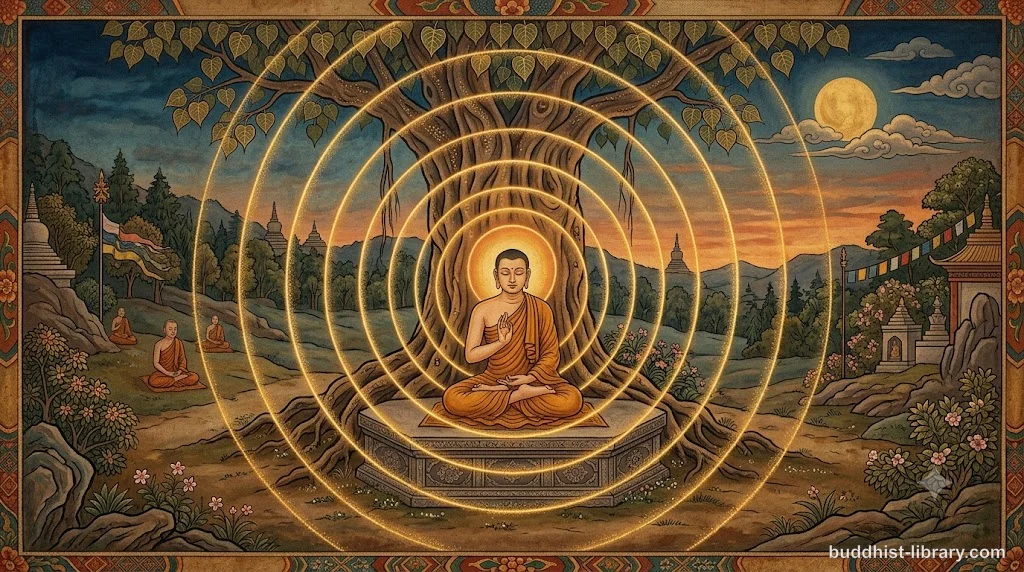
The jhānas are progressive states of meditative absorption where the mind becomes deeply unified, tranquil, and refined. Described in the earliest Buddhist texts, they represent stages of concentration marked by specific mental factors—moving from thought-based stillness through increasingly subtle levels of bliss, equanimity, and spaciousness. The Buddha himself practiced and taught jhāna as a crucial support for insight and liberation.
What Are the Jhānas?
The word jhāna (Pali) or dhyāna (Sanskrit) means “meditation” or “absorption.” In Buddhist practice, it refers to specific states of deep mental unification achieved through sustained concentration.
The Buddha himself discovered jhāna as a child. Sitting under a rose-apple tree, he spontaneously entered the first jhāna—an experience he later recognized as pointing toward the path to awakening.
Ordinary concentration? The mind still wanders, requiring constant effort to maintain focus. Jhāna is different. The mind settles into its object with minimal exertion, the five hindrances (sensory desire, ill will, sloth and torpor, restlessness and worry, doubt) temporarily cease, and distinct wholesome mental factors arise. This isn’t a trance or blank state. Awareness remains bright and clear, but the mind’s usual scattering activity stills.
The Pali Canon describes primarily four material jhānas (rūpa-jhāna), followed by four immaterial attainments (arūpa-jhāna or āyatana). Each represents progressively subtler refinement of consciousness. While advanced meditation literature details eight total stages, the four foundational jhānas form the core practice most commonly discussed.
The Four Jhānas: A Progression of Absorption
First Jhāna: Thought, Joy, and Bliss
The first jhāna arises when the five hindrances have been suppressed and the mind unifies around its meditation object—often the breath. Five characteristic factors are present:
- Vitakka (applied thought): directing attention to the object
- Vicāra (sustained thought): keeping attention connected
- Pīti (rapture/joy): energetic pleasure, often physically palpable
- Sukha (happiness/bliss): a softer, more pervasive well-being
- Ekaggatā (one-pointedness): unification of mind
The first jhāna still includes thinking (vitakka and vicāra), but thought becomes refined. No longer discursive planning or commentary—just a gentle application and sustaining of attention.
Pīti can manifest as waves of energy, tingling, or bodily rapture. Many practitioners describe it as deeply refreshing, like the mind finally getting rest it didn’t know it needed.
The Sāmaññaphala Sutta (DN 2) offers a vivid simile: a skilled bath attendant mixes soap powder with water until it forms a cohesive ball, saturated throughout but not dripping—just as the body becomes suffused with joy and bliss born of seclusion.
Second Jhāna: Joy and Bliss Without Thought
As concentration deepens, even the subtle activity of vitakka and vicāra feels like disturbance. When they’re abandoned, the second jhāna arises—characterized by:
- Pīti (rapture)
- Sukha (happiness)
- Ekaggatā (one-pointedness)
Thought subsides entirely.
The mind settles into stillness, and a quality called ajjhattaṃ sampasādanaṃ (internal confidence or tranquility) emerges—a deep trust in the process, free from the need to manage or direct. Concentration becomes nearly effortless.
The simile: a lake fed by an underground spring, with no external inlet. Cool water wells up from within and pervades the entire lake. Similarly, joy and bliss born of concentration saturate the meditator’s experience from within.
Many practitioners report the second jhāna as smoother and more stable than the first. The energetic quality of pīti remains, but without the “doing” quality of applied thought, the absorption feels self-sustaining.
Third Jhāna: Equanimous Bliss
With repeated entry into the second jhāna, even the energized joy of pīti can seem coarse. When pīti fades, the third jhāna emerges—characterized by:
- Sukha (happiness, now more refined)
- Ekaggatā (one-pointedness)
- Upekkhā (equanimity): balanced, even awareness
Here, the intense rapture settles into a profound contentment and equanimity. Mindfulness (sati) and clear comprehension (sampajañña) become especially prominent. The Buddha described this jhāna as one the noble ones describe as “dwelling in pleasure, equanimous and mindful.”
The simile: blue, red, or white lotuses born in water, growing in water, not rising above it, but nourished from root to tip by cool water—so too the meditator is suffused with bliss divested of rapture.
Many traditions consider the third jhāna exceptionally stable and conducive to insight practice. The quality of sukha here is less affective than in earlier jhānas—more like deep well-being than excited pleasure.
Fourth Jhāna: Pure Equanimity
When even the subtle happiness of the third jhāna is relinquished, the fourth jhāna arises—the most refined of the material absorptions:
- Upekkhā (equanimity)
- Ekaggatā (one-pointedness)
Pleasure and pain, joy and sorrow—all have ceased. What remains is bright, clear awareness neither leaning toward pleasure nor pulling away from pain. Breathing becomes so subtle it may seem to stop entirely (passaddhikāya-saṅkhāra). This jhāna is described as having sati-pārisuddhiṃ—purity of mindfulness due to equanimity.
The simile: a person sitting wrapped from head to foot in a clean white cloth, with no part of the body untouched—so the mind is enveloped in pure, bright awareness.
The fourth jhāna serves as the foundation for developing higher knowledges (abhiññā) such as recollection of past lives, the divine eye, and most importantly, the insight that leads to liberation. The Buddha famously attained awakening from the base of the fourth jhāna.
How to Develop Jhāna: The Prerequisites
Jhāna doesn’t arise from concentration alone. The classical path describes essential supports:
Ethical Conduct (Sīla)
The five precepts form the foundation. When conduct is aligned with non-harming, the mind naturally experiences less remorse, worry, and agitation—conditions that block concentration. The Buddha repeatedly emphasized that jhāna grows from virtue.
Seclusion and Suitable Conditions
While not everyone can ordain or undertake intensive retreat, progress accelerates with:
- Reduced sensory stimulation
- Minimal social obligations during practice periods
- A quiet, safe environment
- Teacher guidance when available
Even short retreats (3–10 days) provide conditions that support deeper states than typical home practice allows.
Working with the Hindrances
The five hindrances are direct obstacles to jhāna:
- Sensory desire: longing for pleasant sights, sounds, tastes, touches, or ideas
- Ill will: aversion, irritation, resentment
- Sloth and torpor: dullness, sleepiness, lack of energy
- Restlessness and worry: agitation, anxiety, mental restlessness
- Doubt: uncertainty about the practice, the teaching, or one’s ability
Each hindrance has specific antidotes. For example, mettā (loving-kindness) counters ill will; recollection of inspiring qualities counters sloth; mindfulness of the body grounds restlessness. Jhāna becomes accessible when these five have been—at least temporarily—abandoned.
Choosing a Meditation Object
The Visuddhimagga lists forty classical meditation subjects (kammaṭṭhāna), but the breath (ānāpānasati) remains most widely taught. Other suitable objects include:
- Kasiṇas (colored disks or visualized elements)
- Body contemplation (kāyagatāsati)
- Brahmavihāras (loving-kindness, compassion, appreciative joy, equanimity)
The object should match the meditator’s temperament and become familiar through consistent practice. Stability with one object deepens concentration more effectively than switching frequently.
Access Concentration (Upacāra-samādhi)
Before first jhāna, practitioners typically experience access concentration—a threshold state where:
- The breath or object becomes vivid and absorbing
- Peripheral awareness dims
- The nimitta (mental sign or light) may appear
- Hindrances weaken significantly but aren’t fully abandoned
- Pleasant sensations and mental clarity arise
This isn’t jhāna yet—thought still occurs, and stability isn’t complete—but it’s the doorway. With patient practice, access concentration naturally matures into first jhāna.
Common Misconceptions About Jhāna
”Jhāna Is Only for Advanced Practitioners”
Wrong. While jhāna represents refined concentration, it’s not inherently beyond reach.
The Buddha taught jhāna to laypeople, including newly ordained monks. What’s required is proper conditions, instruction, and sustained effort—not decades of practice. Many contemporary teachers report students accessing first jhāna within intensive retreat settings.
”You Need Supernatural Experiences or Visions”
Jhāna is natural—a capacity latent in every human mind when conditions align. While unusual phenomena (lights, sounds, energetic sensations) may accompany deepening concentration, they’re not jhāna itself. The defining characteristics are the mental factors and the quality of unification, not flashy experiences.
”Jhāna Is Escapism”
Critics sometimes portray jhāna as blissful avoidance of reality. They’re missing the point.
The Buddha explicitly taught jhāna as a support for insight, not an end in itself. The stability, clarity, and mental pliability developed through jhāna provide an ideal foundation for investigating the three characteristics (impermanence, suffering, non-self) and penetrating the nature of experience.
Jhāna sharpens the tool. Insight uses that tool for liberation.
”All Concentration States Are Jhāna”
Simply having good focus or experiencing pleasant meditation doesn’t qualify as jhāna. The texts describe specific factors and a particular quality of unification and ease. Many practitioners experience near-jhāna states—stable, pleasant, but without full factor development. While valuable, these preliminary states differ from classical jhāna.
Jhāna in Different Buddhist Traditions
Theravāda: Foundation or Option?
Theravāda preserves the most detailed jhāna teachings from the Pali Canon, but approaches differ:
- Pa Auk Sayadaw tradition: Treats jhāna mastery as essential, systematically training meditators through all eight jhānas before insight practice
- Mahasi Sayadaw tradition: Emphasizes vipassanā (insight) from the start, viewing jhāna as optional or even potentially distracting
- Ajahn Chah lineage: Values jhāna as a natural outgrowth of practice but doesn’t make it a formal requirement
This internal debate—whether jhāna is necessary for awakening—continues. The suttas suggest the Buddha himself relied on jhāna, and many passages link jhāna to the path, but some argue momentary concentration (khaṇika-samādhi) suffices.
Mahāyāna: Different Terminology, Similar States
Mahāyāna texts describe dhyāna (Sanskrit form of jhāna) but often integrate it within broader practices:
- Zen: Emphasizes zazen (sitting meditation), which can involve deep absorption states, though formal jhāna stages aren’t highlighted. Kōan practice or shikantaza (just sitting) may lead to unified mind states equivalent to jhāna.
- Pure Land: Concentrative recitation of Amitābha Buddha’s name can produce absorbed states similar to jhāna factors.
- Tibetan Buddhism: Shamatha (calm-abiding) practice develops single-pointed concentration corresponding to jhāna-like absorption, though terminology and framework differ (e.g., nine stages of shamatha). Deity yoga practices may incorporate absorptive states.
The underlying experiences—mental unification, specific factors, progressive refinement—appear across traditions, even when frameworks and goals diverge.
Jhāna and the Path to Awakening
The Buddha didn’t teach jhāna for its own sake. While the states are profoundly peaceful—offering temporary relief from suffering and a preview of release—they’re not liberation. Jhāna belongs to the samatha (tranquility) side of practice, which must be balanced with vipassanā (insight).
From the stability of jhāna—especially the fourth—the mind is optimally positioned to investigate reality. The Ānāpānasati Sutta (MN 118) describes breath meditation culminating in jhāna, then using that concentrated awareness to contemplate impermanence, dispassion, and cessation. Similarly, the Satipaṭṭhāna Sutta frames mindfulness practice in ways that naturally develop both concentration and insight.
Awakened disciples like Sāriputta and Moggallāna were described as jhāna masters. The Buddha’s own awakening unfolded from the foundation of the fourth jhāna. While debate persists about whether jhāna is strictly necessary, the texts consistently present it as the optimal support—a mind purified of hindrances, unified, pliant, and bright is far better equipped to see reality clearly than one scattered and reactive.
Key Takeaways
- Jhāna = meditative absorption: progressive states of deep mental unification described in the earliest Buddhist texts
- Four primary jhānas: each marked by specific factors, moving from thought-based joy through refined equanimity
- Not mystical, but natural: accessible given proper conditions (ethics, seclusion, teacher, sustained practice)
- Requires addressing hindrances: sensory desire, ill will, dullness, restlessness, and doubt must be temporarily abandoned
- Supports insight: jhāna creates the mental stability and clarity ideal for penetrating the nature of experience
- Emphasis varies by tradition: from essential (Pa Auk) to optional (Mahasi) to implicit (Zen, Tibetan shamatha)
- Not the goal, but a powerful support: jhāna refines the tool; wisdom uses it to cut the roots of suffering
Frequently Asked Questions
Can anyone reach jhāna, or is it only for monks?
Jhāna is accessible to anyone with sufficient dedication and proper guidance. While traditional Buddhist monastics have advantages—uninterrupted practice time, minimal distractions, and direct teacher access—lay practitioners throughout history have attained jhāna. The key factors are consistent daily practice, ethical conduct as a foundation, and patient cultivation of concentration. Many contemporary meditation teachers report lay students reaching at least the first jhāna with dedicated retreat practice.
How long does it take to reach the first jhāna?
There’s no fixed timeline—it varies dramatically by individual. Some dedicated practitioners report jhāna access within weeks of intensive retreat practice, while others practice for years. Factors include natural concentration ability, quality of instruction, consistency of practice, life circumstances, and how well the five hindrances have been addressed. Retreat settings with 6–8 hours of daily practice tend to accelerate progress compared to home practice. The Buddha emphasized patient effort without fixation on results.
Are jhāna and samādhi the same thing?
They’re closely related but not identical. Samādhi refers to the broader quality of mental unification or concentration—a spectrum from momentary focus to deep absorption. Jhāna specifically denotes refined states of absorption characterized by distinct mental factors and sustained stability. You can have samādhi without jhāna (like access concentration), but jhāna always involves samādhi. Think of samādhi as the general capacity for concentrated attention, and jhāna as particular plateaus of that capacity developed to high degrees.
Do all Buddhist traditions emphasize jhāna practice?
No—emphasis varies considerably. Theravāda traditions, especially those following the Pali Canon closely, often treat jhāna as central to the path. Zen tends to de-emphasize formal jhāna stages in favor of just sitting (shikantaza) or koan practice, though deep absorption states can arise. Tibetan traditions incorporate jhāna-like states within deity yoga and other practices but use different terminology. Even within Theravāda, some teachers (like Mahasi Sayadaw) emphasize insight over deep concentration, while others (like Pa Auk Sayadaw) make jhāna foundational. The debate continues about whether jhāna is necessary for awakening.
Concentration as Support, Not Substitute
The jhānas represent one of the Buddha’s most distinctive contributions to meditation practice—a systematic map of concentration states that countless practitioners have verified across 2,500 years.
They’re not exotic or supernatural. They’re natural capacities of the human mind revealed when the right conditions converge.
For those drawn to deep practice, jhāna offers both immediate refuge—periods of profound peace and well-being—and long-term support for insight. The concentrated, pliant, bright mind emerging from jhāna is uniquely positioned to investigate experience and uproot the causes of suffering.
But here’s what matters: the Buddha’s final teaching wasn’t “enter jhāna and abide there.” It was to investigate reality with diligence until freedom is realized.
Jhāna is a powerful ally on that journey. Wisdom—seeing clearly how things are—remains the liberating factor.
Read more:
- What Is Samādhi? Understanding Concentration in Buddhist Meditation — Explore the broader spectrum of concentration, from momentary focus to deep absorption, and how samādhi supports both tranquility and insight practices.
- The Satipaṭṭhāna Sutta: Foundations of Mindfulness Explained — Discover how the Buddha’s core mindfulness teaching integrates concentration and insight, providing the framework within which jhāna and wisdom work together on the path to awakening.
- How to Start Buddhist Meditation: A Beginner’s Guide — If you’re new to meditation and curious about developing the foundational skills that eventually lead to jhāna, this practical guide covers essential techniques, posture, and common obstacles for beginners.
📖 Source / license: Sāmaññaphala Sutta (DN 2, SuttaCentral); Visuddhimagga IV–V (Buddhaghosa); Ānāpānasati Sutta (MN 118); Ṭhānissaro Bhikkhu, 'With Each and Every Breath' (dhammatalks.org)
Frequently asked questions
Can anyone reach jhāna, or is it only for monks?
Jhāna is accessible to anyone with sufficient dedication and proper guidance. While traditional Buddhist monastics have advantages—uninterrupted practice time, minimal distractions, and direct teacher access—lay practitioners throughout history have attained jhāna. The key factors are consistent daily practice, ethical conduct as a foundation, and patient cultivation of concentration. Many contemporary meditation teachers report lay students reaching at least the first jhāna with dedicated retreat practice.
How long does it take to reach the first jhāna?
There's no fixed timeline—it varies dramatically by individual. Some dedicated practitioners report jhāna access within weeks of intensive retreat practice, while others practice for years. Factors include natural concentration ability, quality of instruction, consistency of practice, life circumstances, and how well the five hindrances have been addressed. Retreat settings with 6–8 hours of daily practice tend to accelerate progress compared to home practice. The Buddha emphasized patient effort without fixation on results.
Are jhāna and samādhi the same thing?
They're closely related but not identical. Samādhi refers to the broader quality of mental unification or concentration—a spectrum from momentary focus to deep absorption. Jhāna specifically denotes refined states of absorption characterized by distinct mental factors and sustained stability. You can have samādhi without jhāna (like access concentration), but jhāna always involves samādhi. Think of samādhi as the general capacity for concentrated attention, and jhāna as particular plateaus of that capacity developed to high degrees.
Do all Buddhist traditions emphasize jhāna practice?
No—emphasis varies considerably. Theravāda traditions, especially those following the Pali Canon closely, often treat jhāna as central to the path. Zen tends to de-emphasize formal jhāna stages in favor of just sitting (shikantaza) or koan practice, though deep absorption states can arise. Tibetan traditions incorporate jhāna-like states within deity yoga and other practices but use different terminology. Even within Theravāda, some teachers (like Mahasi Sayadaw) emphasize insight over deep concentration, while others (like Pa Auk Sayadaw) make jhāna foundational. The debate continues about whether jhāna is necessary for awakening.