What Is Avijjā? The Root of Suffering in Buddhism
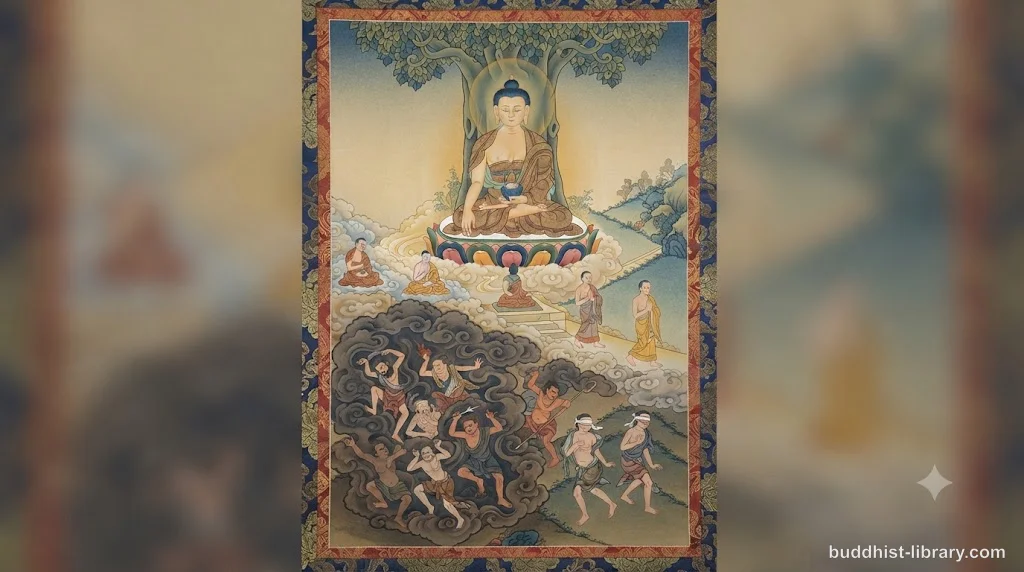
Avijjā—often translated as ignorance—is the fundamental misunderstanding of reality that the Buddha identified as the root cause of all suffering. It’s not merely not knowing; it’s actively misconstruing the nature of existence, mistaking the impermanent for permanent, suffering for happiness, and non-self for self. This deep delusion keeps us bound to the cycle of rebirth (saṃsāra) and drives every form of craving and clinging.
What Does Avijjā Mean in Pali?
The Pali word avijjā (Sanskrit: avidyā) literally means “non-knowledge” or “absence of knowing.”
But that translation misleads. It suggests ordinary not-knowing—the kind where you can’t fix a car or solve a math problem. Avijjā is different.
In Buddhist psychology, it refers specifically to ignorance of the Four Noble Truths:
- Not understanding suffering (dukkha)
- Not understanding the origin of suffering (craving)
- Not understanding the cessation of suffering (nibbāna)
- Not understanding the path to the cessation of suffering (the Noble Eightfold Path)
The Sammādiṭṭhi Sutta (MN 9) defines avijjā as “not knowing suffering, not knowing the origin of suffering, not knowing the cessation of suffering, not knowing the way leading to the cessation of suffering.”
This isn’t theoretical ignorance. It’s an active distortion—we see the world through a filter that inverts reality.
Why Is Avijjā the Root Cause of Suffering?
In the Buddha’s teaching on dependent origination (paṭiccasamuppāda), avijjā occupies the first position:
“With ignorance as condition, volitional formations arise…”
—Nidāna Saṃyutta (SN 12.2)
This doesn’t mean ignorance came first in time. The Buddha rejected questions about the absolute beginning of saṃsāra as unhelpful.
Rather, avijjā is the primary condition that enables the entire cycle of suffering. Here’s why:
It Generates Wrong View
When we don’t see the Three Marks of Existence—impermanence (anicca), suffering (dukkha), and non-self (anattā)—we naturally adopt wrong views:
- We cling to things as if they were permanent
- We chase experiences believing they’ll bring lasting happiness
- We construct and defend a sense of self that doesn’t exist in the way we imagine
It Fuels Craving (Taṇhā)
Ignorance creates the conditions for craving.
If we truly understood that phenomena are impermanent and incapable of providing lasting satisfaction, we wouldn’t grasp at them with such desperation. But we don’t see clearly. So we keep reaching for what cannot fulfill us.
It Drives Karmic Formations
Ignorance shapes our intentions and actions (saṅkhāra). Without understanding cause and effect, we act in ways that produce suffering for ourselves and others—then wonder why life feels hard.
How Does Avijjā Manifest in Daily Life?
Avijjā isn’t abstract. It shows up every day—in ways you might not recognize as ignorance at all:
In relationships: You believe another person can complete you or make you permanently happy. When they inevitably change or the relationship ends, suffering arises—not because relationships are bad, but because the expectation was built on ignorance.
In career: You chase success thinking, “Once I get that promotion, I’ll finally be content.” You get it, feel satisfied for a week, then the mind starts hunting for the next thing. The pattern repeats because the underlying ignorance—that external achievements can provide lasting peace—was never examined.
In self-image: You construct an identity—“I am a successful person,” “I am spiritual,” “I am a failure”—and defend it fiercely. When reality contradicts that story, you suffer. The ignorance lies in taking these mental constructs as solid, permanent truths.
In reactions to pain: When physical or emotional pain arises, ignorance makes you believe it’s permanent (“This will never end”) or personal (“Why is this happening to me?”). Both views amplify suffering.
What Avijjā Is Not
Common misunderstandings need clearing up:
- Not lack of education: A person can have multiple degrees and still be steeped in avijjā if they don’t understand the Four Noble Truths. Academic knowledge and wisdom are different things.
- Not stupidity: Intelligence and ignorance in the Buddhist sense are unrelated. Brilliant people can be profoundly ignorant of the nature of suffering.
- Not doubt: Healthy skepticism (vicikicchā, when constructive) differs from ignorance. Avijjā is confidence in the wrong things—certainty that the self is real, that phenomena are permanent.
How Is Avijjā Overcome?
The opposite of avijjā is vijjā (knowledge) or paññā (wisdom). The Buddha’s entire teaching aims to replace ignorance with direct understanding.
Through Right View (Sammā Diṭṭhi)
The first factor of the Noble Eightfold Path, Right View, is understanding:
- The law of kamma (actions have consequences)
- The Four Noble Truths
- The Three Marks of Existence
This isn’t intellectual belief—it’s seeing reality clearly through meditation and investigation.
Through Insight Meditation (Vipassanā)
Vipassanā practice directly addresses ignorance by cultivating moment-to-moment awareness of:
- Anicca: Observing how sensations, thoughts, and emotions constantly arise and pass
- Dukkha: Noticing the subtle stress in trying to hold onto or push away experience
- Anattā: Seeing that there’s no stable, independent self behind these processes
When you sit in meditation and watch a painful sensation arise, peak, and dissolve, you’re dismantling ignorance in real time.
You’re proving to yourself—not through belief, but through direct experience—that phenomena are impermanent and not-self.
Through Study and Reflection
While experience is primary, the Buddha encouraged study of the Dhamma. Reading suttas, listening to teachings, and reflecting on them primes the mind to recognize truth when insight arises.
Bhikkhu Bodhi writes: “Understanding begins as conceptual knowledge (sutamaya paññā), matures through reflective contemplation (cintāmaya paññā), and culminates in direct experiential wisdom (bhāvanāmaya paññā).”
Through Ethical Conduct (Sīla)
Keeping the Five Precepts purifies actions and reduces the chaos that clouds the mind. A mind turbulent with guilt, regret, or the consequences of harmful actions can’t see clearly. Sīla creates the conditions for wisdom to arise.
The Relationship Between Avijjā and the Other Links
In dependent origination, ignorance conditions volitional formations (saṅkhāra), which condition consciousness (viññāṇa), and so on through the twelve links ending in aging, death, and suffering.
But the chain can be broken. The Buddha taught:
“With the remainderless fading away and cessation of ignorance comes cessation of volitional formations. With the cessation of volitional formations, cessation of consciousness…”
—Nidāna Saṃyutta (SN 12.1)
This is the path in reverse. When ignorance is fully uprooted—when you see the Four Noble Truths with complete clarity—the entire cycle of suffering unwinds.
Stages of Removing Avijjā
The removal of ignorance happens in stages, corresponding to the four stages of awakening:
-
Stream-entry (Sotāpanna): The meditator gains unshakable confidence in the Buddha, Dhamma, and Sangha, and sees through the illusion of a permanent self. Certain fetters tied to ignorance—identity view, doubt, and belief in rites and rituals—are permanently abandoned.
-
Once-returning (Sakadāgāmī): Gross forms of sensual craving and ill will are weakened. Ignorance thins but isn’t eliminated.
-
Non-returning (Anāgāmī): Sensual desire and ill will are completely uprooted. Subtler forms of ignorance remain.
-
Arahatship (Arahat): All ignorance is eradicated. The arahat sees reality with perfect clarity and is freed from all suffering.
Even before stream-entry, every moment of clear seeing weakens ignorance. The path is gradual, but each insight counts.
Key Points About Avijjā
- Avijjā is ignorance of the Four Noble Truths and the true nature of reality—not mere lack of information
- It’s the first link in dependent origination, meaning it’s the root condition enabling the cycle of suffering
- Ignorance manifests as clinging to permanence, self, and the belief that external things can bring lasting happiness
- It’s overcome through Right View, meditation (especially vipassanā), ethical conduct, and study of the Dhamma
- The removal of ignorance is gradual, corresponding to the four stages of awakening, with full eradication at arahatship
- Without ignorance, the entire chain of suffering ceases—making its elimination the primary aim of Buddhist practice
Conclusion: The Light That Dispels Darkness
The Buddha compared ignorance to darkness and wisdom to light.
Just as a lamp dispels darkness the moment it’s lit, wisdom dispels ignorance the moment it arises. You don’t fight darkness—you turn on the light.
This is the promise of the Dhamma: that ignorance, no matter how deep, can be replaced with clear seeing. And in that seeing lies the end of suffering.
As the Dhammapada (verse 282) says:
“Wisdom springs from meditation; without meditation wisdom wanes. Knowing these two paths of progress and decline, one should conduct oneself so that wisdom increases.”
Avijjā kept the Buddha-to-be wandering in saṃsāra for countless lifetimes. Vijjā—the direct knowledge of the Four Noble Truths—set him free. The same path is open to all who walk it with sincerity.
Read more:
- What Is Dependent Origination (Paṭiccasamuppāda)? — Avijjā is the first link in this twelve-linked chain showing how suffering arises and how it can cease.
- The Three Marks of Existence: Understanding Reality in Buddhism — Ignorance is fundamentally not seeing these three characteristics—impermanence, suffering, and non-self—in all phenomena.
- What Is Paññā? Understanding Wisdom in Buddhism — Paññā is the direct antidote to avijjā, the light that dispels the darkness of ignorance.
📖 Source / license: Sammādiṭṭhi Sutta (MN 9), Access to Insight; Nidāna Saṃyutta (SN 12), SuttaCentral; The Noble Eightfold Path by Bhikkhu Bodhi
Frequently asked questions
Is avijjā the same as not knowing facts?
No. Avijjā isn't ordinary lack of knowledge—it's a fundamental delusion about reality itself. You can know many facts yet still be ignorant of the Four Noble Truths, impermanence, and non-self. It's the inability to see things as they truly are.
How does avijjā differ from moha (delusion)?
While moha is one of the three poisons describing general confusion and dullness, avijjā specifically refers to ignorance of the Four Noble Truths and the true nature of reality. Avijjā is the deepest level—it's what makes all other defilements possible.
Can avijjā be partially removed?
Yes. The path to awakening involves gradual reduction of ignorance through developing wisdom (paññā). Stream-entrants have removed certain aspects, but full elimination only comes with arahatship. Each insight weakens ignorance's hold.
Why does the Buddha call avijjā the 'first' in dependent origination?
Avijjā appears first in the cycle of dependent origination (paṭiccasamuppāda) not chronologically, but causally—it's the fundamental condition that sets everything else in motion. Without ignorance, the entire chain of suffering doesn't arise.