What Is Kamma-Vipāka? Understanding the Results of Karma in Buddhism
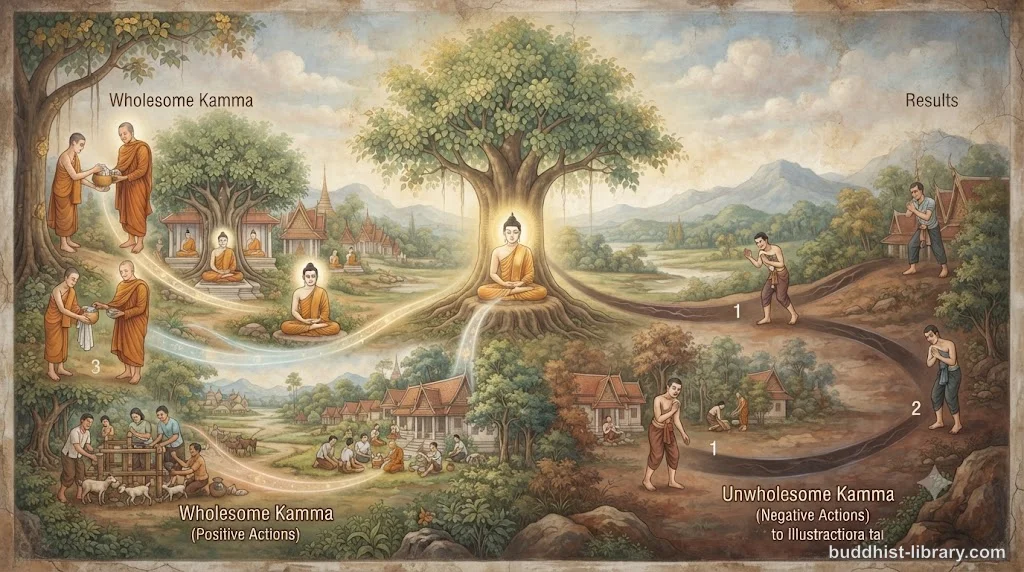
Kamma-vipāka is the ripening or fruition of karma—the results that emerge when intentional actions mature under the right conditions. In Buddhism, this isn’t divine reward or punishment, but a natural moral causality: wholesome intentions ripen into well-being, unwholesome ones into suffering, shaping both present experience and future rebirths.
Understanding kamma-vipāka clarifies why we experience what we do and how our present choices matter. It’s not fatalism—it’s the mechanics of moral cause and effect across time.
What Does Kamma-Vipāka Mean?
Kamma (Sanskrit: karma) means intentional action—deeds of body, speech, and mind driven by volition (cetanā). Vipāka literally means “ripening” or “result”—the fruit that emerges when those seeds of action meet the right conditions.
The Buddha taught this in the Cūḷakammavibhaṅga Sutta (MN 135): “Beings are owners of their kamma, heirs of their kamma; kamma is the womb from which they are born, their companion, their refuge. Whatever kamma they do—good or evil—of that they will be the heirs.”
Kamma-vipāka is not:
- Divine judgment: No external judge metes out rewards or punishments.
- Fixed fate: Present actions can influence how past kamma ripens.
- Simple tit-for-tat: Results depend on conditions, intention, and accumulated tendencies—not mechanical one-to-one exchanges.
It is a natural law governing moral causality—like physical laws govern matter, kamma-vipāka governs the ethical dimension of experience.
How Does Kamma Ripen Into Vipāka?
Not all kamma ripens immediately. The Buddha described four classes of kamma by timing:
- Diṭṭhadhamma-vedanīya-kamma: Results felt in this very life (e.g., immediate regret after harsh speech).
- Upapajja-vedanīya-kamma: Results felt in the next rebirth.
- Aparāpariya-vedanīya-kamma: Results felt in future lives beyond the next.
- Ahosi-kamma: Kamma that becomes ineffective and produces no result (rare, often through deep insight or counteracting strong wholesome kamma).
The ripening depends on:
- Strength of intention: Stronger volition produces more potent results.
- Supporting conditions: Like seeds needing soil and water, kamma ripens when circumstances align.
- Accumulated kamma: Past actions create tendencies that shape when and how new kamma matures.
This explains why results aren’t instant—moral causality unfolds across the stream of consciousness, not on a fixed schedule.
What Are the Types of Kamma-Vipāka?
The Buddha categorized kamma-vipāka by quality:
Kusala-vipāka (Wholesome Results)
Actions rooted in non-greed, non-hatred, and non-delusion ripen into:
- Pleasant feelings (physical and mental ease)
- Favorable rebirths (human, celestial realms)
- Supportive conditions for practice (health, security, good teachers)
Examples: generosity leads to abundance; patience ripens into beauty and health (Cūḷakammavibhaṅga Sutta).
Akusala-vipāka (Unwholesome Results)
Actions rooted in greed, hatred, and delusion ripen into:
- Painful feelings (suffering, distress)
- Unfavorable rebirths (animal, hungry ghost, hell realms)
- Obstructive conditions (illness, poverty, conflict)
Examples: killing shortens lifespan; harsh speech leads to being slandered; miserliness results in poverty.
Abyākata-vipāka (Indeterminate Results)
Some vipāka are neutral—neither pleasant nor painful—such as certain rebirth consciousness types in fortunate realms. These don’t push toward suffering or liberation but sustain the process of becoming.
How Does Kamma-Vipāka Relate to Rebirth?
Kamma-vipāka is the engine of rebirth in saṃsāra. At death, the strongest or most habitual kamma from one’s life conditions the next rebirth. The Milindapañha compares this to a mango falling from a tree—the final moment’s kamma determines where consciousness re-establishes.
Once reborn, past kamma continues to ripen:
- Janaka-kamma (productive kamma) generates the new existence.
- Upatthambhaka-kamma (supporting kamma) sustains it.
- Upapīḷaka-kamma (obstructive kamma) weakens or disrupts well-being.
This isn’t transmigration of a soul—there’s no permanent self moving between lives. Instead, kamma links moments of consciousness causally, like flame passing from one candle to the next.
Understanding this, the Buddha’s teaching on anattā (non-self) reveals that what we call “I” is a process shaped by past intentions, not an unchanging entity receiving cosmic justice.
Can Kamma-Vipāka Be Changed or Mitigated?
While you cannot erase past kamma, you can influence how it ripens and create new, stronger kamma to counteract old patterns.
Present Wholesome Actions
Strong wholesome kamma in the present can suppress or delay unwholesome vipāka. The Loṇakapalla Sutta (AN 3.99) compares this to salt: a teaspoon of salt makes a cup of water undrinkable, but the same salt dissolves harmlessly in the Ganges River. A vast reservoir of wholesome kamma dilutes the impact of past unwholesome actions.
Mindfulness and Insight
When vipāka arises as unpleasant feeling, mindfulness (sati) prevents reactive craving or aversion—stopping new kamma from forming. Insight into the three marks of existence weakens attachment to results, reducing suffering even when difficult vipāka ripens.
Path Progress
Stream-enterers and higher practitioners have exhausted certain classes of kamma. For instance, a stream-enterer will never be reborn in the lower realms—past unwholesome kamma strong enough to produce such results has been “burnt out” by insight.
Kamma is not fate. It’s a field you cultivate moment by moment.
Common Misunderstandings About Kamma-Vipāka
”Why Do Bad Things Happen to Good People?”
Present suffering doesn’t mean present wrongdoing. Painful vipāka ripening now may reflect past kamma from this life or previous ones. The Buddha rejected simple moral accounting—complex conditions shape when and how results manifest.
”Is Everything Due to Kamma?”
No. The Buddha identified multiple causes of experience: kamma, physical processes (bile, phlegm), environmental conditions, and chance. Not every headache or accident is karmic retribution. Kamma is one factor among many.
”Can I Use Kamma-Vipāka to Predict the Future?”
The specific timing and form of vipāka are complex and often unpredictable. The Buddha called the precise workings of kamma one of the “unconjecturables” (Acintita Sutta, AN 4.77)—obsessing over karmic details leads to madness, not wisdom.
Key Points: Kamma-Vipāka in Practice
- Vipāka is the natural ripening of intentional actions, not divine judgment or fate.
- Timing varies: Results may appear in this life, the next rebirth, or future lives.
- Quality matters: Wholesome intentions ripen into well-being; unwholesome into suffering.
- Rebirth is driven by kamma: The strongest or last moment’s kamma shapes the next existence.
- Mitigation is possible: Present wholesome actions and insight can weaken past unwholesome results.
- Not everything is kamma: Physical, environmental, and chance factors also shape experience.
- Practice transforms results: Mindfulness changes your relationship to vipāka; the path exhausts future unwholesome ripening.
Conclusion: Living with Kamma-Vipāka
Understanding kamma-vipāka reveals both accountability and freedom. You inherit the results of past intentions, but you’re not imprisoned by them. Every moment offers a choice: plant seeds of wisdom and compassion, or feed greed, hatred, and delusion.
The Buddha’s teaching isn’t about escaping consequences—it’s about transforming causes. By cultivating the Noble Eightfold Path, you stop creating new suffering and gradually exhaust old kamma, walking toward liberation.
Kamma-vipāka is the moral architecture of saṃsāra—and understanding it is the first step toward dismantling it.
Read more:
- Karma and Rebirth in Buddhism: How They Actually Work—Explore the broader mechanics of karma across lifetimes and how intention shapes future existence.
- What Is Dependent Origination (Paṭiccasamuppāda)?—Understand the twelve-link chain that explains how kamma conditions rebirth and perpetuates saṃsāra.
- What Is Saṃsāra? The Wheel of Rebirth in Buddhism—Learn how kamma-vipāka drives the cycle of death and rebirth and what it takes to escape it. to escape it.
📖 Source / license: Cūḷakammavibhaṅga Sutta (MN 135), SuttaCentral; Atthasālinī (The Expositor), Buddhaghosa
Frequently asked questions
Is kamma-vipāka the same as instant karma?
No. While some results ripen quickly, most kamma-vipāka unfolds over time—even across lifetimes. The timing depends on conditions, not on immediate moral bookkeeping.
Can I avoid kamma-vipāka from past actions?
You cannot erase past kamma, but you can transform how you meet its results through present wholesome actions, mindfulness, and wisdom. The path weakens the force of unwholesome kamma.
Does every action produce kamma-vipāka?
Intentional actions (kamma) produce results; unintentional or purely physical movements do not. The mental quality—wholesome, unwholesome, or neutral—determines the fruit.
Why do good people suffer if kamma works fairly?
Present suffering does not negate goodness—it reflects complex past kamma ripening now. Present wholesome actions plant seeds for future well-being, even if current conditions are difficult.