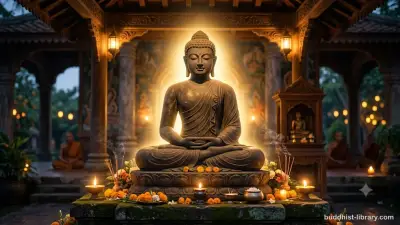
The Four Brahmavihāras: Cultivating the Divine Abodes

The Four Brahmavihāras—loving-kindness (mettā), compassion (karuṇā), empathetic joy (muditā), and equanimity (upekkhā)—are sublime mental states the Buddha taught to cultivate boundless goodwill toward all beings. Practiced both in formal meditation and daily life, they dissolve ill-will, envy, and indifference, replacing them with an open heart that remains steady in the face of life’s ups and downs.
What Are the Four Brahmavihāras?
The Pali term brahmavihāra translates as “divine abode” or “sublime attitude”—literally, the dwelling place of the Brahma gods. The Buddha taught that anyone who lives with these four qualities abides in a state of mind as lofty and peaceful as the highest heavenly realms, even while walking, working, or eating.
The four brahmavihāras are:
- Mettā (Loving-Kindness) — The sincere wish for all beings to be happy, safe, and at ease.
- Karuṇā (Compassion) — The wish for all beings who suffer to be free from suffering.
- Muditā (Empathetic Joy) — Rejoicing in the happiness and success of others, free from envy.
- Upekkhā (Equanimity) — A balanced, impartial awareness that neither clings to pleasure nor recoils from pain.
Each quality balances and complements the others. Mettā prevents compassion from becoming overwhelming pity; equanimity keeps loving-kindness from slipping into attachment; empathetic joy counters the subtle resentment that can arise when others prosper.
Why Practice the Brahmavihāras?
Practical Benefits
The brahmavihāras are not mere ideals. They produce tangible effects:
- Reduced anger and irritability: Cultivating mettā weakens habitual ill-will and impatience.
- Greater resilience: Upekkhā helps you stay centered when facing criticism, loss, or uncertainty.
- Improved relationships: People sense genuine goodwill and respond with more trust and warmth.
- Less envy and comparison: Muditā transforms the habit of measuring yourself against others into genuine celebration.
- Protection from burnout: Karuṇā with upekkhā allows you to care deeply without becoming emotionally depleted.
Spiritual Significance
In the Metta Sutta (Sn 1.8), the Buddha described one who practices loving-kindness as “traveling safely through becoming”—protected from hostility, calmer in mind, and preparing the ground for deeper insight. The brahmavihāras are not just ethical virtues; they are concentration practices (samādhi bhāvanā) that can lead to meditative absorption (jhāna) and serve as a foundation for wisdom practices.
The Buddha also taught that one who dies with a mind imbued with the brahmavihāras is reborn in a Brahma realm—a metaphor for the peace and dignity these qualities bring, whether understood literally or as a description of psychological transformation.
How to Practice Each Brahmavihāra
1. Mettā (Loving-Kindness)
Core phrase: “May all beings be happy. May they be safe. May they be healthy. May they live with ease.”
How to practice:
- Sit comfortably and bring to mind someone easy to love—a close friend, a pet, a benefactor.
- Silently repeat: “May you be happy. May you be safe. May you be healthy. May you live with ease.”
- Once warmth arises, extend the same phrases to yourself, then to a neutral person (a neighbor you barely know), then to a difficult person, and finally to all beings everywhere without distinction.
- If the phrases feel mechanical, pause and imagine what genuine happiness or safety would look like for that person.
Common pitfall: Forcing a feeling.
Mettā is an intention, not an emotion you manufacture. If you feel nothing at first, that’s normal. Continue gently offering the wish. Warmth will grow over time.
For a deeper dive into mettā practice, see our guide to Mettā: The Practice of Loving-Kindness.
2. Karuṇā (Compassion)
Core phrase: “May you be free from suffering. May you find relief and peace.”
How to practice:
- Bring to mind someone experiencing difficulty—illness, loss, stress, loneliness.
- Reflect on their pain without trying to fix it or turn away.
- Silently offer: “May you be free from suffering. May you find relief.”
- Gradually extend compassion to yourself (for your own struggles), to neutral and difficult people, and to all beings who suffer.
Balancing compassion with equanimity: Compassion can become overwhelming if you take on others’ pain as your own. This is where upekkhā comes in—you acknowledge suffering with an open heart, but without clinging to outcomes you cannot control. Ṭhānissaro Bhikkhu describes this as “goodwill with wisdom”: you care, but you also recognize each person’s own karma and capacity for change.
3. Muditā (Empathetic Joy)
Core phrase: “May your happiness continue and grow. I rejoice in your good fortune.”
How to practice:
- Think of someone who recently experienced success, good news, or a moment of joy.
- Notice any resistance—envy, comparison, dismissiveness—and gently set it aside.
- Silently offer: “I’m happy for you. May your happiness grow.”
- Extend this to others, including those whose success might normally trigger jealousy.
Why it’s difficult: Modern culture trains us to compare and compete.
Muditā directly counters that habit. It asks you to celebrate what goes well for others, recognizing that another person’s joy doesn’t diminish your own. When muditā is strong, others’ victories feel like shared victories.
4. Upekkhā (Equanimity)
Core phrase: “All beings are the owners of their actions. Their happiness and suffering depend on their actions, not on my wishes.”
How to practice:
- Reflect on the limits of your control: you can offer goodwill, but you cannot force anyone to be happy or free from pain.
- Silently acknowledge: “I care about your well-being, and I cannot control what happens to you. May you find your own path to peace.”
- Upekkhā is especially helpful when facing someone who refuses help, or when you’ve done all you can and must let go.
Common misconception: Equanimity is not indifference. It’s caring without clinging—staying warm-hearted while accepting that change, loss, and autonomy are part of life. The Pali term upekkhā shares a root with passati (to see clearly)—equanimity is clear seeing, free from the distortions of craving and aversion.
Key Points: The Brahmavihāras in Summary
- The four divine abodes are mettā (loving-kindness), karuṇā (compassion), muditā (empathetic joy), and upekkhā (equanimity).
- Each supports the others: mettā provides warmth, karuṇā responds to suffering, muditā celebrates joy, and upekkhā keeps the heart balanced.
- They are both meditation objects and ways of living: formal practice trains the mind; daily application transforms relationships and resilience.
- Anyone can practice them, regardless of religious background—they are human capacities, not sectarian doctrines.
- Results are gradual but reliable: with consistent practice, the brahmavihāras reduce anger, envy, and anxiety, and increase patience, generosity, and inner peace.
- They prepare the mind for deeper insight: a heart softened by the brahmavihāras is more receptive to the Buddha’s teachings on impermanence, non-self, and the end of suffering.
How the Brahmavihāras Work Together
The four brahmavihāras are not practiced in isolation—they balance and reinforce one another:
- Mettā without upekkhā can become clinging or disappointment when others don’t respond as you hope.
- Karuṇā without upekkhā can lead to burnout or despair when faced with overwhelming suffering.
- Muditā without mettā might feel hollow, a mere suppression of envy rather than genuine joy.
- Upekkhā without mettā or karuṇā can become cold detachment.
When all four are present, the heart remains open, warm, and steady. You wish others well (mettā), respond to their pain (karuṇā), celebrate their joy (muditā), and accept the limits of your control with grace (upekkhā). This is what the tradition calls appamāṇa—boundless or immeasurable—because these qualities extend without limit to all beings, in all directions.
Brahmavihāras Across Buddhist Traditions
While the Four Brahmavihāras are most explicitly taught in the Theravāda tradition, they appear across Mahāyāna and Vajrayāna as well:
- Theravāda: The brahmavihāras are foundational meditation practices, taught alongside mindfulness and insight. They’re considered both samatha (calm) and preparation for vipassanā (insight).
- Mahāyāna: The brahmavihāras align closely with the bodhisattva ideal—compassion and loving-kindness (mettā and karuṇā) drive the vow to liberate all beings. Muditā and upekkhā support the bodhisattva in remaining joyful and balanced across countless lifetimes of service.
- Vajrayāna: Brahmavihāra practices are woven into deity yoga and tonglen (giving and receiving) meditations, where practitioners visualize taking in others’ suffering and sending out happiness—an embodied expression of karuṇā and mettā.
All traditions agree: these qualities are not mere sentiments but trainable mental factors that lead to liberation.
Integrating the Brahmavihāras into Daily Life
Formal meditation is where you train the brahmavihāras; daily life is where they mature. Here’s how to carry them beyond the cushion:
- Mettā in the morning: Start each day by silently wishing well-being to yourself and those you’ll encounter.
- Karuṇā when hearing bad news: Instead of recoiling or turning away, pause and silently offer compassion.
- Muditā when someone shares good news: Notice any jealousy or dismissiveness, and consciously replace it with “I’m glad for you.”
- Upekkhā in traffic, lines, or delays: Remind yourself that you can’t control everything, and let go of the tension.
- Before difficult conversations: Take a breath, recall mettā, and enter with goodwill rather than defensiveness.
The brahmavihāras become a lens through which you see others—not as competitors, obstacles, or strangers, but as fellow beings navigating the same uncertain, painful, joyful human experience.
Common Questions
Can the brahmavihāras help with anxiety or depression?
Research suggests that mettā and compassion practices can reduce symptoms of depression, increase positive emotions, and improve self-compassion. They don’t replace therapy or medication, but they can be a helpful complement. The key is consistency—10–15 minutes daily over several weeks.
What if I can’t feel loving-kindness toward a difficult person?
Start with someone easier. The brahmavihāras are not about forcing emotions—they’re about planting seeds. Over time, as mettā strengthens toward neutral and friendly people, it becomes easier to extend it to those who’ve caused harm. You can also phrase it more neutrally: “May you find peace” rather than “I love you,” which might feel dishonest.
Are the brahmavihāras the same as positive thinking?
No. Positive thinking often involves denying or suppressing difficulty. The brahmavihāras—especially karuṇā and upekkhā—acknowledge pain and imperfection directly. They’re not about pretending everything is fine; they’re about holding both joy and suffering with a wise, open heart.
How do the brahmavihāras relate to the Eightfold Path?
They support Right Intention (goodwill, non-harming) and Right Effort (cultivating wholesome mental states). When practiced as concentration exercises, they contribute to Right Concentration. When expressed in action, they manifest as Right Speech and Right Action. See our guide to The Noble Eightfold Path for more on how these practices interconnect.
Conclusion: Living in the Divine Abodes
The Four Brahmavihāras are among the most accessible and transformative practices the Buddha offered. They require no special equipment, no retreat center, no doctrinal commitment—just a willingness to repeatedly turn the mind toward goodwill, compassion, joy, and balance.
When you practice the brahmavihāras, you’re not trying to become a saint overnight. You’re training habits of attention.
Notice when ill-will arises and choose kindness. Notice when envy appears and choose joy. Notice when you’re clinging to control and choose to let go.
Over time, these choices become your default responses. The “divine abodes” cease to be something you practice—they become where you live.
As the Metta Sutta concludes: “By not holding to fixed views, the pure-hearted one, having clarity of vision, being freed from all sense-desires, is not born again into this world.” Whether you take that literally or as a poetic description of freedom from grasping, the message is clear—the brahmavihāras open a path to peace, here and now.
Read more:
- Mettā: The Practice of Loving-Kindness — A detailed guide to cultivating loving-kindness meditation, the first of the four brahmavihāras.
- What Is Mindfulness (Sati) in Buddhism? — Explore how mindfulness practice complements and deepens brahmavihāra cultivation.
- The Noble Eightfold Path: A Complete Guide — See how the brahmavihāras support Right Intention and Right Concentration on the Buddhist path.
📖 Source / license: Metta Sutta (Sn 1.8, Sutta Nipāta); Access to Insight (dhammatalks.org); teachings of Bhikkhu Bodhi and Ṭhānissaro Bhikkhu
Frequently asked questions
Can I practice the brahmavihāras without being Buddhist?
Yes. The brahmavihāras are universal mental qualities that benefit anyone who cultivates them, regardless of religious background. While rooted in Buddhist practice, loving-kindness, compassion, empathetic joy, and equanimity are human capacities that improve well-being and relationships for practitioners of any tradition or none.
How long does it take to see results from brahmavihāra practice?
With consistent daily practice, many people notice they feel calmer and more patient relatively quickly. Deeper transformation—like automatic compassionate responses or unshakeable equanimity—develops over sustained cultivation. The key is regularity rather than duration; even brief daily sessions can support gradual change in how you respond to difficult emotions and relationships.
What's the difference between karuṇā (compassion) and mettā (loving-kindness)?
Mettā is the wish for all beings to be happy and well; karuṇā is the wish for beings who are suffering to be free from that suffering. Mettā is warm and inclusive; karuṇā arises specifically in response to witnessing pain. Both are expressions of goodwill, but karuṇā has a responsive, relieving quality while mettā is more general and preventive.
Can the brahmavihāras be practiced in daily activities, not just meditation?
Absolutely. The brahmavihāras are meant to infuse all of life. You can practice mettā while greeting a neighbor, karuṇā when hearing difficult news, muditā when celebrating a colleague's success, and upekkhā when facing criticism or delays. Formal meditation sessions train the mind, but the real fruit appears in how you respond moment-to-moment throughout the day.