The Mahāsatipaṭṭhāna Sutta: The Great Discourse on Mindfulness
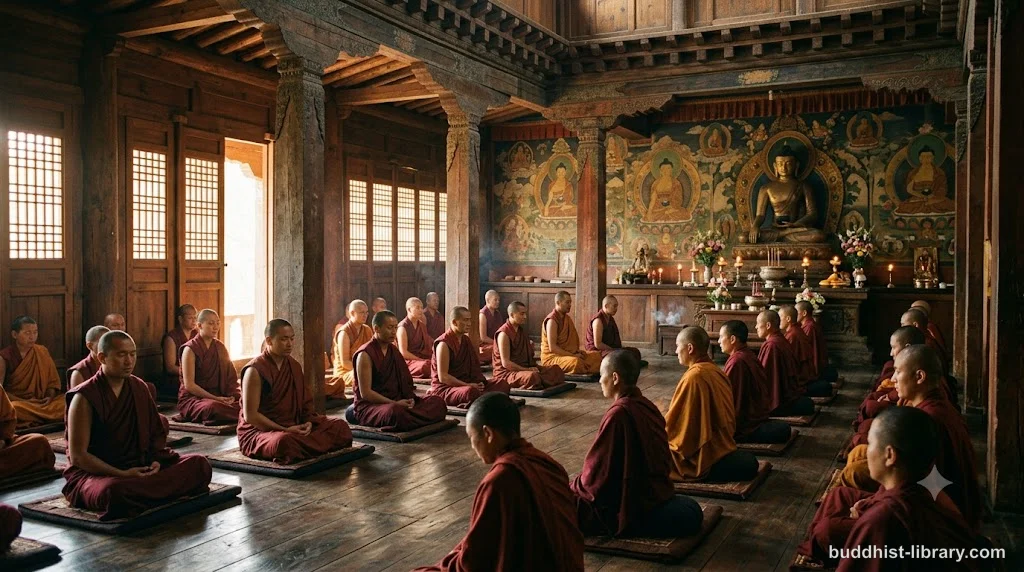
The Mahāsatipaṭṭhāna Sutta is the Buddha’s most comprehensive teaching on mindfulness meditation, preserved as DN 22 in the Pali Canon. It presents four foundations—body, feelings, mind, and phenomena—as a complete path to liberation, offering detailed instructions for transforming bare awareness into penetrative insight that ends suffering.
What is the Mahāsatipaṭṭhāna Sutta?
The Mahāsatipaṭṭhāna Sutta—literally the “Great Discourse on the Foundations of Mindfulness”—is the twenty-second discourse in the Dīgha Nikāya (Collection of Long Discourses). The Buddha delivered this teaching to the Kuru people at Kammāsadhamma, framing it as “the direct path” for purification, overcoming sorrow, and realizing Nibbāna.
This is not a philosophical text. It’s a practice manual. The Buddha systematically outlines how to establish continuous mindful awareness across four domains: the body (kāya), feelings (vedanā), mind (citta), and mental phenomena (dhammā). Each foundation builds on the previous one, transforming simple attention into wisdom that penetrates the three characteristics of existence—impermanence, suffering, and non-self.
Why “great”? Length and depth. The shorter Satipaṭṭhāna Sutta (MN 10) gives you the framework cleanly. This version expands it—most notably with a detailed exposition of the Four Noble Truths embedded in the fourth foundation.
How does it differ from the shorter Satipaṭṭhāna Sutta?
Both versions share the same core structure: the four foundations of mindfulness practiced through contemplation of body, feelings, mind, and dhammas. The difference lies in elaboration, not essence.
The Mahāsatipaṭṭhāna Sutta provides extended treatment of the fourth foundation—contemplation of dhammas. After covering the Five Hindrances, Five Aggregates, Six Sense Bases, Seven Factors of Enlightenment, and Four Noble Truths (as the shorter version does), it expands the Four Noble Truths section dramatically. Each truth receives detailed analysis: the nature of suffering, its origin in craving, the possibility of cessation, and the Noble Eightfold Path as the way forward.
Who benefits from the expansion? Practitioners who want comprehensive understanding. Think of the shorter version as the map, this one as the map with topographical details filled in. Different levels of granularity, same destination: direct knowledge of reality as it is.
What are the four foundations of mindfulness?
1. Contemplation of the Body (Kāyānupassanā)
The first foundation grounds awareness in physical reality. The Buddha teaches fourteen exercises:
- Mindfulness of breathing (ānāpānasati)
- Awareness of bodily postures (sitting, standing, walking, lying down)
- Clear comprehension in all activities
- Reflection on the body’s anatomical parts (32 parts meditation)
- Analysis of the four elements (earth, water, fire, air)
- Nine cemetery contemplations (observing stages of bodily decomposition)
These practices anchor attention in present-moment experience. You’re not thinking about the body—you’re directly observing its changing nature. The breath rises and falls. Postures shift. Sensations appear and dissolve. Through sustained observation, the illusion of a solid, permanent “me” in this body begins to crack.
2. Contemplation of Feelings (Vedanānupassanā)
The second foundation turns to vedanā—the feeling tone that accompanies every experience. The Buddha identifies three types: pleasant, unpleasant, and neither-pleasant-nor-unpleasant. Each can be worldly (carnal) or unworldly (spiritual).
This practice intercepts reactivity at its source. Before you crave pleasant feelings or resist unpleasant ones, you simply note: “pleasant feeling has arisen” or “unpleasant feeling has arisen.” You observe how feelings arise dependent on conditions, persist briefly, and pass away. Understanding vedanā disrupts the automatic chain from feeling to craving to suffering.
3. Contemplation of Mind (Cittānupassanā)
The third foundation observes mental states themselves. You note whether the mind is:
- Lustful or free from lust
- Hateful or free from hate
- Deluded or undeluded
- Contracted or distracted
- Developed or undeveloped
- Surpassed or unsurpassed
- Concentrated or unconcentrated
- Liberated or unliberated
This is not judgment—it’s recognition. When anger is present, you know “anger is present.” When it’s absent, you know its absence. You’re learning to observe the mind’s activity without identifying with it, seeing thoughts and emotions as impersonal processes rather than “my” anger or “my” joy.
4. Contemplation of Dhammas (Dhammānupassanā)
The fourth foundation examines mental phenomena through five frameworks:
- The Five Hindrances (sensual desire, ill will, sloth and torpor, restlessness and worry, doubt): recognizing obstacles to concentration and understanding how they arise and cease
- The Five Aggregates (form, feeling, perception, mental formations, consciousness): seeing how what we call “self” is actually five impermanent processes
- The Six Internal and External Sense Bases (eye and forms, ear and sounds, etc.): understanding how contact gives rise to fetters and how to abandon them
- The Seven Factors of Enlightenment (mindfulness, investigation, energy, joy, tranquility, concentration, equanimity): cultivating qualities that support awakening
- The Four Noble Truths: direct understanding of suffering, its origin, its cessation, and the path—the expanded section that distinguishes this “great” discourse
This foundation transforms mindfulness into insight. You’re no longer just aware—you’re seeing dependent origination in action, recognizing how clinging creates suffering, understanding the path to liberation.
Why did the Buddha call this “the direct path”?
At the opening of the discourse, the Buddha makes a striking claim: “Bhikkhus, this is the direct path for the purification of beings, for the overcoming of sorrow and lamentation, for the disappearance of pain and grief, for the attainment of the right method, for the realization of Nibbāna—namely, the four foundations of mindfulness.”
“Direct path” (ekāyano maggo) means this isn’t preliminary practice. You’re not building skills to eventually start real meditation—this is the real meditation. When you establish mindfulness of body, feelings, mind, and dhammas, you’re already walking the path to liberation.
The directness lies in its immediacy. You don’t need to master complex philosophy first. Start with the breath. Notice how it feels. Observe it change. That simple act, sustained with continuity and clear comprehension, becomes the vehicle for seeing the three characteristics and achieving liberating insight.
The Buddha promises results for those who practice diligently: “Whoever, bhikkhus, should develop these four foundations of mindfulness in this way for seven years… for seven months… for seven days, one of two fruits may be expected: either final knowledge here and now, or if there is a trace of clinging left, non-return.” This isn’t hyperbole—it’s the transformative power of sustained, skillful attention.
How do you practice the Mahāsatipaṭṭhāna Sutta?
The discourse gives a repeated formula for each contemplation:
“One dwells contemplating the body in the body, ardent, clearly comprehending, mindful, having removed covetousness and grief concerning the world.”
Four qualities define the practice:
-
Ardent (ātāpī): You bring energy and determination. This isn’t passive watching—it’s engaged investigation.
-
Clearly comprehending (sampajāno): You understand what you’re observing. When breathing in a long breath, you know “I breathe in long.” There’s no confusion or dullness.
-
Mindful (satimā): You maintain continuous awareness without forgetting the object. Attention doesn’t wander, or when it does, you recognize it immediately and return.
-
Having removed covetousness and grief concerning the world: You temporarily set aside desire for and aversion to worldly experience. You’re not practicing to get something or escape something—you’re simply seeing what is.
Start with one foundation—traditionally the breath within body contemplation. Sit, establish attention on the breath at the nostrils or abdomen, and note “breathing in… breathing out.” When the mind wanders (it will), gently return to the breath. Build continuity first.
As concentration strengthens, expand to other body contemplations: postures, activities, anatomical parts. Then include feelings—noticing the pleasant, unpleasant, or neutral tone accompanying experiences. Observe mind states as they arise. Finally, examine mental phenomena through the five frameworks.
The practice unfolds in daily life too. Walking, you know you’re walking. Eating, you know you’re eating. Angry, you know anger is present. This continuous mindfulness—in formal sitting and ordinary activities—is what ripens into insight.
What role does the Mahāsatipaṭṭhāna Sutta play in modern practice?
This discourse became the foundation for contemporary vipassanā (insight meditation) movements. Teachers across traditions—Mahasi Sayadaw, S.N. Goenka, Ajahn Chah, Joseph Goldstein—draw directly from these teachings.
Different approaches emphasize different aspects. Mahasi Sayadaw’s method focuses on noting (labeling experiences as they arise). Goenka’s tradition emphasizes body scanning and vedanā observation. Thai Forest teachers often start with ānāpānasati and expand to broad choiceless awareness. All trace back to these four foundations.
The discourse also provides a framework for psychological understanding. Western teachers and therapists adapted satipaṭṭhāna into Mindfulness-Based Stress Reduction (MBSR) and similar programs. While secular mindfulness often strips away the Buddhist context, the core mechanism—sustained, non-reactive awareness—comes straight from this text.
For traditional practitioners, the Mahāsatipaṭṭhāna Sutta remains the supreme meditation manual. Monks memorize it, monasteries study it, and meditators return to it for guidance through every stage of practice.
Key Points
- The Mahāsatipaṭṭhāna Sutta (DN 22) is the Buddha’s most detailed teaching on mindfulness meditation, presenting a complete path to liberation
- Four foundations—body, feelings, mind, and dhammas—provide a comprehensive framework for developing awareness and insight
- The “great” version expands on the shorter Satipaṭṭhāna Sutta (MN 10) primarily through extended commentary on the Four Noble Truths
- Practice requires four qualities: ardency, clear comprehension, mindfulness, and temporary renunciation of worldly craving
- The Buddha called this “the direct path” because sustained practice can lead to full awakening or non-returning within months or even days
- This discourse grounds modern vipassanā movements and influenced contemporary mindfulness-based interventions
- All four foundations work together—body awareness stabilizes attention, feeling observation interrupts reactivity, mind contemplation reveals impersonality, and dhamma investigation yields liberating insight
Frequently Asked Questions
What is the difference between the Satipaṭṭhāna Sutta and the Mahāsatipaṭṭhāna Sutta?
The Mahāsatipaṭṭhāna Sutta (DN 22) is an expanded version of the Satipaṭṭhāna Sutta (MN 10). While both teach the four foundations of mindfulness, the longer version includes additional detailed explanations—particularly in the contemplation of dhammas section, where it expands on the Four Noble Truths with extensive analysis.
Do I need to practice all four foundations of mindfulness?
The Buddha taught all four foundations as an integrated framework. While you can emphasize one foundation initially, complete practice involves bringing mindful awareness to body, feelings, mind states, and mental phenomena. They support and reinforce each other on the path to liberation.
Can laypeople practice the Mahāsatipaṭṭhāna Sutta teachings?
Yes. The Buddha explicitly states in the discourse that this practice is open to monastics and laypeople alike. While intensive retreat practice is beneficial, the four foundations can be applied in daily life—mindfulness of body while walking, awareness of feelings as they arise, observing mind states during conversations.
How long does it take to complete the Mahāsatipaṭṭhāna Sutta practice?
The sutta famously states that dedicated practice can lead to full awakening or non-returning “in seven years, or seven months, or seven days.” However, this refers to intensive, continuous practice. Most practitioners work with these teachings over years, gradually deepening their understanding and insight.
Is this the same as modern mindfulness meditation?
The four foundations provide the foundation for modern mindfulness practice, but traditional satipaṭṭhāna is more comprehensive. It explicitly aims for insight into impermanence, suffering, and non-self—leading to liberation from saṃsāra. Contemporary secular mindfulness often focuses on stress reduction and well-being, adapting but not fully preserving the Buddhist framework.
Conclusion
The Mahāsatipaṭṭhāna Sutta is Buddhism’s most thorough practice manual. No abstract philosophy here—the Buddha gave step-by-step instructions for seeing reality as it actually is.
Four domains: body, feelings, mind, dhammas. Four arenas where you can watch suffering arise and learn to uproot it. Each contemplation builds on the previous one. Body awareness stabilizes attention. Feeling observation catches reactivity before it spirals. Mind contemplation breaks identification with thoughts and emotions. Dhamma investigation cuts through to how suffering gets constructed—and how it can stop.
What earns the “great” designation isn’t length. It’s completeness. This discourse maps the entire path from distracted consciousness to full awakening, nothing omitted.
The practice is immediate because the tools are always present. You already have a body. Feelings arise constantly. Your mind is active right now. Mental phenomena unfold whether you’re watching or not. The four foundations aren’t waiting for ideal conditions—they’re available this breath, this moment. What changes everything is the choice to look: ardently, clearly, mindfully, with wise renunciation of craving.
The method hasn’t changed in 2,600 years. Neither has what it addresses—the structure of human suffering and the possibility of waking up through direct understanding.
Read more:
- What Is Mindfulness (Sati) in Buddhism? — Explore the broader concept of sati beyond just meditation, including its role as the seventh factor of the Noble Eightfold Path and how it differs from modern secular interpretations.
- The Satipaṭṭhāna Sutta: Foundations of Mindfulness Explained — Compare this great discourse with its shorter counterpart (MN 10) to understand the core framework without the extended commentary.
- Vipassanā: Insight Meditation Practice in Buddhism — See how the four foundations of mindfulness lead to vipassanā (insight) practice and the direct realization of the three characteristics.
📖 Source / license: DN 22, Mahāsatipaṭṭhāna Sutta (trans. Bhikkhu Bodhi, Bhikkhu Ñāṇamoli)
Frequently asked questions
What is the difference between the Satipaṭṭhāna Sutta and the Mahāsatipaṭṭhāna Sutta?
The Mahāsatipaṭṭhāna Sutta (DN 22) is an expanded version of the Satipaṭṭhāna Sutta (MN 10). While both teach the four foundations of mindfulness, the longer version includes additional detailed explanations—particularly in the contemplation of dhammas section, where it expands on the Four Noble Truths with extensive analysis.
Do I need to practice all four foundations of mindfulness?
The Buddha taught all four foundations as an integrated framework. While you can emphasize one foundation initially, complete practice involves bringing mindful awareness to body, feelings, mind states, and mental phenomena. They support and reinforce each other on the path to liberation.
Can laypeople practice the Mahāsatipaṭṭhāna Sutta teachings?
Yes. The Buddha explicitly states in the discourse that this practice is open to monastics and laypeople alike. While intensive retreat practice is beneficial, the four foundations can be applied in daily life—mindfulness of body while walking, awareness of feelings as they arise, observing mind states during conversations.
How long does it take to complete the Mahāsatipaṭṭhāna Sutta practice?
The sutta famously states that dedicated practice can lead to full awakening or non-returning 'in seven years, or seven months, or seven days.' However, this refers to intensive, continuous practice. Most practitioners work with these teachings over years, gradually deepening their understanding and insight.