The Middle Way in Buddhism: Walking Between Extremes

The Middle Way is the Buddha’s rejection of extremes — neither chasing pleasure nor torturing the body. It is the balanced path to awakening, embodied in the Noble Eightfold Path, discovered after the Buddha abandoned six years of harsh asceticism and found that true freedom lies in clarity, not suffering.
What is the Middle Way?
The Middle Way (Majjhimā Paṭipadā in Pali) is the foundational principle of Buddhist practice. In his first discourse, the Dhammacakkappavattana Sutta, the Buddha described it as the path that avoids two extremes:
- Indulgence in sensual pleasures — the pursuit of gratification through the senses, which leads to attachment and never satisfies.
- Self-mortification — harsh ascetic practices like extreme fasting, self-torture, or punishing the body in the belief that suffering purifies.
The Buddha declared both extremes “unworthy, unprofitable, and fit for the ordinary person.” The Middle Way, by contrast, is the path that “gives vision, gives knowledge, and leads to calm, to direct knowing, to awakening, to nibbāna.” That path is the Noble Eightfold Path.
Why did the Buddha reject asceticism?
Before his awakening, the Buddha — then Prince Siddhārtha — left his palace and spent six years practicing extreme asceticism. He fasted until his body became skeletal, held his breath until he fainted, and subjected himself to intense physical deprivation. The ancient texts describe him as so emaciated that his ribs stood out “like the beams of an old shed,” and when he touched his stomach, he could feel his spine.
Despite this, he gained no insight. He realized that these practices only weakened the mind and body, creating more suffering without leading to freedom. In the Mahāsaccaka Sutta (MN 36), he recounts the moment he abandoned asceticism:
“I thought: ‘This is not the path to awakening.’ … I thought: ‘Why am I afraid of that pleasure that has nothing to do with sensual pleasures and unwholesome states?’ I thought: ‘I am not afraid of that pleasure.’”
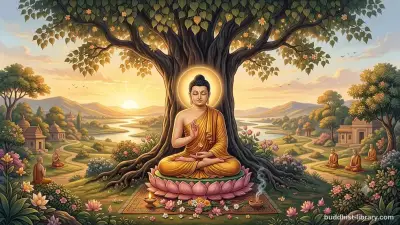
He accepted food, regained strength, and soon after — while seated in meditation under the Bodhi tree — he attained full awakening. The Middle Way he discovered was not a compromise between extremes but a third option: a path that neither clings to pleasure nor punishes the body, because both strategies miss the real problem — the mind’s craving and ignorance.
What does the Middle Way look like in practice?
The Middle Way is not an abstract ideal. It is the Noble Eightfold Path, the practical training the Buddha taught. This path has three divisions:
Wisdom (paññā)
- Right View — understanding the Four Noble Truths and the nature of reality
- Right Intention — intention toward renunciation, goodwill, and harmlessness
Ethical Conduct (sīla)
- Right Speech — truthful, helpful, kind speech
- Right Action — ethical behavior, embodied in the Five Precepts
- Right Livelihood — earning a living without causing harm
Mental Cultivation (samādhi)
- Right Effort — cultivating wholesome mental states, abandoning unwholesome ones
- Right Mindfulness — continuous awareness of body, feelings, mind, and mental objects (see What Is Mindfulness (Sati) in Buddhism?)
- Right Concentration — deepening meditation to the level of jhāna
Each element balances effort and ease. Right Effort, for example, is neither lazy nor exhausting. Right Concentration is sustained focus, not forced tension.
The path is workable. It can be practiced by laypeople and monastics alike, without extremes.
Is the Middle Way just “everything in moderation”?
Not quite. The Middle Way is often misunderstood as bland moderation — a little indulgence, a little discipline, nothing too intense. But the Buddha was precise. He did not teach “a little bit of everything.” He taught a specific balance oriented toward liberation.
For instance:
- Ethical conduct: The Middle Way does not say “lie a little, but not too much.” It says: abandon lying entirely, because falsehood causes harm. (Right Speech is not moderate lying; it is the complete abandonment of false speech.)
- Meditation: The path does not say “meditate a little, not too much.” It encourages deep, sustained practice — even to the point of jhāna — but without the self-torture of asceticism.
- Renunciation: The Buddha did not teach “cling to sensual pleasures moderately.” He taught letting go of craving, which is not a middle ground between indulgence and asceticism — it is a different direction altogether.
The Middle Way is functional moderation — just enough effort, nourishment, rest, and discipline to support awakening. It is pragmatic, not ideological.
The Middle Way in daily life
Even for those not pursuing monastic life, the Middle Way offers a clear framework:
- Don’t starve yourself, but don’t overeat. Nourish the body to sustain practice.
- Don’t chase pleasure constantly, but don’t reject joy. Enjoy wholesome pleasures — friendship, beauty, the satisfaction of ethical living — without clinging.
- Don’t exhaust yourself, but don’t be lazy. Practice diligently, but know when to rest.
- Don’t punish yourself for mistakes, but don’t ignore them either. Learn, adjust, and continue.
The thread running through all of this is mindful discernment — the ability to see what actually leads to clarity and freedom, and what does not.
Key points: The Middle Way
- The Middle Way is the Buddha’s path between self-indulgence and self-mortification.
- It was discovered after the Buddha abandoned extreme asceticism and found that suffering the body does not free the mind.
- The Middle Way is not an abstract compromise; it is the Noble Eightfold Path — a practical training in ethics, meditation, and wisdom.
- It is not bland moderation. It is functional balance: just enough effort, discipline, and nourishment to support awakening.
- The path works because it sustains clarity and energy, rather than exhausting or dulling the mind.
- In daily life, the Middle Way means choosing what genuinely supports well-being and wisdom, and letting go of the rest.
What the Middle Way is not
A few common misunderstandings:
It is not moral relativism. The Buddha did not say “all views are valid if balanced.” He taught a specific path grounded in the Four Noble Truths and the ending of suffering.
It is not passivity. Walking the Middle Way requires effort — Right Effort is one of the eight factors. The difference is that this effort is sustainable and directed, not reckless or self-destructive.
It is not a compromise for those too weak to be extreme. The Buddha rejected asceticism not because it was too hard, but because it did not work. The Middle Way is the effective path, not the easy one.
Why does the Middle Way matter today?
We live in a culture of extremes. We swing between indulgence and guilt, overwork and burnout, self-optimization and self-neglect.
The Middle Way offers a way out. A path that does not demand perfection or self-punishment, but asks only that we see clearly what leads to suffering and what leads to peace.
The Buddha’s discovery was that freedom does not require extremes. It requires balance, clarity, and the willingness to abandon what does not work — even if we have invested years in it.
Read more:
- The Noble Eightfold Path: A Complete Guide — the practical embodiment of the Middle Way in eight trainings.
- The Four Noble Truths: The Heart of the Buddha’s Teaching — the framework that the Middle Way was designed to fulfill.
- The Life of the Buddha: From Prince Siddhārtha to Awakening — the story of how the Buddha discovered the Middle Way after abandoning asceticism.
📖 Source / license: Grounded in the Dhammacakkappavattana Sutta (SN 56.11), the Ariyapariyesana Sutta (MN 26), and the Mahāsaccaka Sutta (MN 36); translations by Bhikkhu Bodhi and Ṭhānissaro Bhikkhu (SuttaCentral, Access to Insight).
Frequently asked questions
What is the Middle Way in Buddhism?
The Middle Way (Majjhimā Paṭipadā) is the Buddha's path that avoids the two extremes of self-indulgence in sensual pleasures and self-mortification through harsh asceticism. It is embodied in the Noble Eightfold Path — a practical course of ethical conduct, mental cultivation, and wisdom.
Why did the Buddha reject asceticism if he was an ascetic himself?
Before his awakening, the Buddha practiced severe asceticism for six years, nearly starving himself to death. He found that this extreme weakened the mind and body without leading to liberation. After abandoning asceticism and accepting nourishment, he discovered the Middle Way — a path that sustains clarity and energy rather than destroying them.
Does the Middle Way mean avoiding all pleasure?
No. The Middle Way rejects addiction to pleasure, not pleasure itself. It recognizes that clinging to sensual experience creates suffering, but it does not demand that practitioners live in misery. The path encourages wholesome pleasures — like the joy of meditation or ethical living — while abandoning harmful cravings.
Is the Middle Way the same as moderation in everything?
Not exactly. While moderation is part of it, the Middle Way is more precise: it is the specific path outlined in the Noble Eightfold Path. It is not simply 'a little bit of everything,' but a deliberate balance that avoids both excess and deficiency in the things that matter for liberation.