Right View (Sammā Diṭṭhi): The Foundation of the Buddhist Path

Right View (Sammā Diṭṭhi) is the first and most essential factor of the Noble Eightfold Path—the Buddha’s prescription for ending suffering. It means seeing reality as it truly is: understanding the Four Noble Truths, recognizing the law of karma, and perceiving the Three Characteristics of existence (impermanence, suffering, and not-self). Without Right View, all other spiritual practices remain incomplete.
The Buddha placed Right View first for a reason. Just as a foundation determines whether a building stands or collapses, Right View determines whether your spiritual practice leads to liberation or merely circles around the same patterns of suffering.
What Does Right View Actually Mean?
Right View is not about adopting a set of beliefs or joining a philosophical camp. In the Sammādiṭṭhi Sutta (MN 9), the Buddha’s chief disciple Sāriputta defines Right View as understanding specific aspects of reality:
- The Four Noble Truths: suffering exists; it has a cause (craving); it can end; and there’s a path to that end
- Karma and its results: wholesome actions lead to happiness, unwholesome actions lead to suffering
- Dependent Origination: how phenomena arise in dependence on conditions
- The Three Characteristics: all conditioned things are impermanent (anicca), unsatisfactory (dukkha), and not-self (anattā)
Right View means understanding these truths not just intellectually but experientially—seeing them operating in your own life, moment by moment.
Bhikkhu Bodhi writes: “Right view is not mere theoretical knowledge or blind belief, but direct penetrative insight into the nature of existence.” This penetration transforms how you experience every aspect of life.
Why Is Right View the Foundation of the Path?
The Buddha taught that wisdom (paññā) has two aspects: Right View and Right Intention. Together they form the wisdom group of the Eightfold Path, while the remaining six factors constitute ethics and meditation.
Right View provides the framework for practice. Consider:
- Without understanding suffering (the First Noble Truth), why would you practice?
- Without seeing craving as the cause (the Second Noble Truth), where would you direct your effort?
- Without confidence that freedom is possible (the Third Noble Truth), what would sustain your practice during difficulty?
- Without understanding the path (the Fourth Noble Truth), how would you know what to do?
The Mahācattārīsaka Sutta (MN 117) describes how Right View supports every other factor: it defines right speech, right action, right livelihood, right effort, right mindfulness, and right concentration. Each factor gains its “rightness” from being aligned with the understanding of the Four Noble Truths.
Think of it this way: you can practice meditation for years, but if you’re meditating to avoid problems rather than to understand and uproot their causes, you’re not on the Buddha’s path—you’re using technique as escape.
Mundane Right View vs. Supramundane Right View
Buddhist texts distinguish two levels of Right View:
Mundane Right View (lokiya sammā-diṭṭhi): Understanding karma and rebirth. This view recognizes that actions have consequences, that ethical conduct matters, and that wholesome mental states lead to better outcomes. This level of Right View keeps you oriented toward skillful living and creates the conditions for deeper practice.
Supramundane Right View (lokuttara sammā-diṭṭhi): Direct insight into the Four Noble Truths and the Three Characteristics. This is the penetrating wisdom that sees through the illusion of self, understands dependent origination directly, and leads to stages of awakening. This view doesn’t just know about impermanence—it sees every arising phenomenon dissolving in real time.
The path moves from mundane to supramundane. You begin by accepting the Buddha’s teachings on karma and rebirth, study the Four Noble Truths, and gradually—through meditation and reflection—develop direct insight that replaces belief with knowledge.
What Right View Is Not
Several common misunderstandings obscure what the Buddha meant:
Right View is not blind faith. The Buddha encouraged investigation: “Do not accept anything merely because it accords with your scriptures… but when you know for yourselves…” (Kālāma Sutta, AN 3.65). Right View begins with trust in the teaching but matures through direct experience.
Right View is not nihilism. Understanding anattā (not-self) doesn’t mean nothing exists or that you don’t exist. It means seeing that what we call “self” is a process—not a fixed, permanent entity. Phenomena arise and pass; they’re real in the conventional sense but empty of inherent, independent existence.
Right View is not pessimism. Recognizing that conditioned existence is marked by dukkha doesn’t mean life is only suffering. It means seeing clearly that clinging to impermanent things—expecting them to provide lasting satisfaction—leads to dissatisfaction. Right View also recognizes the Third Noble Truth: suffering can end.
Right View is not metaphysics for its own sake. The Buddha famously refused to answer certain metaphysical questions (Is the world eternal? Is the self identical with the body?), calling them “not conducive to disenchantment, dispassion, cessation, peace, direct knowledge, awakening, nibbāna” (Cūḷamāluṅkya Sutta, MN 63). Right View is practical wisdom aimed at liberation, not abstract philosophy.
How Do You Develop Right View?
Right View develops through three interconnected practices:
1. Learning (suta-mayā paññā)
Study the Buddha’s teachings—the Four Noble Truths, dependent origination, the aggregates, the sense bases. Read the suttas, study with teachers, and engage with the tradition. This builds the intellectual framework.
Ṭhānissaro Bhikkhu notes: “The first stage in developing right view is to learn the Dhamma—to memorize important passages, to study their meaning, and to put their principles into practice.”
2. Reflection (cintā-mayā paññā)
Reflect on what you’ve learned. Does your experience confirm the teachings? Where do you see impermanence operating? When does clinging cause suffering in your life? Contemplation moves the teachings from ideas to insights.
3. Meditation (bhāvanā-mayā paññā)
Direct meditative insight—vipassanā—allows you to see the Three Characteristics and dependent origination directly. As concentration deepens through samatha practice and mindfulness sharpens through satipaṭṭhāna, you begin to witness impermanence, suffering, and not-self as immediate realities rather than abstract concepts.
These three work together: learning provides the map, reflection applies it to your life, and meditation reveals the territory directly.
Right View in Daily Life
Right View isn’t reserved for meditation retreats—it transforms ordinary experience:
- Relationships: Seeing that all beings, like you, seek happiness and avoid suffering (the First Noble Truth) cultivates compassion.
- Challenges: Understanding that difficulties arise from conditions, not from a permanent, unchanging “you,” reduces the tendency to take things personally.
- Success: Recognizing impermanence prevents clinging to achievements and reduces the suffering that comes when things inevitably change.
- Ethical decisions: Understanding karma makes the consequences of actions clear—not as punishment from an external force, but as the natural result of causes and conditions.
Right View acts as a lens. The same event—a job loss, a criticism, a compliment—looks entirely different when seen through the framework of the Four Noble Truths and the Three Characteristics.
Key Points
- Right View is the first factor of the Noble Eightfold Path because it provides the framework for all other practice
- It means understanding the Four Noble Truths, karma, dependent origination, and the Three Characteristics
- There are two levels: mundane (understanding karma and rebirth) and supramundane (direct insight into the nature of reality)
- Right View develops through learning the teachings, reflecting on them, and cultivating direct meditative insight
- It transforms how you experience relationships, challenges, success, and ethical choices in daily life
- Right View is not blind faith, nihilism, pessimism, or abstract metaphysics—it’s practical wisdom aimed at liberation
Frequently Asked Questions
What is Right View in Buddhism?
Right View (Sammā Diṭṭhi) is understanding the Four Noble Truths, karma, rebirth, and the Three Characteristics. It means seeing reality as it actually is—impermanent, unsatisfactory, and not-self—rather than through the distortions of craving and ignorance.
Why is Right View the first factor of the Eightfold Path?
Right View comes first because it provides the framework for all other factors. Without understanding what the problem is (suffering) and how it works (dependent origination), the remaining seven factors lack direction and purpose.
Can you practice Buddhism without Right View?
You can practice meditation or ethics without Right View, but the Buddha taught that without understanding the Four Noble Truths and dependent origination, practice lacks the liberating wisdom that leads to awakening. Right View transforms practice from mere technique into a path to freedom.
Is Right View the same across all Buddhist traditions?
The core elements—understanding suffering, its cause, its end, and the path—are universal. However, Theravāda emphasizes the Four Noble Truths and dependent origination, Mahāyāna adds the doctrine of emptiness (śūnyatā), and Vajrayāna incorporates tantric views of reality. The foundation remains consistent.
How long does it take to develop Right View?
Developing mundane Right View—understanding karma and the Four Noble Truths intellectually—can begin immediately through study and reflection. Supramundane Right View—direct insight into the nature of reality—develops gradually through consistent meditation practice and can culminate in stream-entry, the first stage of awakening, though the timeline varies widely among practitioners.
Conclusion: Seeing Clearly, Walking Wisely
Right View is where the path begins and where it culminates.
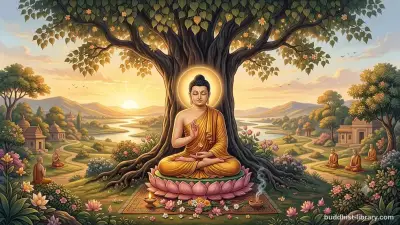
You start with faith in the Buddha’s teaching. You develop intellectual understanding through study, deepen that understanding through reflection, and finally—through meditation—see directly what the Buddha saw under the Bodhi tree.
Every step of the Eightfold Path depends on this foundation. Right Intention arises from Right View. Right Speech, Action, and Livelihood express Right View in behavior. Right Effort, Mindfulness, and Concentration sharpen and deepen Right View until it becomes the direct, liberating wisdom that ends suffering.
The Buddha didn’t ask you to believe everything he taught. He asked you to investigate, to test the teachings against your experience, and to see for yourself.
Right View is the fruit of that investigation—the clear seeing that transforms suffering into freedom.
Read more:
- The Noble Eightfold Path: A Complete Guide — Explore how Right View connects with the other seven factors to form the Buddha’s path to liberation.
- The Four Noble Truths: The Heart of the Buddha’s Teaching — Understand the framework that Right View is built upon: suffering, its cause, its cessation, and the path.
- Anattā (Non-Self): What the Buddha Really Meant — Dive deeper into one of the Three Characteristics that Right View helps you perceive directly.
📖 Source / license: Sammādiṭṭhi Sutta (MN 9), SuttaCentral; Mahācattārīsaka Sutta (MN 117); Right View (Ñāṇavīra Thera), Access to Insight; The Noble Eightfold Path (Bhikkhu Bodhi)
Frequently asked questions
What is Right View in Buddhism?
Right View (Sammā Diṭṭhi) is understanding the Four Noble Truths, karma, rebirth, and the Three Characteristics. It means seeing reality as it actually is—impermanent, unsatisfactory, and not-self—rather than through the distortions of craving and ignorance.
Why is Right View the first factor of the Eightfold Path?
Right View comes first because it provides the framework for all other factors. Without understanding what the problem is (suffering) and how it works (dependent origination), the remaining seven factors lack direction and purpose.
Can you practice Buddhism without Right View?
You can practice meditation or ethics without Right View, but the Buddha taught that without understanding the Four Noble Truths and dependent origination, practice lacks the liberating wisdom that leads to awakening. Right View transforms practice from mere technique into a path to freedom.
Is Right View the same across all Buddhist traditions?
The core elements—understanding suffering, its cause, its end, and the path—are universal. However, Theravāda emphasizes the Four Noble Truths and dependent origination, Mahāyāna adds the doctrine of emptiness (śūnyatā), and Vajrayāna incorporates tantric views of reality. The foundation remains consistent.