The Ten Fetters (Saṃyojana): Stages of Liberation in Buddhism
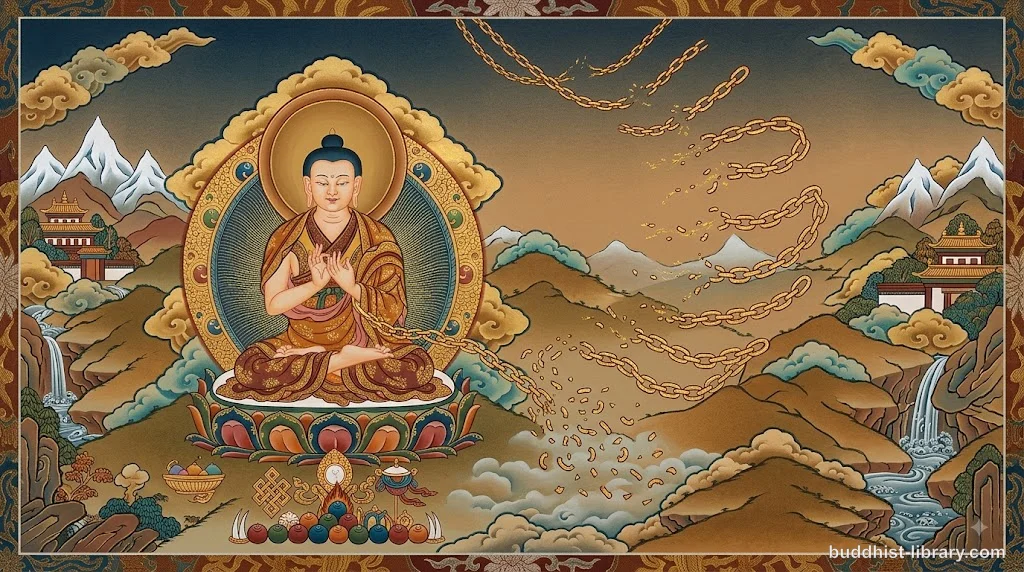
The ten fetters (saṃyojana) are the mental chains that bind consciousness to the cycle of rebirth and suffering. Understanding them reveals both what keeps us trapped and the precise stages of liberation—from the first breakthrough of stream-entry to the complete freedom of an arahant.
What Are the Ten Fetters?
Liberation isn’t an all-or-nothing leap in the Buddha’s teaching. It’s a dismantling—progressive, measurable, precise. The Saṃyutta Nikāya identifies ten fetters: mental defilements that tether beings to saṃsāra. Not abstract concepts. Observable patterns of clinging and confusion that perpetuate suffering.
The fetters divide into two groups:
The Five Lower Fetters (binding to the sensual realm):
- Sakkāya-diṭṭhi (self-identification view): The belief in a permanent, separate self
- Vicikicchā (doubt): Skeptical uncertainty about the Buddha, Dhamma, and Saṅgha
- Sīlabbata-parāmāsa (attachment to rites and rituals): Mistaking external observances for the path itself
- Kāma-rāga (sensual desire): Craving for pleasure through the five senses
- Vyāpāda (ill will): Aversion, anger, and hostility toward experience
The Five Higher Fetters (binding to refined existence):
- Rūpa-rāga (desire for form): Attachment to refined meditative states with form
- Arūpa-rāga (desire for formlessness): Attachment to formless meditative absorptions
- Māna (conceit): The comparing mind—“I am better/worse/equal”
- Uddhacca (restlessness): Subtle agitation of mind
- Avijjā (ignorance): Fundamental misunderstanding of reality
The Four Stages of Liberation
Buddhist liberation unfolds in four clearly defined stages, each marked by the elimination or weakening of specific fetters:
Stream-Enterer (Sotāpanna)
The first breakthrough. A stream-enterer has permanently eliminated the first three fetters:
- Self-view is abandoned (though self-reference in speech continues)
- Doubt about the path is eradicated
- Belief that mere ritual leads to liberation is gone
This person is guaranteed full awakening within seven lifetimes maximum. They’ve entered the irreversible stream flowing toward nibbāna. The Saṃyutta Nikāya is blunt: “It is impossible for a stream-enterer to die without having realized the fruit of arahantship.”
Once-Returner (Sakadāgāmī)
Beyond eliminating the first three fetters, the once-returner has significantly weakened (but not eliminated) sensual desire and ill will. Anger arises less frequently and with less intensity; sensual craving loosens its grip. This person will return to the human realm at most one more time before full liberation.
Non-Returner (Anāgāmī)
At this stage, fetters four and five are completely abandoned. Sensual desire and ill will no longer arise at all—not even subtle forms. The non-returner will not be reborn in the sensual realm. If not fully awakened in this life, they’ll be reborn in the Pure Abodes (special heavenly realms for non-returners) and attain arahantship there.
Arahant
Complete liberation. All ten fetters are destroyed. Even the subtlest attachments to refined meditative states, the faintest trace of conceit, restlessness, and the root ignorance itself—all gone. The arahant lives with “nothing further to do.” At death, there is no more rebirth.
Why These Ten? The Logic of the List
The fetters aren’t random. They’re a systematic analysis of what perpetuates becoming (bhava).
The first three are cognitive errors: wrong views about self, uncertainty about the path, confusion about what actually leads to freedom. These must go first. You can’t navigate with a faulty map.
Fetters four and five—sensual desire and ill will—fuel kammic action in the sensual sphere. They drive the chase for pleasure and the recoil from pain that keeps the rebirth process churning.
The higher fetters are subtler. Even after sensory pleasure loses its pull, attachment to refined meditative states (jhānas and formless absorptions) can still bind. The last three—conceit, restlessness, ignorance—are the deepest roots. They require profound insight to uproot.
How Are Fetters Abandoned?
The fetters aren’t removed through willpower or repression. They’re abandoned through insight—seeing clearly how they operate and what they cost.
Direct seeing, not belief: Stream-entry happens when you directly perceive the three characteristics (impermanence, suffering, non-self) in your own experience. Sakkāya-diṭṭhi (self-view) isn’t defeated by believing “there is no self”; it’s abandoned when the fabricated nature of “selfing” becomes unmistakable.
The path of practice: The Noble Eightfold Path systematically develops the factors that lead to abandoning the fetters:
- Right view challenges self-identification and doubt
- Right concentration (jhāna) provides the stability needed to see the higher fetters
- Right mindfulness reveals the arising and passing of mental phenomena
- Right effort guards against the conditions that feed the fetters
Progressive, not all at once: The Buddha was explicit—these are abandoned in sequence. You don’t eliminate conceit (the eighth fetter) before you’ve dealt with sensual desire (the fourth). There’s a natural order to psychological maturation.
Common Misunderstandings
“I’ve abandoned self-view because I understand anattā intellectually.”
Intellectual understanding isn’t abandonment. Stream-entry requires direct, transformative insight—the kind that permanently alters how you relate to experience. Many long-term practitioners still carry sakkāya-diṭṭhi even while teaching non-self.
“The fetters are all equally difficult.”
They’re not. The first three are within reach of dedicated lay practitioners. The Majjhima Nikāya is full of examples of laypeople attaining stream-entry. The higher fetters—especially the last five—typically require intensive meditation and renunciation. Most Buddhist teachers across traditions acknowledge this gradation.
“If I’m a stream-enterer, I should feel completely different.”
Stream-enterers still experience pain, frustration, and preference. What’s different is the absence of self-view, doubt, and ritual attachment. The other fetters (weakened but not eliminated until arahantship) continue to condition experience.
Practical Implications
Understanding the fetters gives you a diagnostic tool. When suffering arises, ask: which fetter is active right now?
- Am I taking this personally? (Sakkāya-diṭṭhi)
- Am I doubting whether this practice works? (Vicikicchā)
- Am I thinking the right technique or ceremony will save me? (Sīlabbata-parāmāsa)
- Am I craving pleasant experience? (Kāma-rāga)
- Am I resisting what’s here? (Vyāpāda)
- Am I attached to this peaceful state? (Rūpa-rāga or arūpa-rāga)
- Am I comparing myself to others? (Māna)
- Is the mind scattered and agitated? (Uddhacca)
- Am I missing the basic nature of what’s happening? (Avijjā)
This is investigation, not self-judgment. The fetters are impersonal conditions, not personal failures.
Key Takeaways
- The ten fetters are specific mental defilements that bind beings to suffering and rebirth
- They are abandoned progressively through four stages: stream-entry, once-returning, non-returning, and arahantship
- The first three fetters can be eliminated by serious practitioners; the rest require deeper meditation
- Liberation isn’t mysterious—it’s the systematic abandonment of these observable patterns
- The path is gradual, though each stage represents a definitive shift in consciousness
Read more:
- The Four Noble Truths: The Heart of the Buddha’s Teaching — Understanding dukkha and the path to its cessation provides the framework for why the fetters must be abandoned.
- The Seven Factors of Enlightenment: Cultivating the Bojjhaṅgas — These qualities directly support the weakening and elimination of the fetters.
- What Is Nirvana (Nibbāna)? Meaning and Misconceptions — The complete abandonment of all ten fetters is the doorway to the unconditioned.
📖 Source / license: Saṃyutta Nikāya 45.179 (SuttaCentral), Majjhima Nikāya 64 (Bhikkhu Bodhi translation)
Frequently asked questions
What are the ten fetters in Buddhism?
The ten fetters (saṃyojana) are mental defilements that bind beings to the cycle of rebirth: self-identification view, doubt, attachment to rites and rituals, sensual desire, ill will, desire for form, desire for formlessness, conceit, restlessness, and ignorance.
What is the difference between a stream-enterer and an arahant?
A stream-enterer (sotāpanna) has eliminated the first three fetters and will attain full liberation within seven lifetimes maximum. An arahant has eliminated all ten fetters completely and will not be reborn after death.
Can I work on eliminating the fetters myself?
Yes, but they are abandoned progressively through the Noble Eightfold Path—particularly through developing insight (vipassanā) and concentration (samādhi). The first three are accessible to dedicated practitioners; the remaining seven require deeper meditation and wisdom.
Why are the ten fetters called 'fetters'?
The Pali term saṃyojana literally means 'that which binds together'—specifically, binding consciousness to existence and suffering. Like chains on a prisoner, these mental states keep beings trapped in saṃsāra until they are broken.