Vipassanā: Insight Meditation Practice in Buddhism
Vipassanā — Pāli for “insight” or “clear seeing” — is the Buddhist meditation practice of directly observing the arising and passing of physical sensations, mental states, and phenomena to penetrate their true nature: impermanent, unsatisfactory, and without inherent self. This experiential investigation dissolves attachment and ignorance, leading progressively toward awakening and liberation from suffering.
The Satipaṭṭhāna Sutta — the primary scriptural basis for insight practice — describes the four establishments of mindfulness as the “direct path” to purification, freedom from suffering, and the realization of nibbāna. Vipassanā is the investigation at the heart of this practice.
Unlike concentration practices that calm the mind by focusing on a single object, vipassanā turns awareness toward the changing flow of experience itself. Body sensations. Feelings. Thoughts. Mental qualities. You observe them directly to see what the Buddha taught: all conditioned things are impermanent (anicca), unsatisfactory (dukkha), and not-self (anattā).
What Does Vipassanā Mean?
The Pāli word vipassanā combines vi- (intensive prefix) and passanā (seeing), meaning “seeing clearly” or “seeing in a special way.” Not ordinary perception. Penetrative insight — the direct, experiential understanding of reality’s true characteristics.
In the early Buddhist texts, vipassanā is closely paired with samatha (tranquility meditation). Samatha develops mental stability and calm by concentrating on a single object — the breath, a meditation phrase. Vipassanā investigates the nature of experience itself. The two support each other: concentration provides the stability needed for clear observation, while insight reveals why clinging causes suffering.
Vipassanā is sometimes called “insight meditation” in English. It’s the practice of observing phenomena as they actually are, rather than through the distorted lens of craving, aversion, and delusion.
How Does Vipassanā Work?
Vipassanā meditation works by training sustained, non-reactive awareness of moment-to-moment experience. The meditator observes — without judgment, preference, or storytelling — the constant arising and passing of sensations, emotions, perceptions, and thoughts.
Key Points of Vipassanā Practice
- Direct observation: You watch experience as it unfolds, without analysis or commentary. If a pain arises in the knee, you note “pain, pain” and observe its intensity, location, and quality — but you don’t create a story about it.
- Noting impermanence: Every sensation, thought, and emotion arises, exists briefly, and passes away. By seeing this flux directly, attachment weakens. What constantly changes cannot be clung to.
- Equanimity: You cultivate balance toward pleasant and unpleasant experiences. Pain is observed with the same steady awareness as pleasure. This breaks the habitual cycle of craving and aversion.
- Insight into the Three Marks: Sustained observation reveals the three universal characteristics taught by the Buddha — impermanence (anicca), suffering/unsatisfactoriness (dukkha), and non-self (anattā). These aren’t intellectual conclusions but lived realizations.
The Visuddhimagga, the classical Theravāda meditation manual by Buddhaghosa, describes a progressive series of insight knowledges (vipassanā-ñāṇas) that unfold as practice deepens: knowledge of arising and passing away, knowledge of dissolution, knowledge of fear, disenchantment, desire for deliverance, and finally equanimity toward formations. These stages map the gradual letting-go that culminates in awakening.
Why Is Vipassanā Central to Buddhist Practice?
The Buddha described vipassanā as essential to liberation. In the Satipaṭṭhāna Sutta (MN 10), he says:
“This is the direct path for the purification of beings, for the overcoming of sorrow and lamentation, for the disappearance of pain and grief, for the attainment of the right method, and for the realization of Nibbāna — namely, the four establishments of mindfulness.”
Vipassanā is how we verify the Buddha’s teachings through our own experience. You don’t merely believe that everything is impermanent. You watch thoughts, emotions, and sensations arise and vanish thousands of times until the truth becomes undeniable. The pattern repeats until you can’t unsee it. Clinging to what cannot last produces suffering. Letting go brings peace.
This direct knowing distinguishes vipassanā from intellectual study. Understanding impermanence conceptually is helpful. Experiencing it viscerally transforms the mind at a deep level — watching a cherished emotion dissolve into emptiness, feeling the body as a stream of sensations rather than a solid “me.”
How Do You Practice Vipassanā Meditation?
While specific instructions vary by teacher and tradition, most vipassanā methods share a common structure:
Basic Vipassanā Instructions
-
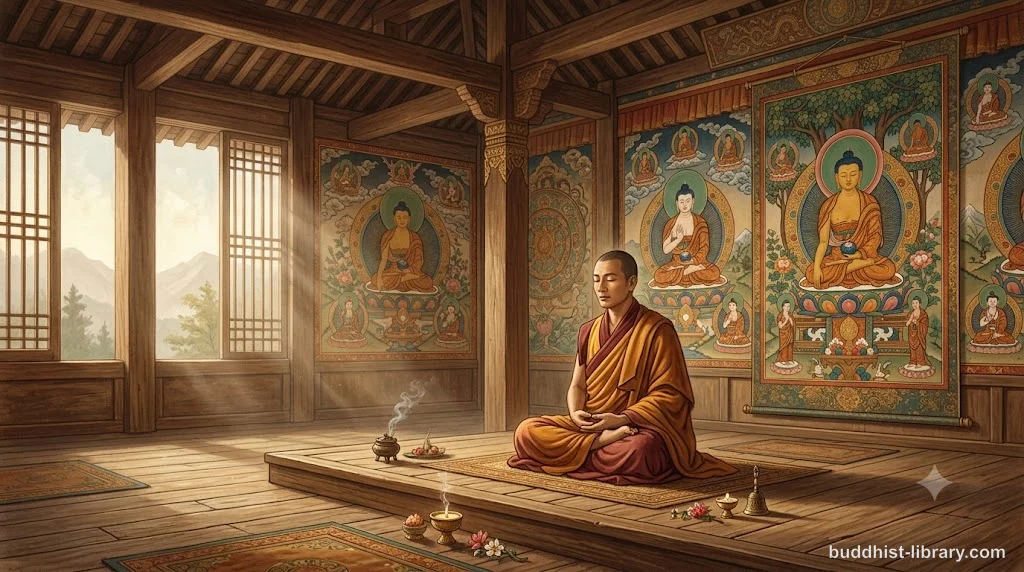
Posture: Sit comfortably with the spine upright. Traditional postures include cross-legged on a cushion or sitting in a chair with feet flat on the floor. Maintain a posture that supports alertness without unnecessary strain.
-
Anchor attention: Begin by establishing mindfulness of breathing — observing the natural rhythm of the breath at the nose, chest, or abdomen. This builds initial concentration (samatha).
-
Expand awareness: Once the mind has settled, expand attention to include the whole field of experience. Notice whatever arises most prominently: body sensations (pressure, warmth, tingling), sounds, emotions, thoughts.
-
Mental noting: Many traditions use brief mental labels to sharpen awareness: “rising, falling” for breath, “hearing” for sounds, “thinking” when thoughts appear, “pain” or “pleasure” for sensations. Labels are light and factual, not analytical.
-
Observe without reacting: When something pleasant arises, notice any craving to keep it. When something unpleasant appears, notice aversion or resistance. The practice is to simply observe these reactions without acting on them — returning again and again to bare awareness.
-
See impermanence: Watch each phenomenon arise, persist briefly, and pass away. A sound appears and fades. A thought surfaces and dissolves. Even intense emotions have a beginning, middle, and end.
Walking Meditation
Vipassanā isn’t limited to sitting. Walking meditation is a common complementary practice. You walk slowly, noting “lifting, moving, placing” as you observe the sensations in each step. This brings the same quality of mindful observation into movement.
Intensive Retreats
Many vipassanā practitioners attend silent meditation retreats (ranging from a weekend to several months) where they meditate for many hours each day under a teacher’s guidance. Retreats provide the sustained continuity of practice that allows deep insights to emerge. The most well-known formats include the Mahāsi Sayadaw tradition (Burma), S.N. Goenka’s 10-day courses, and Western Insight Meditation Society (IMS) retreats.
What Insights Arise from Vipassanā?
The ultimate goal of vipassanā is the direct realization of the Three Marks of Existence and, through that understanding, the gradual or sudden uprooting of greed, hatred, and delusion.
The Three Universal Characteristics
- Impermanence (anicca): Everything conditioned arises and passes away. No experience lasts. Even the sense of “I” observing is a process, not a thing.
- Unsatisfactoriness (dukkha): Because everything changes, clinging to anything — pleasure, identity, achievement — leads to frustration and suffering. What cannot be held cannot satisfy permanently.
- Non-self (anattā): There is no fixed, unchanging “self” behind experience. What we call “I” is a collection of changing processes — body, feelings, perceptions, mental formations, consciousness — none of which is truly “me” or “mine.”
As these truths become experientially obvious, attachment naturally weakens. You stop clinging to pleasant sensations because you’ve seen them vanish a thousand times. You stop resisting pain because you understand it’s temporary and impersonal. This shift from belief to knowing is what changes behavior and brings freedom.
Common Challenges in Vipassanā Practice
Restlessness and Distraction
The mind wanders constantly at first. This is normal.
Each time you notice distraction, gently return to the object of awareness. Eventually, distraction itself becomes an object of insight: “wandering, wandering.”
Physical Pain
Sitting still for extended periods often brings discomfort. Vipassanā asks you to observe pain with curiosity rather than immediately shifting position. You may discover that “pain” is actually a cluster of changing sensations — heat, throbbing, tightness — none of which stays the same for long. This investigation can be transformative, though teachers advise adjusting posture if pain becomes overwhelming.
Difficult Emotions
Suppressed grief, anger, or fear often surface during silent meditation. Teachers encourage “staying with” the emotion — observing it in the body as sensation, watching it intensify and subside — rather than avoiding or indulging it. This is where healing happens.
”Nothing Is Happening”
Periods of apparent stagnation are common. You sit daily and feel like you’re getting nowhere.
Teachers describe this as part of the path. The mind is reorganizing at a level below conscious awareness. Patience and continuity matter more than dramatic experiences.
How Does Vipassanā Relate to Daily Life?
Retreat practice provides depth. But the real test of vipassanā is everyday life. Can you bring the same quality of mindful awareness to frustration in traffic, conflict with a colleague, or the urge to check your phone?
Vipassanā trains you to pause before reacting.
You see anger arise as a wave of heat and tension. In that gap of awareness, you have a choice. You notice craving for praise without immediately seeking it. This space between stimulus and response is where freedom lives.
The Buddha encouraged integrating insight practice with ethical conduct (the Five Precepts) and wise effort. Vipassanā alone doesn’t make someone kind, but it reveals the suffering caused by unskillful actions — and that revelation naturally inclines the heart toward compassion.
Vipassanā Across Buddhist Traditions
Though most strongly associated with Theravāda Buddhism, the principle of insight meditation appears across all schools:
- Theravāda: Systematic vipassanā methods taught by Mahāsi Sayadaw, U Ba Khin, and their students (including S.N. Goenka and Western teachers like Joseph Goldstein and Sharon Salzberg).
- Zen (Mahāyāna): Shikantaza (“just sitting”) emphasizes non-conceptual awareness of present experience. Kōan practice also cultivates sudden insight.
- Tibetan (Vajrayāna): Mahāmudrā and Dzogchen traditions use direct observation of mind’s nature to recognize emptiness and luminosity.
The terminology and framing differ, but the core practice — turning awareness toward the nature of experience itself — is a common thread.
Read more:
- What Is Mindfulness (Sati) in Buddhism? — Understand the foundational quality cultivated in all vipassanā practice.
- The Satipaṭṭhāna Sutta: Foundations of Mindfulness Explained — Explore the primary sutta teaching the four establishments of mindfulness that frame vipassanā meditation.
- What Are the Jhānas? Understanding Meditative Absorption in Buddhism — Learn about the deep concentration states that often complement and support insight practice.
📖 Source / license: Satipaṭṭhāna Sutta (MN 10), Visuddhimagga (Path of Purification) by Buddhaghosa, and contemporary teachings by Mahāsi Sayadaw, S.N. Goenka, and Joseph Goldstein
Frequently asked questions
What is the difference between samatha and vipassanā meditation?
Samatha (calm-abiding) develops concentration and tranquility, often using a single object like the breath. Vipassanā (insight) investigates the true nature of phenomena — their impermanence, unsatisfactoriness, and lack of inherent self. While samatha calms the mind, vipassanā penetrates reality. Many practitioners develop both, as concentration supports insight.
Can I practice vipassanā meditation without a teacher?
While it's possible to begin vipassanā practice using recorded instructions or written guides, working with a qualified teacher is strongly recommended, especially for longer retreats. A teacher can guide you through difficult experiences, correct misunderstandings, and help you recognize genuine insight versus mental fabrication. Many traditions offer both group classes and individual guidance.
How long does it take to experience insight through vipassanā?
The timeline varies greatly by individual. Some practitioners report moments of insight within days of intensive practice, while others develop understanding gradually over months or years. Traditional texts describe a progressive path through stages of insight (ñāṇas). What matters most is consistent, patient practice rather than chasing specific experiences or timelines.
Is vipassanā only for Theravāda Buddhists?
No. While vipassanā is most systematically taught in Theravāda traditions, insight meditation appears across all Buddhist schools. Mahāyāna Zen practices like shikantaza and kōan study cultivate insight, as do Tibetan practices like Mahāmudrā and Dzogchen. The word and specific techniques may differ, but the principle of direct investigation into reality's nature is universal in Buddhism.