What Are Jātaka Tales? The Buddha's Past-Life Stories
Jātaka tales are traditional Buddhist stories recounting the Buddha’s past lives across hundreds of births—as prince, merchant, animal, and deity—each illustrating a virtue or moral teaching. Preserved in the Pali Canon and across Buddhist cultures, these 547 canonical stories (and many more in various traditions) serve as both entertainment and ethical instruction, showing how the future Buddha cultivated the perfections over countless lifetimes before his final awakening.
The Jātakas occupy a unique place in Buddhist literature: they bridge sacred scripture and folk narrative, philosophy and storytelling, making profound teachings accessible through memorable characters and situations.
What Does “Jātaka” Mean?
The word jātaka (Pali: jātaka, Sanskrit: jātaka) means “birth story” or “story of a previous birth.” Each tale recounts an episode from one of the Buddha’s past lives before he was born as Prince Siddhattha Gotama.
In the Theravada tradition, the canonical Jātaka collection appears in the Khuddaka Nikāya (“Minor Collection”), the fifth division of the Sutta Piṭaka. The verses (gāthā) are considered the Buddha’s own words, while the prose framing stories were added by later commentators to provide context.
Mahayana traditions preserve additional Jātakas not found in the Pali Canon, such as the Jātakamālā (“Garland of Birth Stories”) by Āryaśūra, which focuses on stories illustrating the perfections (pāramitā).
What Do Jātaka Tales Teach?
Each Jātaka illustrates one or more of the ten perfections (pāramī) that the Bodhisatta (the Buddha-to-be) cultivated over innumerable lifetimes:
- Generosity (dāna) — giving without hesitation
- Moral discipline (sīla) — ethical conduct
- Renunciation (nekkhamma) — letting go of worldly attachments
- Wisdom (paññā) — discernment and understanding
- Energy (viriya) — persistent effort
- Patience (khanti) — forbearance and tolerance
- Truthfulness (sacca) — honesty and integrity
- Determination (adhiṭṭhāna) — firm resolve
- Loving-kindness (mettā) — goodwill toward all beings
- Equanimity (upekkhā) — balanced, unshaken mind
The Bodhisatta appears in various forms—sometimes human (king, merchant, ascetic, beggar), sometimes animal (elephant, monkey, deer, parrot), and occasionally as a deity. This narrative flexibility allowed the stories to reach audiences across social classes and literacy levels.
Famous Examples
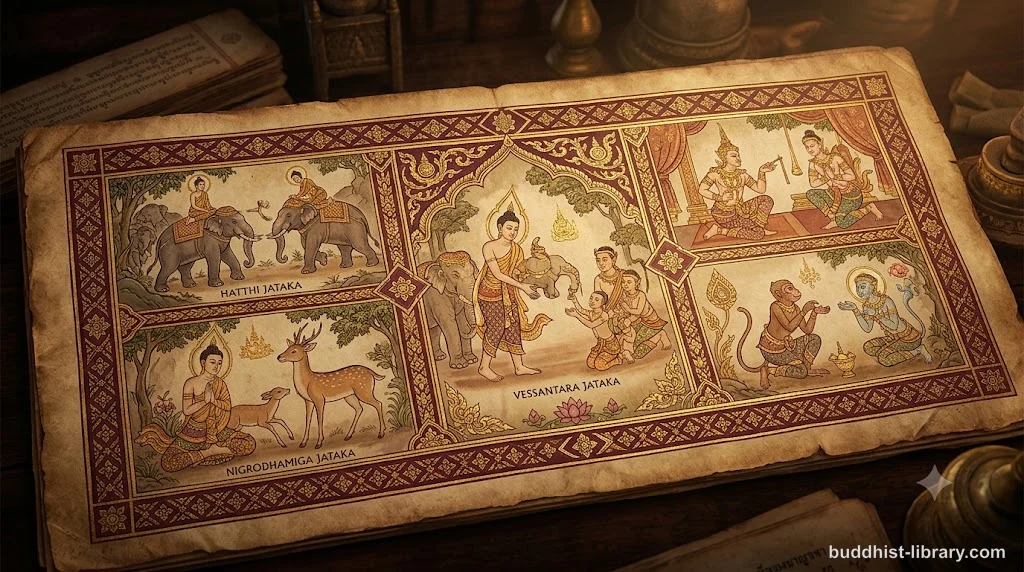
The Vessantara Jātaka: The Bodhisatta, as Prince Vessantara, perfects generosity by giving away everything—his magical rain-making elephant, his kingdom, his children, even his wife—demonstrating dāna to its ultimate extent before being reunited with his family and restored to his kingdom.
The Mahākapi Jātaka: The Bodhisatta as a great monkey king sacrifices his own body as a bridge so his troop can escape hunters, exemplifying mettā and selfless leadership.
The Telapatta Jātaka: The Bodhisatta, born as a tree spirit, demonstrates khanti (patience) when he refrains from harming a man who repeatedly damages his tree, eventually teaching the man through kindness rather than retaliation.
How Are Jātaka Tales Structured?
Canonical Jātakas follow a consistent four-part structure:
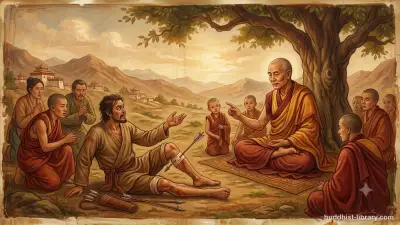
- Present-day frame (paccuppanna-vatthu): The Buddha encounters a situation or question among his disciples.
- Past-life story (atīta-vatthu): The Buddha narrates a tale from one of his previous births that parallels the present situation.
- Verses (gāthā): The core teaching in poetic form, considered the Buddha’s actual words preserved from that past life.
- Identification (samodhāna): The Buddha reveals which characters in the past story correspond to people in the present, typically identifying himself as the main virtuous character.
This framing device allows the Buddha to address contemporary moral questions through timeless narrative, making abstract virtues concrete and memorable.
Are Jātaka Tales Part of the Buddha’s Core Teaching?
This question has been debated among Buddhist scholars and practitioners. The verses are included in the Pali Canon and considered authentic, but the prose narratives are later commentary.
From a doctrinal perspective, Jātakas don’t introduce new philosophical concepts—the Four Noble Truths, dependent origination, and the Noble Eightfold Path remain the foundation. Instead, Jātakas illustrate how these teachings manifest in action across varied circumstances.
What makes Jātakas significant is their function as accessible entry points to Buddhist ethics. Before a person grasps the subtleties of anattā or paṭiccasamuppāda, they can understand the moral of a story about a selfless monkey king or an honest merchant.
How Have Jātaka Tales Influenced Buddhist Culture?
Beyond scripture, Jātakas have shaped Buddhist art, architecture, and popular culture for over two millennia:
- Visual art: Jātaka scenes adorn temple walls from Sanchi and Ajanta in India to Borobudur in Indonesia and Bagan in Myanmar.
- Performance: Traditional theater, puppetry, and dance across Southeast Asia regularly dramatize Jātaka stories.
- Literature: Jātakas influenced regional literary traditions—Thai Phra Malai, Burmese Ponnasa Jātaka, and Sinhalese Pansiya Panas Jātaka Potha Vahanse all adapted and expanded the corpus.
- Moral education: Parents and teachers use Jātakas to convey ethical lessons to children, much like Aesop’s fables in Western culture.
The Vessantara Jātaka, in particular, is so culturally significant in mainland Southeast Asia that it’s often recited annually in marathon sessions lasting through the night.
What About Animals in Jātaka Tales?
The presence of the Bodhisatta as animals in many Jātakas raises interesting questions. Does this imply literal rebirth across species? Does it suggest animals possess moral capacity?
Traditional commentaries treat these as straightforward past-life accounts within the framework of saṃsāra—the cycle of rebirth where beings take form according to their karma. The Bodhisatta’s ability to maintain wisdom and virtue even in animal form demonstrates the continuity of mental qualities across rebirths.
Modern readers may interpret these stories symbolically: the wise elephant represents strength tempered by compassion; the honest parrot embodies truthfulness regardless of circumstances. This allegorical reading doesn’t diminish the teachings—if anything, it universalizes them beyond literal belief in rebirth.
Either way, the consistent message remains: ethical qualities like generosity, patience, and loving-kindness matter more than one’s station, species, or circumstances.
Can We Practice Based on Jātaka Tales Today?
While the stories are ancient, the virtues they illustrate remain relevant. Consider these practical applications:
Generosity: The Vessantara Jātaka’s extreme giving may seem impractical, but it invites reflection—what am I withholding? Where does my attachment prevent genuine generosity? Even modest acts of dāna cultivate the same quality.
Patience: The tree spirit’s forbearance toward the man damaging his tree offers a model for responding to irritation without retaliation—applicable in traffic jams, workplace conflicts, or family tensions.
Wisdom: Many Jātakas feature the Bodhisatta resolving disputes or solving problems through clever insight rather than force—a reminder that Right View and discernment often surpass aggression.
The key is not to imitate the stories literally (most of us won’t give away our children or become tree spirits), but to cultivate the underlying qualities in our context.
Frequently Asked Questions
How many Jātaka tales are there?
The Pali Canon contains 547 Jātaka tales in the Khuddaka Nikāya, though various traditions preserve different collections. Mahayana sources include additional stories not found in the Theravada canon.
Are Jātaka tales considered historical fact?
Scholars generally view Jātakas as didactic literature—teaching stories meant to illustrate virtues and moral principles rather than historical records. Their value lies in the ethical teachings they convey.
Can laypeople study Jātaka tales?
Absolutely. Jātaka tales are accessible to everyone and have been popular teaching tools for laypeople throughout Buddhist history, often shared through art, drama, and oral storytelling.
What is the difference between Jātaka tales and other Buddhist scriptures?
Unlike the suttas (discourses) that record the Buddha’s teachings during his final life, Jātakas narrate his previous births as various beings—human and animal—before achieving Buddhahood, illustrating the long cultivation of perfections.
Where to Begin Reading Jātakas
For English readers, several translations offer accessible entry points:
- Short selections: Eugene Watson Burlingame’s Buddhist Legends (three volumes) presents key Jātakas with commentary.
- Complete collection: E.B. Cowell’s six-volume The Jātaka or Stories of the Buddha’s Former Births (Cambridge, 1895–1907) remains the standard English translation of all 547 canonical tales, available free online.
- Curated anthologies: Modern collections often select the most memorable stories, making them ideal for beginners.
Online, Access to Insight and SuttaCentral offer selected Jātakas with scholarly introductions.
Conclusion: Timeless Wisdom Through Story
Jātaka tales demonstrate that the Buddha’s path wasn’t achieved in a single lifetime but through sustained cultivation of virtue across countless births.
Whether read as literal past-life accounts or as universal moral fables, they convey a consistent message: ethical qualities—generosity, patience, honesty, compassion—transcend circumstances and gradually transform the mind.
Buddhism is sometimes stereotyped as austere or philosophical. Jātakas remind us it has always included storytelling, humor, drama, and the full range of human (and animal) experience. They make ancient wisdom tangible, memorable, and actionable.
Read more:
- The Dhammapada: An Introduction to the Buddha’s Verses — Another foundational Pali text that distills Buddhist ethics into memorable verses, complementing the narrative approach of Jātakas.
- The Ten Perfections (Pāramī): Qualities to Cultivate on the Path — A detailed exploration of the ten virtues that the Bodhisatta perfected across the Jātaka tales, essential for understanding what these stories teach.
- Dāna: The Practice and Power of Generosity in Buddhism — The first perfection illustrated in many Jātaka tales, including the famous Vessantara story, explained in contemporary practice.
📖 Source / license: Jātaka (Khuddaka Nikāya, Pali Canon); Buddhist Legends translated by Eugene Watson Burlingame; The Jātaka or Stories of the Buddha's Former Births, ed. E.B. Cowell
Frequently asked questions
How many Jātaka tales are there?
The Pali Canon contains 547 Jātaka tales in the Khuddaka Nikāya, though various traditions preserve different collections. Mahayana sources include additional stories not found in the Theravada canon.
Are Jātaka tales considered historical fact?
Scholars generally view Jātakas as didactic literature—teaching stories meant to illustrate virtues and moral principles rather than historical records. Their value lies in the ethical teachings they convey.
Can laypeople study Jātaka tales?
Absolutely. Jātaka tales are accessible to everyone and have been popular teaching tools for laypeople throughout Buddhist history, often shared through art, drama, and oral storytelling.
What is the difference between Jātaka tales and other Buddhist scriptures?
Unlike the suttas (discourses) that record the Buddha's teachings during his final life, Jātakas narrate his previous births as various beings—human and animal—before achieving Buddhahood, illustrating the long cultivation of perfections.