What Is Saṃsāra? The Wheel of Rebirth in Buddhism
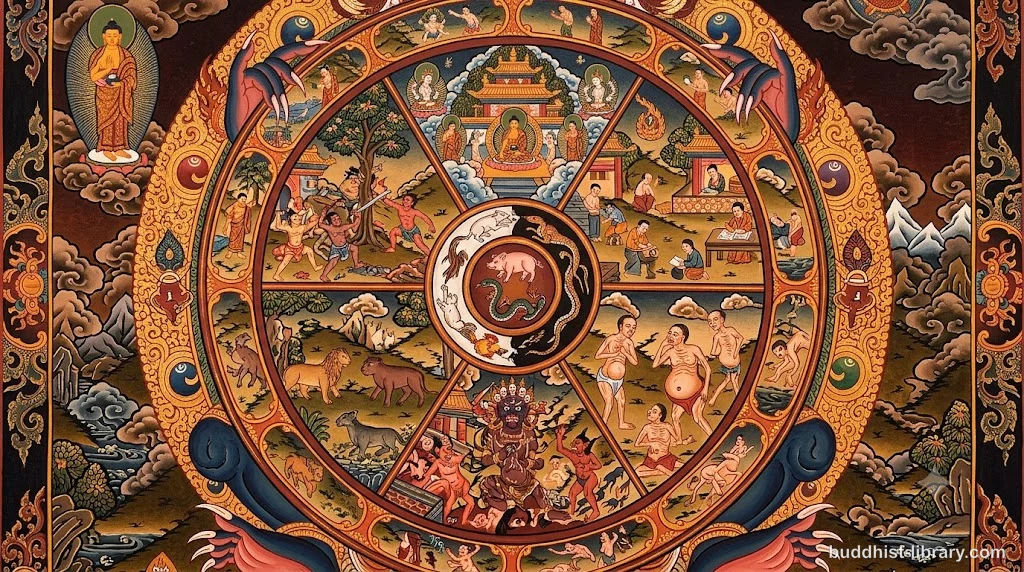
Saṃsāra is the Buddhist term for the cycle of repeated birth, death, and rebirth driven by karma and craving. It describes not just reincarnation, but the entire process of becoming—an endless wheel of existence spanning countless lifetimes across multiple realms, perpetuated by ignorance and desire, and escapable only through awakening to Nibbāna.
The Buddha spoke of this cycle not as punishment, but as a natural law—the result of actions (karma) propelled by unenlightened mental states. Understanding saṃsāra is essential to grasping what Buddhism aims to liberate us from.
What Does Saṃsāra Mean?
The Pali and Sanskrit word saṃsāra literally means “wandering on” or “continuous flowing.” It refers to the repetitive cycle through which beings traverse birth after birth, driven by the momentum of past actions and the mental defilements that fuel them.
In the Saṃyutta Nikāya (SN 15), the Buddha illustrates the incomprehensible length of saṃsāra using vivid metaphors: the tears shed across countless lifetimes would fill the oceans; the bones of one person accumulated over rebirths would pile higher than mountains. These teachings underscore that this wandering has been going on beginninglessly for each being—we have all been cycling through birth and death for an unimaginable expanse of time.
Unlike the Abrahamic notion of a single life followed by eternal heaven or hell, Buddhism presents existence as an ongoing process with no absolute beginning, but a possible end through awakening.
How Does the Wheel of Saṃsāra Turn?
The cycle is sustained by three interconnected processes:
1. Karma and Rebirth
Every intentional action—mental, verbal, or physical—leaves a karmic imprint. Wholesome actions (rooted in non-greed, non-hatred, non-delusion) plant seeds for pleasant rebirths and conditions; unwholesome actions (rooted in greed, hatred, delusion) generate suffering and unfortunate rebirths.
At death, consciousness does not simply vanish. Instead, the accumulated karmic momentum propels a new “linking” into another existence. This is not the transmigration of a soul (Buddhism denies a permanent self), but the continuation of a causal process—like one candle lighting another without transferring substance.
2. The Twelve Links of Dependent Origination
The Buddha described the mechanics of saṃsāra through paṭiccasamuppāda (dependent origination), a twelve-link chain showing how ignorance leads to rebirth:
- Ignorance (avijjā)
- Volitional formations (saṅkhāra)
- Consciousness (viññāṇa)
- Name-and-form (nāma-rūpa)
- Six sense bases (saḷāyatana)
- Contact (phassa)
- Feeling (vedanā)
- Craving (taṇhā)
- Clinging (upādāna)
- Becoming (bhava)
- Birth (jāti)
- Aging and death (jarā-maraṇa)
This cycle repeats across lifetimes: ignorance conditions formations, which condition consciousness, which re-arises in a new birth, leading again to aging, death, and rebirth. Breaking the chain—especially at ignorance or craving—stops the wheel.
3. The Three Root Poisons
Three fundamental mental defilements drive the engine of saṃsāra:
- Greed (lobha)—endless desire for pleasure, possessions, experiences
- Hatred (dosa)—aversion, anger, ill will
- Delusion (moha)—ignorance of the Four Noble Truths, misunderstanding reality
These poisons perpetuate unwholesome karma and keep beings bound to the cycle. Their opposites—generosity, loving-kindness, and wisdom—lead toward liberation.
What Are the Realms of Saṃsāra?
Traditional Buddhist cosmology describes six realms (or five in some schools) where beings can be reborn based on their karma:
- Hell realms (naraka)—intense suffering; rebirth driven by severe hatred and cruelty
- Hungry ghost realm (preta)—gnawing craving and insatiable hunger; result of greed and stinginess
- Animal realm (tiryak)—instinct-driven existence; consequence of ignorance and delusion
- Human realm (manuṣya)—balanced pleasure and pain; ideal for spiritual practice
- Demigod realm (asura)—competitive and envious; driven by jealousy and pride
- Heavenly realms (deva)—blissful but temporary; result of wholesome karma but still within saṃsāra
Crucially, even the highest heavenly realms are impermanent. Devas eventually exhaust their good karma and are reborn elsewhere—possibly in lower realms. Only Nibbāna offers permanent escape.
How Is Saṃsāra Different from Reincarnation?
Reincarnation in Hindu and popular Western contexts often implies a soul or self (ātman) that transmigrates between bodies. Buddhism rejects this view. The doctrine of anattā (non-self) denies any permanent, unchanging essence that travels from life to life.
Instead, what continues is a process—a stream of consciousness and karmic momentum. Think of it like a river: the water flowing downstream today is not the same water that flowed yesterday, yet the river persists as a continuous process. Similarly, the person reborn is neither entirely the same nor entirely different from the one who died.
The Milindapañha (Questions of King Milinda) offers another analogy: a flame passed from one lamp to another. The second flame arises dependent on the first, but it is not identical to it. Connection without identity.
Can You Escape Saṃsāra?
Yes—and this is the central promise of Buddhism. Liberation from saṃsāra is called Nibbāna (Pali) or Nirvāṇa (Sanskrit), which literally means “extinguishing” or “blowing out”—the cessation of the fires of greed, hatred, and delusion.
The path to escape is the Noble Eightfold Path: Right View, Right Intention, Right Speech, Right Action, Right Livelihood, Right Effort, Right Mindfulness, and Right Concentration. Through sustained ethical conduct, mental cultivation, and wisdom, practitioners uproot the defilements that bind them to the wheel.
The Buddha and countless arahants (fully enlightened disciples) have demonstrated that liberation is achievable in this very life. Upon their deaths, they are not reborn—they have stepped off the wheel entirely.
Why Does Saṃsāra Matter?
Understanding saṃsāra clarifies what Buddhism is fundamentally about: liberation from suffering. The First Noble Truth teaches that all conditioned existence is marked by dukkha (unsatisfactoriness, suffering). Saṃsāra is the broader context—an endless repetition of birth, aging, sickness, death, and rebirth.
Recognizing the futility and suffering inherent in this cycle generates saṃvega—a sense of spiritual urgency. This urgency motivates practice. The Buddha’s teaching is not about attaining a better rebirth in saṃsāra, but about transcending it entirely.
Key Takeaways
- Saṃsāra is beginningless but can end: Each being has wandered through countless lifetimes, but liberation is possible through awakening.
- It operates through karma and mental defilements: Intentional actions rooted in greed, hatred, and delusion propel the cycle forward.
- No soul transmigrates: What continues is a causal process, not a permanent self.
- All realms within saṃsāra are impermanent: Even heavenly rebirths are temporary; only Nibbāna offers lasting peace.
- The path out is the Noble Eightfold Path: Through ethical living, mental training, and wisdom, the cycle can be broken.
Read more:
- Karma and Rebirth in Buddhism: How They Actually Work—Dive deeper into the mechanics of karma that drive the saṃsāric process and how actions shape future lives.
- What Is Dependent Origination (Paṭiccasamuppāda)?—Explore the twelve-link chain that explains precisely how ignorance and craving perpetuate the cycle of rebirth.
- What Is Nirvana (Nibbāna)? Meaning and Misconceptions—Understand the ultimate goal of Buddhist practice—the complete liberation from saṃsāra and the end of all suffering.
📖 Source / license: SuttaCentral (SN 15, SN 22, MN 9), Access to Insight (Ṭhānissaro Bhikkhu translations), The Connected Discourses of the Buddha (Bhikkhu Bodhi)
Frequently asked questions
Is saṃsāra the same as reincarnation?
Not exactly. Reincarnation implies a fixed soul transmigrating between bodies. Saṃsāra in Buddhism is the continuation of a process without a permanent self—what continues is the momentum of karma and mental conditioning, not an unchanging essence.
Can you escape saṃsāra in this lifetime?
Yes. The Buddha and countless arahants (fully awakened disciples) attained Nibbāna in their lifetimes, ending the cycle of rebirth. The Noble Eightfold Path is the practical method taught for this liberation.
What keeps us trapped in saṃsāra?
Three root causes keep the wheel turning: craving (taṇhā), ignorance (avijjā), and clinging (upādāna). These mental defilements generate karma that fuels continued rebirth. Eliminating these defilements through wisdom and practice ends the cycle.
Do all Buddhist traditions accept saṃsāra literally?
Most traditional Theravāda, Mahāyāna, and Vajrayāna schools accept literal rebirth. Some modern interpretations view saṃsāra psychologically—the cycle of suffering we create moment-to-moment through clinging and identification. Both readings appear in classical texts.