The Three Refuges (Tisaraṇa): Taking Refuge in Buddha, Dhamma, Sangha
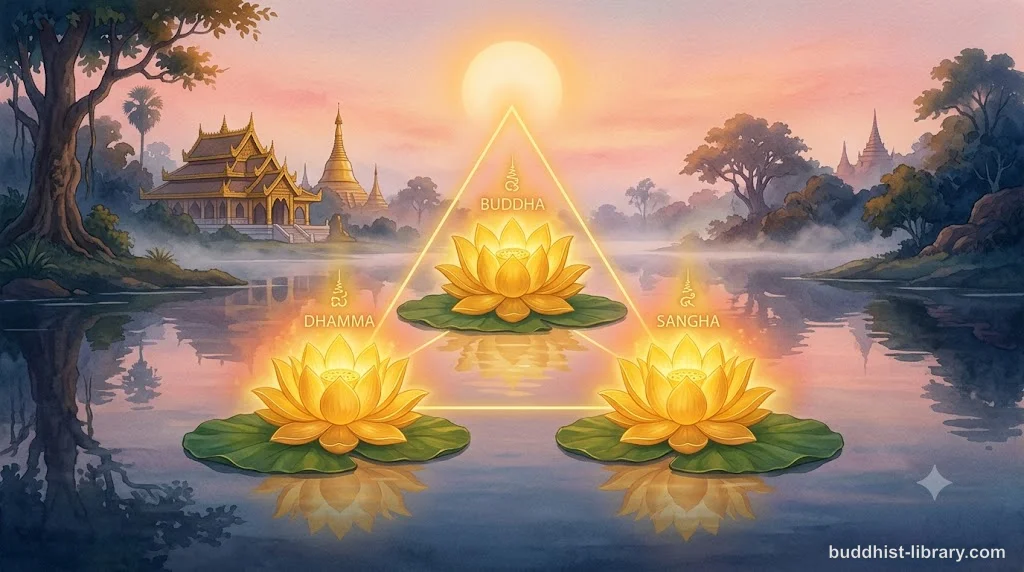
The Three Refuges — Buddha, Dhamma, Sangha — are the foundation of Buddhist practice. Taking refuge means committing to the awakened teacher, the path of truth, and the community of practitioners as your guides toward liberation from suffering. This is how the Buddhist journey begins.
If you’ve ever wondered what makes someone “Buddhist,” the answer is simple: taking refuge in the Three Refuges. Also called the Triple Gem or Tisaraṇa in Pali, these are the Buddha (the teacher), the Dhamma (the teaching), and the Sangha (the community). Together, they form the core commitment that defines the Buddhist path.
This is not mere belief. It is a living practice — a daily return to what guides, supports, and protects you on the path to awakening. Not a creed. A compass.
What Are the Three Refuges?
The Three Refuges are the foundational supports of Buddhist practice. The traditional Pali formula, recited by Buddhists worldwide, goes:
Buddhaṁ saraṇaṁ gacchāmi.
I go to the Buddha for refuge.Dhammaṁ saraṇaṁ gacchāmi.
I go to the Dhamma for refuge.Saṅghaṁ saraṇaṁ gacchāmi.
I go to the Sangha for refuge.
Each refuge represents a distinct but interdependent pillar:
The Buddha: The Awakened Teacher
The Buddha is Siddhattha Gotama, the historical figure who attained full awakening (sammāsambodhi) 2,600 years ago. Taking refuge in the Buddha does not mean worshiping a god. It means recognizing that a human being — through wisdom, effort, and ethical conduct — achieved complete liberation from suffering, and that this same potential exists within you.
The Buddha is the living proof that awakening is possible.
The Dhamma: The Teaching and the Truth
The Dhamma (Dharma in Sanskrit) has two interrelated meanings:
- The Buddha’s teaching — the Four Noble Truths, the Noble Eightfold Path, the law of dependent origination, and all the discourses preserved in the Pāli Canon and Mahāyāna sūtras.
- The natural law of reality — the truth of impermanence (anicca), suffering (dukkha), and non-self (anattā).
Taking refuge in the Dhamma means trusting that the path the Buddha taught leads to the cessation of suffering. It is not blind faith; it is confidence born from investigation, practice, and direct experience.
The Sangha: The Community of Practitioners
The Sangha has both a narrow and a broad meaning:
- The Noble Sangha (Ariya Sangha): those who have attained at least the first stage of awakening — stream-entry (sotāpanna).
- The conventional Sangha: the community of monks, nuns, and laypeople who practice the Dhamma together.
Taking refuge in the Sangha means recognizing that the path is best walked with support. You learn from those ahead of you, encourage those beside you, and draw strength from the collective practice.
The Sangha is the refuge that breathes and walks with you.
Why Do Buddhists Take Refuge?
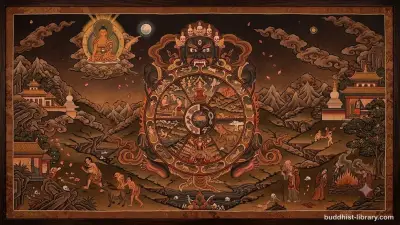
The Buddha taught that all beings wander in saṃsāra — the cycle of birth, death, and rebirth — driven by ignorance and craving. Taking refuge is the conscious decision to stop wandering aimlessly and to follow a tested path toward liberation.
Refuge as Orientation
Life offers countless competing values: wealth, pleasure, power, fame. The Three Refuges act as a spiritual compass. When you take refuge, you declare: “These are my true guides. This is the direction I choose.”
Not rejection of the world. Clarity about what actually leads to peace.
Refuge as Protection
The Pali word saraṇa means “refuge” or “shelter.” The Buddha compared the Three Refuges to a safe island in the flood of existence. They protect not by granting immunity from suffering, but by offering the tools, teachings, and companionship needed to navigate it wisely.
Without refuge, you are adrift.
How Do You Take Refuge?
Taking refuge can be formal or informal, private or public. There is no single right way.
Formal Refuge Ceremony
In many Buddhist communities, refuge is taken in a ceremony led by a monk, nun, or qualified teacher. The ceremony typically includes:
- Recitation of the refuge formula in Pali or the local language.
- Taking the Five Precepts (ethical guidelines for laypeople).
- Reception of a Dhamma name (in some traditions, especially Mahāyāna and Vajrayāna).
This ceremony marks your formal entry into the Buddhist community.
Informal Personal Refuge
Many practitioners take refuge privately, reciting the formula during meditation or daily practice. This personal commitment is just as valid. The Buddha emphasized intention and understanding over ritual. What matters is sincerity, not ceremony.
Daily Practice of Refuge
Taking refuge is not a one-time event. It is a daily practice. Many Buddhists recite the refuge formula every morning, before meditation, or when facing difficulty. Each recitation is a renewal — a reminder of your chosen path.
Some traditions chant the refuges three times to deepen the imprint on the mind.
The Three Refuges Across Traditions
While the core refuge formula is universal, different Buddhist traditions emphasize distinct aspects.
Theravāda: Refuge in the Historical Buddha
Theravāda tradition focuses on the historical Buddha, the Pāli Canon (Tipiṭaka), and the monastic Sangha. The refuge is straightforward: trust the teacher, study the texts, support the monks and nuns.
Lay practitioners often take refuge alongside the Five Precepts, integrating ethical conduct into the refuge commitment.
Mahāyāna: Refuge and the Bodhisattva Path
Mahāyāna adds the Bodhisattva vow — the aspiration to attain Buddhahood not just for oneself but for the liberation of all beings. Refuge here includes reverence for all Buddhas and Bodhisattvas across time and space, not just the historical Gotama.
The Sangha expands to include all beings walking the Bodhisattva path.
Vajrayāna: Refuge in the Three Roots
Vajrayāna Buddhism (Tibetan traditions) includes the standard Three Refuges but adds the Three Roots: the Guru (teacher), the Yidam (meditational deity), and the Ḍākinī or Dharmapāla (protectors). The guru is considered essential — the living link to the lineage of awakening.
Refuge in Vajrayāna is thus sixfold, though the original Three Refuges remain foundational.
Common Misconceptions About Taking Refuge
”Taking refuge means I can’t practice other religions.”
Not necessarily. While some Buddhists view refuge as an exclusive commitment, others integrate Buddhist practice with elements of their cultural or familial traditions. The Buddha encouraged investigation over dogma. What matters is whether your practice genuinely reduces suffering and increases wisdom.
”I have to believe the Buddha was divine.”
No. The Buddha was human. His awakening was the result of human effort, insight, and ethical discipline — not divine intervention. Taking refuge in the Buddha is trusting in human potential, not worshiping a deity.
”Refuge is only for monks and nuns.”
False. The vast majority of Buddhists are laypeople who have taken refuge. Monastic and lay practitioners share the same refuges; they simply express them differently in daily life.
”Once I take refuge, I’m locked in forever.”
Refuge is a commitment, not a cage. You are free to change your path. However, the deeper your practice, the less likely you will want to abandon it — not because of obligation, but because you see its results.
The Psychological Depth of Refuge
Modern teachers often interpret the Three Refuges psychologically:
- Refuge in the Buddha: Trust in your own awakened potential (Buddha-nature).
- Refuge in the Dhamma: Commitment to truth, investigation, and reality as it is.
- Refuge in the Sangha: Recognition that transformation happens in relationship, not isolation.
This is not a departure from tradition. It is the same teaching expressed in contemporary language. The Buddha himself said, “Be an island unto yourself” (attadīpā, DN 16 — though often rendered “lamp,” the Pali dīpa means island in this context). The external refuges point inward.
Key Principles of the Three Refuges
- They are interconnected. You cannot truly take refuge in one without the others. The Buddha points to the Dhamma; the Dhamma requires the Sangha to be preserved and practiced.
- They are not objects of worship. They are guides, supports, and ideals. Respect, yes. Blind devotion, no.
- They grow with your practice. A beginner takes refuge differently than someone with years of meditation. The formula stays the same; the depth changes.
- They are tested by life. Refuge is not abstract. It is where you turn when suffering arises, when doubt clouds the mind, when the path feels steep.
Frequently Asked Questions
What are the Three Refuges in Buddhism?
The Three Refuges (Tisaraṇa or Triple Gem) are the Buddha (the awakened teacher), the Dhamma (the teaching), and the Sangha (the community of practitioners). Taking refuge means committing to these as your spiritual guides and supports on the path to liberation.
Do I have to be Buddhist to take the Three Refuges?
Taking the Three Refuges is traditionally how someone formally becomes Buddhist. However, anyone can appreciate and learn from the Buddha’s teachings without making this formal commitment. Many people study Buddhism for years before deciding to take refuge.
What happens when you take refuge in Buddhism?
Taking refuge is a personal commitment, not a binding contract. It marks your intention to follow the Buddhist path, study the teachings, and practice with ethical conduct and meditation. Some people take refuge privately; others do so in a ceremony with a teacher and community.
Is taking refuge the same across all Buddhist traditions?
The core formula is the same across Theravāda, Mahāyāna, and Vajrayāna traditions. However, Mahāyāna adds the Bodhisattva vow, and Vajrayāna includes refuge in the guru and protective deities. The spirit — seeking guidance and support on the path — remains consistent.
Can I take refuge without a teacher?
Yes. Many practitioners take refuge on their own after studying the teachings and feeling a genuine commitment. However, having a teacher or community provides guidance, accountability, and encouragement. If you choose to take refuge alone, consider connecting with a Sangha later for support.
What are the Five Precepts, and do I have to take them with the refuges?
The Five Precepts are ethical guidelines for laypeople: refrain from killing, stealing, sexual misconduct, false speech, and intoxication. In many traditions, they are taken alongside the refuges. They are not rigid rules but training principles that support mental clarity and compassion.
Conclusion: A Lifelong Compass
The Three Refuges are not a membership card. They are a compass. When you lose your way, they bring you back. When the mind is confused, they clarify. When suffering arises, they remind you: there is a path, a teacher who walked it, companions walking it with you.
To take refuge is to stop drifting and start walking — toward clarity, toward freedom, toward the end of suffering.
As the Buddha said in the Dhammapada:
“Those who have gone to the Buddha, the Dhamma, and the Sangha for refuge, who see with right wisdom the Four Noble Truths — dukkha, its arising, its cessation, and the Noble Eightfold Path leading to the end of dukkha — that is the safe refuge, that is the highest refuge. Having gone to that refuge, one is released from all suffering.”
— Dhammapada 190–192
Read more:
- The Four Noble Truths: The Heart of the Buddha’s Teaching — The foundational teaching that the refuges support you to understand and embody.
- The Five Precepts: Buddhist Ethics in Daily Life — Often taken alongside the refuges, these ethical guidelines form the practical foundation of Buddhist lay practice.
- What Is Mindfulness (Sati) in Buddhism? — Once you have taken refuge, mindfulness is one of the first practices you cultivate on the path.
📖 Source / license: Khuddakapāṭha (Minor Readings), Tipiṭaka; Access to Insight (Ṭhānissaro Bhikkhu); SuttaCentral
Frequently asked questions
What are the Three Refuges in Buddhism?
The Three Refuges (Tisaraṇa or Triple Gem) are the Buddha (the awakened teacher), the Dhamma (the teaching), and the Sangha (the community of practitioners). Taking refuge means committing to these as your spiritual guides and supports on the path to liberation.
Do I have to be Buddhist to take the Three Refuges?
Taking the Three Refuges is traditionally how someone formally becomes Buddhist. However, anyone can appreciate and learn from the Buddha's teachings without making this formal commitment. Many people study Buddhism for years before deciding to take refuge.
What happens when you take refuge in Buddhism?
Taking refuge is a personal commitment, not a binding contract. It marks your intention to follow the Buddhist path, study the teachings, and practice with ethical conduct and meditation. Some people take refuge privately; others do so in a ceremony with a teacher and community.
Is taking refuge the same across all Buddhist traditions?
The core formula is the same across Theravāda, Mahāyāna, and Vajrayāna traditions. However, Mahāyāna adds the Bodhisattva vow, and Vajrayāna includes refuge in the guru and protective deities. The spirit — seeking guidance and support on the path — remains consistent.