What Is the Saṅgha? The Buddhist Community and Its Role
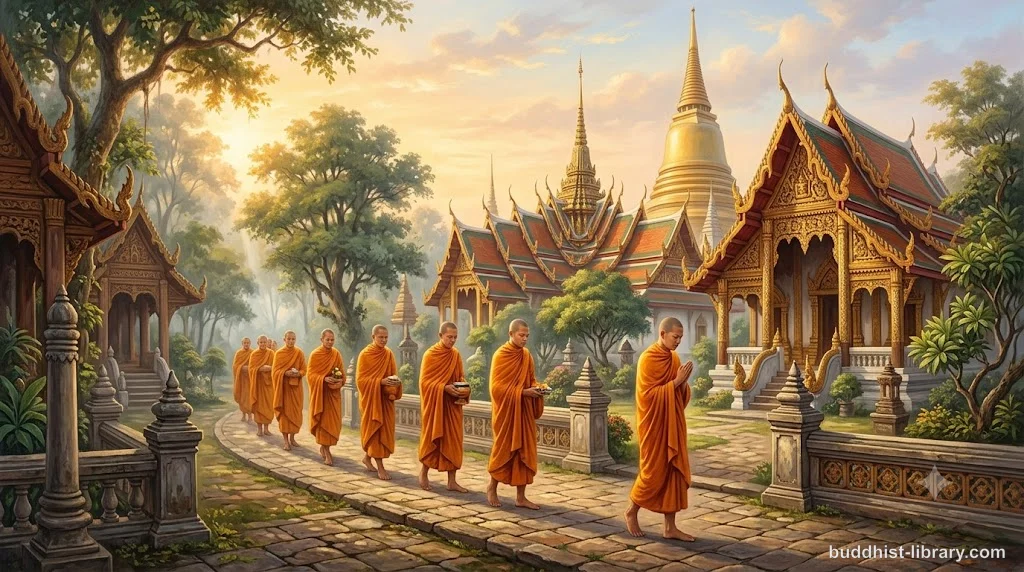
The Saṅgha is the Buddhist community — most precisely, the ordained monks (bhikkhus) and nuns (bhikkhunīs) who preserve the Buddha’s teachings and live by the monastic code (Vinaya). In a deeper sense, it also refers to the Ariya Saṅgha, the Noble Community of all who have attained at least the first stage of awakening, whether ordained or lay. The Saṅgha is the third of the Three Refuges and an essential pillar of Buddhist life.
The word “Saṅgha” (Sanskrit: Saṃgha; Pali: Saṅgha) literally means “assembly” or “community.”
Many spiritual movements in the Buddha’s time had their own saṅghas. What made the Buddhist Saṅgha different? Its disciplined structure, ethical rigor, and singular focus on awakening. Over 2,600 years, these qualities haven’t just survived — they’ve defined what a Saṅgha is. But the term carries layers that need unpacking.
What Are the Two Meanings of Saṅgha?
Buddhist texts distinguish between two kinds of Saṅgha — the conventional Saṅgha and the Ariya Saṅgha (Noble Saṅgha).
The Conventional Saṅgha (Sammati Saṅgha)
This is the ordained monastic community — the bhikkhus (monks) and bhikkhunīs (nuns) who have formally taken ordination and live according to the Vinaya, the monastic code of discipline established by the Buddha.
The conventional Saṅgha is defined by ordination, not spiritual attainment.
A newly ordained monk is part of it even if he hasn’t experienced any deep realization. A lay person with profound insight? Not part of the conventional Saṅgha, no matter how far they’ve progressed.
The Buddha laid out the structure in the Vinaya Piṭaka — rules, ordination procedures, communal harmony (saṅghakamma), the relationship between monastics and lay supporters. This conventional Saṅgha became the primary vehicle for preserving, practicing, and transmitting the Dharma across 2,600 years.
The Ariya Saṅgha (Noble Saṅgha)
This is the community of noble disciples — those who have attained at least the first stage of awakening, known as stream-entry (sotāpanna). This Saṅgha is defined by spiritual realization, not by robes or ordination status.
The Ariya Saṅgha includes four pairs of individuals (or eight types):
- Stream-enterers and those on the path to stream-entry
- Once-returners and those on the path to once-returning
- Non-returners and those on the path to non-returning
- Arahants and those on the path to arahantship
A lay person who has realized stream-entry is part of the Ariya Saṅgha, even without robes. An ordained monk who hasn’t yet had any awakening experience? Not yet part of the Ariya Saṅgha, though certainly part of the conventional one.
When Buddhists recite “I take refuge in the Saṅgha,” tradition holds they’re taking refuge primarily in the Ariya Saṅgha. Why? Because these are the living witnesses that the path actually works.
Why Is the Saṅgha One of the Three Refuges?
The Three Refuges — Buddha, Dharma, Saṅgha — form the foundation of Buddhist identity. In the traditional Pali formula:
Buddhaṃ saraṇaṃ gacchāmi
Dhammaṃ saraṇaṃ gacchāmi
Saṅghaṃ saraṇaṃ gacchāmi
(“I go to the Buddha for refuge. I go to the Dharma for refuge. I go to the Saṅgha for refuge.”)
Why is the Saṅgha the third refuge?
The Saṅgha is the living embodiment of the path. The Buddha is gone. The Dharma exists in texts. But the Saṅgha? Living practitioners who walk the path, embody its fruits, and prove awakening is possible in this life.
The Saṅgha transmits the teachings. The monastic Saṅgha memorized the suttas, recited them, eventually wrote them down. Without this unbroken line of practice and transmission, the Dharma would have vanished.
The Saṅgha creates conditions for practice. Monastic communities offer environments built for training — free from household demands, surrounded by others committed to the same goal. For lay practitioners, the Saṅgha provides guidance, inspiration, and accountability.
Bhikkhu Bodhi writes in Going for Refuge:
“The Saṅgha is the community of noble disciples, those who have entered the path to liberation… It is to this community that we turn for guidance and support on our own journey.”
What Is the Role of the Monastic Saṅgha?
The conventional monastic Saṅgha plays several interrelated roles:
Preservation of the Dharma
Three months after the Buddha’s death, the First Buddhist Council convened. The Saṅgha took responsibility for preserving his teachings right then — reciting the Vinaya and suttas, agreeing on what was authentic, passing it down through unbroken lineages.
In every country where Buddhism took root, the monastic Saṅgha became custodians of scripture, commentaries, practice methods. The Pali Canon (Tipiṭaka) exists today because generations of monks memorized it, recited it, eventually transcribed it. No monastics, no Canon.
Living the Renunciant Life
The monastic Saṅgha lives out the Buddha’s teaching on renunciation (nekkhamma). By relinquishing household life, wealth, and family ties, monastics dedicate themselves fully to the training. This is not an escape but a commitment — giving up lesser satisfactions to pursue the deepest freedom.
The Vinaya establishes the framework for this renunciant life: the 227 rules for monks (bhikkhus) and 311 rules for nuns (bhikkhunīs in the Theravāda count) cover ethics, communal harmony, and practical conduct. The rules are not arbitrary — each traces back to a specific incident, and together they create a container for sustained practice.
Teaching and Guidance
Monastics are expected to teach the Dharma to those who seek it. The Buddha himself spent 45 years traveling and teaching after his awakening. Senior monks and nuns carry on this role, offering meditation instruction, Dharma talks, and personal guidance.
In Theravāda countries, it is common for laypeople to visit monasteries on Uposatha days (observance days aligned with the lunar calendar) to hear teachings, practice meditation, and take the Eight Precepts for a day. This regular contact between monastics and laity keeps the teachings alive in daily life.
Creating a Field of Merit
In traditional Buddhist cultures, the relationship between monastics and lay supporters is symbiotic.
Laypeople offer food, robes, shelter, medicine (dāna, generosity). Monastics offer the Dharma and live as examples of ethical purity and dedicated practice.
This isn’t a transaction. It’s mutual benefit. For laypeople, supporting the Saṅgha is merit-making (puñña) and a way to participate in preserving the teachings. For monastics, relying on alms reinforces humility, gratitude, non-attachment to material wealth.
Can Lay Practitioners Be Part of the Saṅgha?
This is a question with different answers depending on context.
Strictly speaking: No. The conventional Saṅgha is monastics only — those who’ve taken formal ordination and live under the Vinaya.
More broadly: Yes. Lay Buddhists — upāsakas (male lay followers) and upāsikās (female lay followers) — are part of the wider Buddhist community. Some teachers use “Saṅgha” for the entire practicing community, ordained and lay, especially in Western and Mahāyāna contexts.
At the deepest level: Absolutely. A lay person who’s attained stream-entry is part of the Ariya Saṅgha. Attainment doesn’t care about robes. The suttas record many lay arahants, though monastic life is widely considered more conducive to full liberation.
Ṭhānissaro Bhikkhu clarifies this in his writings:
“The Saṅgha as a refuge is the community of those who have attained at least stream-entry. This includes both monastics and laypeople. However, the Buddha also established a conventional Saṅgha — the bhikkhu and bhikkhunī Saṅgha — as the institutional structure to preserve the Dharma.”
The key point: lay practitioners are essential to the Saṅgha’s continuity, even if they are not part of the ordained community. The monastic Saṅgha depends on lay support, and the lay community depends on monastics for guidance and the preservation of practice traditions.
How Does the Saṅgha Support the Path to Awakening?
The Buddha emphasized that the path to liberation is best traveled in community. In the Mahāparinibbāna Sutta (DN 16), shortly before his death, the Buddha described the conditions for the Saṅgha’s longevity:
- Meeting regularly to discuss the Dharma
- Living in harmony, respecting communal decisions
- Not abandoning established training rules
- Respecting elders and listening to their guidance
- Not being overpowered by craving for continued existence
- Delighting in solitude and meditation
- Establishing mindfulness so that good companions in the Dharma would come
These principles apply not just to monastics but to any community of practitioners. The Saṅgha works when it fosters kalyāṇa-mittatā (spiritual friendship) — companions who encourage one another toward virtue, concentration, and wisdom.
In practice, the Saṅgha provides:
Accountability. It’s easier to keep precepts when others are doing the same.
Inspiration. Seeing others progress motivates your own effort.
Correction. Spiritual friends point out blind spots you can’t see yourself.
Transmission. Personal guidance from those further along is invaluable. Books aren’t enough.
The Buddha called spiritual friendship “the entire holy life” (SN 45.2). This is what the Saṅgha does for each practitioner.
What Are the Key Qualities of a Healthy Saṅgha?
Not all communities that call themselves “Saṅgha” function in the way the Buddha intended. A healthy Saṅgha, according to the suttas, is marked by:
1. Harmony (Samagga): Decisions are made collectively through proper procedures. Disputes are resolved according to Dharma and Vinaya, not by power or personality.
2. Ethical integrity (Sīla): Members live by the precepts appropriate to their level (Five Precepts for laypeople, Ten Precepts for novices, full Vinaya for bhikkhus/bhikkhunīs). Ethical lapses are acknowledged and corrected, not hidden.
3. Dedication to practice (Bhāvanā): The community prioritizes meditation, study, and ethical training. Social activities are secondary to the path.
4. Mutual respect (Gārava): Juniors respect seniors, seniors care for juniors. There is no room for arrogance or contempt.
5. Transparency (Ācāra): Teachings, finances, and decision-making are open and clear. The community is not secretive or exclusive.
When these qualities degrade, the Saṅgha risks becoming just another social club or, worse, a source of harm rather than liberation.
How Do Theravāda, Mahāyāna, and Vajrayāna Understand the Saṅgha Differently?
While all Buddhist traditions honor the Saṅgha as one of the Three Refuges, there are differences in emphasis:
Theravāda
Theravāda maintains the strict distinction between the conventional monastic Saṅgha and the Ariya Saṅgha. The monastic Saṅgha is central — the primary refuge and the living link to the Buddha. Lay practitioners support the monastics and engage in practice, but full renunciation (going forth as a monastic) is seen as the optimal condition for reaching nibbāna.
In Theravāda countries (Sri Lanka, Thailand, Myanmar, Cambodia, Laos), monks hold a revered social role. Offering alms to monks is a daily ritual, and monastic ordination (even temporary) is a significant rite of passage, especially for men.
Mahāyāna
Mahāyāna Buddhism broadened the concept of Saṅgha to include all practitioners of the Bodhisattva path, ordained or lay. The emphasis shifts from personal liberation to the collective aspiration to awaken for the sake of all beings.
In Mahāyāna, the term Saṅgha is more inclusive. Lay Bodhisattvas, teachers, and devoted practitioners are often considered part of the Saṅgha. Monastic life is respected but not seen as the only legitimate path to full awakening. Some Mahāyāna schools (especially in East Asia) developed married clergy, further blurring the monastic/lay distinction.
Vajrayāna
In Tibetan and Himalayan Buddhist traditions (Vajrayāna), the Saṅgha includes not just monastics but also ngakpas (non-celibate yogis) and committed lay practitioners. The emphasis is on lineage and transmission — the Saṅgha is the community that holds and passes down specific teachings, empowerments, and practices.
The guru (lama) plays a central role as an embodiment of the Saṅgha’s wisdom. Devotion to the teacher and the lineage is a defining feature, sometimes more emphasized than the institutional monastic structure.
Despite these differences, all traditions agree: the Saṅgha is essential. The path is not walked alone.
What Challenges Does the Modern Saṅgha Face?
The 21st-century Saṅgha — both monastic and lay — faces challenges the Buddha could not have foreseen:
1. Declining ordinations in some regions: In parts of Asia, fewer young people are entering monastic life. Economic development, secularization, and changing social values make the renunciant path less attractive.
2. Loss of monastic discipline: Some monastic communities have relaxed Vinaya standards or become entangled in politics, wealth, or nationalism. This erodes trust and the Saṅgha’s moral authority.
3. Gender inequality: The bhikkhunī (nun) lineage died out in Theravāda countries centuries ago and remains a contentious issue. While some communities have revived full ordination for women, others resist it. This limits women’s access to the same training and status as male monastics.
4. Cultural translation: As Buddhism spreads to the West, questions arise: Can a healthy Saṅgha exist without robes? Without celibacy? Without hierarchical Asian cultural norms? These are live, unresolved debates.
5. Teacher scandals: Abuses of power — financial, sexual, psychological — have damaged trust in some communities. Without proper accountability structures, charismatic teachers can exploit students, undermining the refuge the Saṅgha is meant to provide.
At the same time, the Saṅgha is also adapting and thriving in new contexts: online Dharma communities, urban meditation centers, egalitarian practice groups, and renewed interest in intensive retreat practice. The forms change; the function — preserving and embodying the path — remains.
How Can One Support and Participate in the Saṅgha?
For those inspired by the teachings, engaging with the Saṅgha is a natural step. Here’s how:
For Lay Practitioners
1. Take the refuges formally. Many Buddhist centers offer refuge ceremonies. This is a symbolic commitment but also a meaningful one.
2. Practice the Five Precepts. Ethics are the foundation of the path. Living by the precepts aligns you with the Saṅgha’s values.
3. Support monastic communities. Offer food, funds, or labor. In traditional terms, this is dāna. In practical terms, it sustains those dedicated to preserving the Dharma.
4. Join a local Saṅgha. Whether a meditation group, a temple, or an online community, find companions on the path. Isolation makes practice harder.
5. Seek guidance from teachers. A good teacher who embodies the Dharma is a personal connection to the Saṅgha’s lineage.
For Monastics
1. Uphold the Vinaya. The monastic code is not optional decoration. It’s the structure that makes monastic life viable and trustworthy.
2. Teach and share the Dharma. The gift of Dharma is the highest gift. Make the teachings accessible to those who seek them.
3. Live simply and transparently. Monastics depend on lay support; in return, they offer an example of contentment and renunciation.
4. Support fellow monastics. The Saṅgha’s strength is in its harmony. Foster mutual respect and cooperation.
Why the Saṅgha Still Matters
In an age of individualism and digital isolation, the Saṅgha’s message is countercultural: awakening is communal.
We need teachers who embody the path. Companions who share the journey. Structures that preserve the teachings across generations.
The Buddha didn’t establish the Saṅgha as bureaucratic necessity. He established it because the path is hard. Walking it alone is harder. The Saṅgha — whether four monks chanting under a Bodhi tree, a lay practitioner offering them a meal, or an arahant sitting in silent meditation — is the living refuge, the breathing proof that liberation is real and within reach.
Taking refuge in the Saṅgha isn’t pledging allegiance to an institution. It’s aligning yourself with everyone who’s walked this path before you — and everyone who will walk it after.
Read more:
- The Three Refuges (Tisaraṇa): Taking Refuge in Buddha, Dhamma, Sangha — Understand how the Saṅgha fits within the larger framework of Buddhist refuge and commitment.
- The Five Precepts: Buddhist Ethics in Daily Life — Learn the ethical foundation that unites the Saṅgha, both monastic and lay, in shared values and training.
📖 Source / license: Mahāparinibbāna Sutta (DN 16), Vinaya Piṭaka, 'Going for Refuge' by Bhikkhu Bodhi (Access to Insight)
Frequently asked questions
What are the two meanings of Saṅgha in Buddhism?
The conventional Saṅgha refers to the ordained monastic community of bhikkhus and bhikkhunīs who live by the Vinaya. The Ariya Saṅgha refers to the Noble Community — anyone who has attained at least stream-entry, whether ordained or lay.
Why do Buddhists take refuge in the Saṅgha?
Taking refuge in the Saṅgha acknowledges that the path to awakening is best traveled in community. The Saṅgha preserves and transmits the teachings, provides living examples of the path, and creates conditions for mutual support in Dharma practice.
Can lay Buddhists be part of the Saṅgha?
Yes, in the broader sense. While the conventional Saṅgha is monastic-only, lay practitioners are part of the wider Buddhist community and can attain the Ariya Saṅgha through practice. Lay supporters (upāsakas and upāsikās) form an essential symbiotic relationship with the monastics.
What is the difference between the Saṅgha and the Ariya Saṅgha?
The conventional Saṅgha is defined by ordination status — monks and nuns living under the Vinaya. The Ariya Saṅgha is defined by spiritual attainment — the noble disciples who have reached at least stream-entry, regardless of whether they are ordained or lay.