What Is Saññā? Understanding Perception in Buddhism
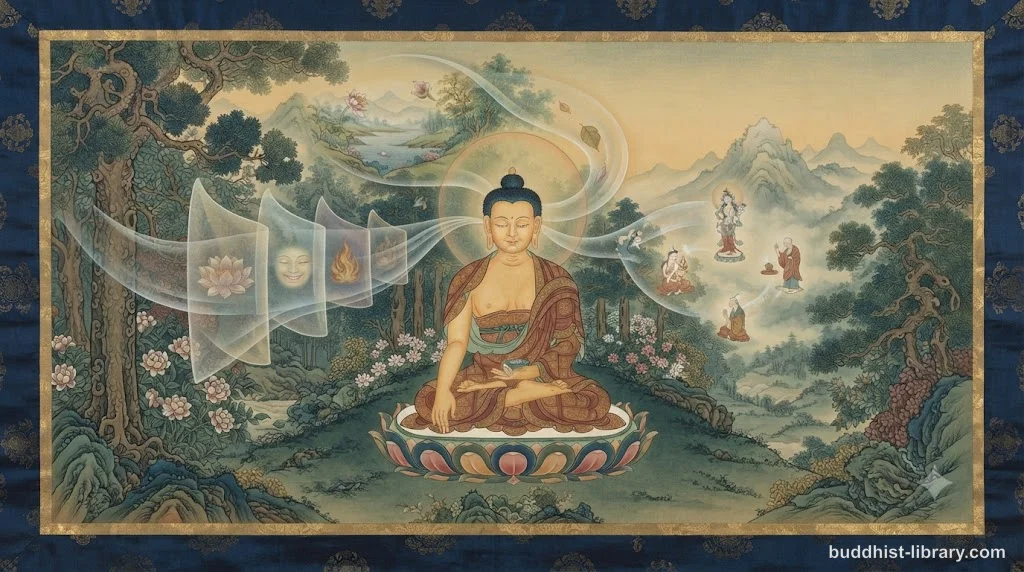
Saññā (Pali) or saṃjñā (Sanskrit)—commonly translated as “perception,” “recognition,” or “apperception”—is the mental function that identifies and labels experience. It’s how we recognize “this is a sound,” “this is blue,” “this is pleasant,” or “this is me.” The Buddha taught that perception is one of the five aggregates (khandhas) that make up what we conventionally call a “person”—and that misunderstanding perception is a root cause of clinging and suffering.
What Does Saññā Mean?
The Pali word saññā comes from saṃ- (together) + jñā (to know), meaning “together-knowing” or “recognition.” It’s the mental factor that picks out distinguishing features and assigns labels.
In the Khandha Saṃyutta (SN 22.79), the Buddha defines perception clearly:
“And what, bhikkhus, is perception? There are these six classes of perception: perception of forms, perception of sounds, perception of odors, perception of tastes, perception of tactile objects, perception of mental phenomena. This is called perception.”
Perception operates across all six sense doors (eye, ear, nose, tongue, body, mind). When contact occurs—say, light hits the eye—consciousness arises, feeling (vedanā) registers the tone (pleasant/unpleasant/neutral), and perception recognizes and names what’s there: “a tree,” “green,” “far away.”
Perception is interpretive, not passive. It doesn’t just receive data; it organizes, categorizes, and gives meaning to raw sensory input.
Perception in the Five Aggregates
The Buddha analyzed experience into five aggregates (pañca-khandha):
- Rūpa (form/materiality) — the physical body and sense objects
- Vedanā (feeling) — the affective tone of experience
- Saññā (perception) — recognition and labeling
- Saṅkhārā (mental formations) — volitions, intentions, habitual tendencies
- Viññāṇa (consciousness) — awareness at the six sense doors
Perception sits between feeling and mental formations in the chain of processing. After contact and feeling arise, perception names what’s happening—and this recognition triggers volitions (saṅkhārā) that shape our response.
In the famous Anattalakkhaṇa Sutta (SN 22.59), the Buddha’s second sermon, he applied the three marks of existence to each aggregate:
“Perception, bhikkhus, is not-self. For if perception were self, this perception would not lead to affliction… Is perception permanent or impermanent?"
"Impermanent, venerable sir."
"Is what is impermanent suffering or happiness?"
"Suffering, venerable sir."
"Is it fitting to regard what is impermanent, suffering, and subject to change as ‘This is mine, this I am, this is my self’?"
"No, venerable sir.”
Perception is impermanent (it arises and ceases moment by moment), unreliable (it can distort and mislead), and not-self (it’s a conditioned process, not a possession or essence).
How Perception Works in Dependent Origination
Perception plays a crucial role in paṭiccasamuppāda (dependent origination), the Buddha’s map of how suffering arises.
The sequence typically includes:
- Contact (phassa) — sense organ + object + consciousness meet
- Feeling (vedanā) — pleasant/unpleasant/neutral tone arises
- Perception (saññā) — recognition: “this is X”
- Craving (taṇhā) — “I want more of this” or “I want this gone”
- Clinging (upādāna) — grasping onto views, sensuality, identity
- Becoming (bhava) — construction of a “self” in relation to experience
- Suffering (dukkha) — inevitable when what’s impermanent is clung to
Perception bridges the gap between bare feeling and reactive craving. When we perceive “this is mine,” “this is who I am,” or “this will make me happy,” we’re laying the conceptual groundwork for clinging.
The Buddha emphasized that perception itself isn’t the problem—it’s a natural function. The problem is identifying with perception and mistaking our interpretive labels for fixed reality.
Distorted Perception (Saññā-Vipallāsa)
The suttas warn that perception can become distorted (vipallāsa), leading us into delusion.
In the Aṅguttara Nikāya (AN 4.49), the Buddha describes four distortions:
- Perceiving permanence in what is impermanent
- Perceiving happiness in what is suffering
- Perceiving self in what is not-self
- Perceiving beauty in what is unattractive (when clinging to sensual objects)
These perceptual distortions—saññā-vipallāsa—are not mere intellectual errors. They’re built into how untrained perception operates. We habitually label experience as “me,” “mine,” “lasting,” “satisfying”—even when investigation reveals otherwise.
For example:
- We perceive our body as “me” even though it’s a changing process.
- We perceive a pleasant meal as “happiness” even though it’s fleeting and dependent on conditions.
- We perceive our opinions as “the truth” even though they’re conditioned by culture, language, and past experiences.
These perceptual habits feel true—but the Buddha taught they’re learned patterns, not ultimate reality.
Perception in Meditation Practice
Observing Perception Arise and Pass
In satipaṭṭhāna (foundations of mindfulness) practice, especially in contemplation of mind-objects (dhammānupassanā), we can observe perception directly.
When a sound occurs:
- Notice the raw auditory contact.
- Notice feeling arise (pleasant, unpleasant, or neutral).
- Notice perception naming it: “car horn,” “music,” “loud,” “annoying.”
- Notice how quickly the mind moves from bare hearing to interpretation and reaction.
This practice reveals that perception is a process, not a thing—and that we have more choice than we think in how we relate to our perceptual labels.
Perception of Impermanence (Aniccasaññā)
One of the most powerful contemplations in Buddhist meditation is aniccasaññā—the perception of impermanence.
In the Girimānanda Sutta (AN 10.60), the Buddha lists “perception of impermanence” as the first of ten perceptions that lead to liberation. When we deliberately cultivate the perception that all formations are impermanent, we re-train perception itself to see what’s actually true rather than what habit assumes.
This isn’t merely thinking “things change.” It’s a shift in how perception functions—seeing arising-and-passing in real time, moment by moment, until the perception of permanence loses its grip.
Other liberating perceptions mentioned in the suttas include:
- Perception of not-self (anattasaññā)
- Perception of suffering (dukkhasaññā)
- Perception of foulness (asubhasaññā) — to counter sensual attachment
- Perception of abandoning (pahānasaññā)
These aren’t “positive thinking” exercises. They’re precision tools for reorienting perception toward truth.
Signless Meditation (Animitta)
In very refined states of concentration and insight, perception can become “signless” (animitta)—that is, no longer locking onto distinguishing marks or mental images.
The Cūḷasuññata Sutta (MN 121) describes a meditative progression in which perception becomes increasingly subtle until it rests in “the signless concentration of mind.” Here, perception no longer fabricates “this” or “that”—there’s awareness without the usual interpretive overlay.
This is not a blank void, but awareness released from the compulsion to label and grasp.
Perception and Language
The Buddha recognized that perception is intimately linked to language and concepts (papañca).
In the Madhupindika Sutta (MN 18), he explains how perception gives rise to “conceptual proliferation”:
“With regard to things seen, heard, sensed, and cognized: in the seen there will be only the seen; in the heard, only the heard; in the sensed, only the sensed; in the cognized, only the cognized.”
The untrained mind doesn’t stop at “the seen”—it proliferates into stories, judgments, identities, and conflicts. This proliferation (papañca) begins when perception solidifies into rigid concepts and when we identify with those concepts as “mine” or “me.”
Training in mindfulness and clear comprehension means seeing perception as perception—recognizing when we’re adding interpretive layers—and letting go of the compulsion to elaborate.
Perception and Emptiness
In Mahāyāna Buddhism, particularly in the Prajñāpāramitā literature, perception is analyzed in the context of śūnyatā (emptiness).
The Heart Sutra famously states:
“Form is emptiness; emptiness is form. Form is not other than emptiness; emptiness is not other than form. The same is true for feeling, perception, mental formations, and consciousness.”
This means perception—like all aggregates—has no intrinsic, independent existence. It arises dependently, functions conditionally, and dissolves when conditions change. To see perception as “empty” is to see it as process rather than possession, activity rather than thing.
This isn’t nihilism. It’s precision: perception occurs, performs its function, and ceases. No owner, no essence, no fixed self behind it.
Common Misconceptions About Perception
”Perception is just sensory input”
Perception is not passive reception of data—it’s active interpretation. Two people can receive the same sensory input and perceive entirely different “realities” based on past conditioning, language, and expectations.
”If I perceive it, it must be real”
The suttas make clear that perception can be distorted and unreliable. What we perceive as “self,” “permanent,” or “mine” may not correspond to how things actually are. Perception is a tool, not a guarantor of truth.
”The goal is to stop perceiving”
The goal isn’t to eliminate perception (except temporarily in very deep states). The goal is to stop identifying with perception—to see it as a conditioned, impermanent process rather than “me” or “mine."
"Positive thinking changes perception”
While intention can influence perception, the Buddha’s approach isn’t about replacing negative labels with positive ones. It’s about seeing through the labeling process itself to the fluid, ownerless nature of experience.
Practical Applications
In Daily Life
- Catch the label: When you notice a strong reaction, pause and ask, “What am I perceiving here?” Often the intensity comes from how you’re naming and interpreting the situation, not the raw facts.
- Question your assumptions: Notice when you perceive something as “permanent,” “mine,” or “the only way it could be.” Is that true, or is it a habitual perceptual overlay?
- Recognize cultural conditioning: Many of our perceptions—about beauty, success, normalcy, identity—are learned from culture and language. Seeing them as constructs rather than truths creates freedom.
In Relationships
- Notice projection: We often perceive others through the lens of our own expectations, fears, and past experiences—not as they actually are in this moment.
- Hold interpretations lightly: When someone’s words or actions trigger you, recognize that your perception of their “intention” or “meaning” is your interpretation—and may not be accurate.
In Meditation
- Name it, release it: When thoughts, emotions, or sensations arise, gently label them (“thinking,” “feeling,” “hearing”) and return to the breath. This trains perception to recognize without clinging.
- Contemplate impermanence: Observe how perceptions arise, linger briefly, and dissolve. Nothing you perceive right now will be here in exactly this form in ten seconds.
Key Takeaways
- Saññā (perception) is the mental function that recognizes, labels, and interprets experience—it’s one of the five aggregates that constitute our sense of self.
- Perception is not passive; it’s an active, conditioned process shaped by past experience, language, and culture.
- Distorted perception (seeing permanence in impermanence, self in not-self) is a root cause of suffering in the Buddha’s teaching.
- In meditation, we observe perception arise and pass, learning to see it as process rather than truth, and training perception itself toward impermanence, not-self, and suffering.
- Liberating perceptions—like perceiving impermanence and not-self—are cultivated deliberately to uproot delusion.
- Perception is empty of intrinsic existence; it arises dependently, functions, and ceases—ownerless and fluid.
Conclusion
The Buddha’s teaching on perception is both profound and practical. By understanding that perception is a conditioned mental function—not a window onto fixed reality—we can begin to question the labels, interpretations, and identities we’ve mistaken for truth.
When we see perception clearly, we see that what we call “self” is a web of perceptual habits. Recognitions of “me,” “mine,” “I am this,” layered over raw, ownerless experience.
The path to liberation doesn’t require us to destroy perception. It invites us to see through it—to recognize perception as perception, label as label, interpretation as interpretation—and to rest in the freedom that comes when we no longer cling to our constructs as reality.
As the Buddha taught in the Anattalakkhaṇa Sutta, when we truly see that perception is impermanent, unreliable, and not-self, we let go—and in that letting go, there is peace.
Read more:
- The Five Aggregates (Khandhas): What We Mistake for ‘Self’ — Explore all five aggregates and how clinging to them creates the illusion of self.
- What Is Vedanā? Understanding Feeling in Buddhist Meditation — Learn about feeling (vedanā), the aggregate that precedes perception in the chain of experience.
- What Is Papañca? Understanding Mental Proliferation in Buddhism — Discover how perception triggers conceptual elaboration and how to work with it in practice. ctice.
📖 Source / license: SuttaCentral (SN 22.79, SN 22.59), Bhikkhu Bodhi's 'The Connected Discourses of the Buddha'
Frequently asked questions
What is the difference between vedanā and saññā?
Vedanā is the feeling tone (pleasant, unpleasant, neutral) that arises with contact, while saññā is the recognition and labeling that follows—identifying what that feeling is 'about.' Vedanā is the raw affective quality; saññā is the interpretive overlay.
How does perception lead to suffering according to Buddhism?
Perception becomes a source of suffering when it solidifies into rigid mental labels and concepts that we mistake for reality itself. We perceive 'mine,' 'self,' 'permanent'—and cling to these perceptions even though they misrepresent the fluid, impermanent, ownerless nature of experience.
Can we have experience without perception?
In very deep meditative states (notably the attainment of cessation, nirodha-samāpatti), perception and feeling are said to cease temporarily. But in ordinary waking experience, perception is always present—it's one of the aggregates that constitute moment-to-moment consciousness.
How do we work with perception in meditation?
By observing perception arise and pass—noticing how we label, categorize, and interpret contact—we can see its constructed nature. This insight loosens identification with perceptions as 'mine' or 'truth,' allowing us to relate to experience with less clinging and more clarity.