The Bhaddekaratta Sutta: The Buddha's Teaching on Living in the Present Moment
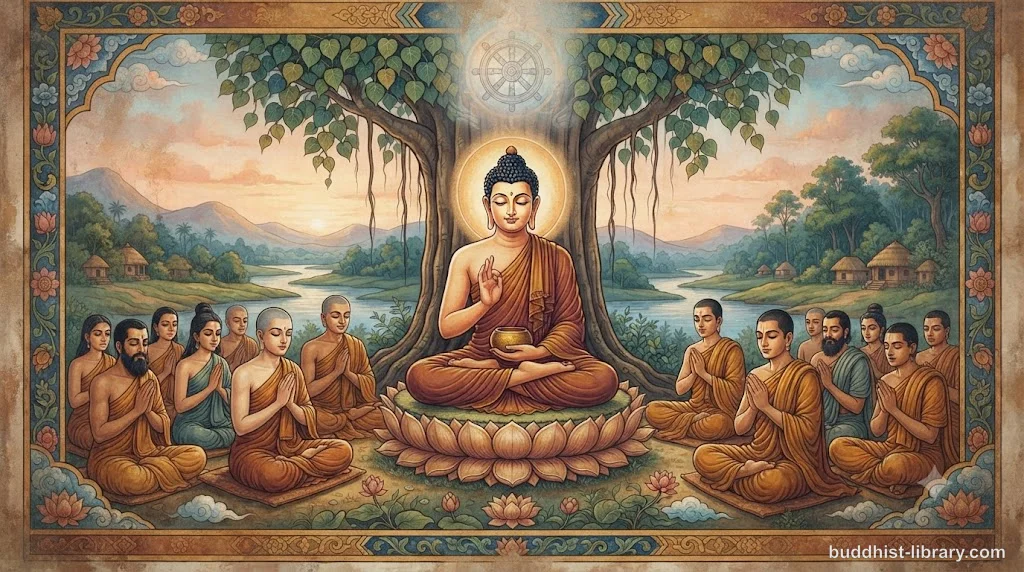
The Bhaddekaratta Sutta teaches that true happiness comes from fully inhabiting the present moment—not chasing what’s gone or yearning for what hasn’t arrived. The Buddha presents a clear framework: let the past be past, don’t project into an uncertain future, see what’s here with wisdom, and cultivate freedom without attachment. This is the path of “one auspicious attachment”—to presence itself.
The Bhaddekaratta Sutta (MN 131) is one of the Buddha’s most direct teachings on living in the present. No elaborate philosophy here. Found in the Majjhima Nikāya (Middle Length Discourses), it offers a poetic verse summary and then unpacks it analytically—showing exactly how to dwell in the here and now with wisdom and freedom.
The title is worth pausing over. Bhaddekaratta can be translated as “one who has had one auspicious attachment” or “one who dwells happily.” It addresses something we all do: our minds pull us into memories of what was or fantasies of what might be. We miss the only moment we actually have.
What does the Bhaddekaratta Sutta teach?
The sutta opens with a memorable verse the Buddha recited:
“Let not a person revive the past
Or on the future build their hopes;
For the past has been left behind
And the future has not been reached.
Instead, with insight they should see
Each presently arisen state;
Let them know that and be sure of it,
Invincibly, unshakably.
Today the effort must be made;
Tomorrow death may come, who knows?
No bargain with mortality
Can keep them and their hordes away.
But one who dwells thus ardently,
Relentlessly, by day and night—
It is they, the Peaceful Sage has said,
Who have had one auspicious attachment.”
Then the Buddha unpacks it systematically. What does it mean to “revive the past”? It’s dwelling on forms, sounds, smells, tastes, touches, or thoughts that have already ceased—generating delight and passion for what no longer exists. And “building hopes on the future”? Yearning for experiences not yet come. Projecting desire onto an uncertain tomorrow.
The alternative is yathābhūtaṁ pajānāti—knowing things “as they actually are” in the present moment. Not passive observation. Penetrative seeing that recognizes the impermanent, conditioned, and unsatisfactory nature of whatever arises right now.
How do we practice not dwelling on the past?
The past is done. Whatever joys or sorrows occurred, whatever we said or left unsaid, whatever we gained or lost—it exists now only as a mental formation. A memory we can grasp or release.
The Buddha’s instruction: don’t generate nandīrāga—delight and lust—for what has already ceased. This doesn’t mean you can’t remember the past or learn from it. Healthy reflection on past actions to understand cause and effect is wise. But the sutta warns against the compulsive replaying of past experiences, nursing old grievances, or clinging to “the good old days” as if they were more real than what’s here now.
When we notice the mind drifting into a past event, the practice is to recognize: “This is a mental formation arising now. The actual event is gone. What’s real is this present moment of remembering.” We can then return attention to present-moment experience—breath, body, the task at hand.
Why shouldn’t we build hopes on the future?
The future hasn’t arrived. It may never arrive in the form we imagine. Yet we spend enormous mental energy planning, worrying, fantasizing, rehearsing conversations that will never happen, constructing elaborate scenarios of success or failure.
Death could come tomorrow—“no bargain with mortality can keep them and their hordes away.” The Buddha isn’t trying to scare you. He’s pointing to saṃvega—spiritual urgency. If death could come at any time, why postpone genuine practice and presence until some imagined perfect future moment?
This doesn’t mean we shouldn’t plan responsibly or set intentions. The Buddha himself planned Dhamma talks, organized the Saṅgha, and made arrangements for the community. The difference is whether we’re attached to our plans, whether we’re living for the future rather than from the present.
When the mind spins futures, we can note: “This is planning” or “This is worry”—and return to what’s actually happening now.
What does it mean to see what’s present “as it actually is”?
The heart of the teaching is yathābhūta-ñāṇa—knowledge of things as they actually are. This is vipassanā, insight meditation in action.
The Buddha instructs us to observe each presently arisen state—whether it’s a sight, sound, thought, emotion, or physical sensation—and see it clearly:
- It’s impermanent (anicca): Even as we observe it, it’s changing and will pass away.
- It’s unsatisfactory (dukkha): It can’t provide lasting fulfillment because it’s unstable.
- It’s not-self (anattā): It’s not “me” or “mine”—just a conditioned phenomenon arising and passing in awareness.
The sutta emphasizes seeing this “invincibly, unshakably” (asaṃhīraṃ asaṅkuppaṃ). This isn’t intellectual understanding but direct perception that becomes stable through repeated observation. We see form as form, feeling as feeling, not as possessions or extensions of self.
How do we cultivate what’s present without clinging?
Here’s the paradox: be fully present, yet don’t grasp what’s present. How do you engage with the now without attachment?
Clear comprehension (sampajañña). You can be completely engaged—working, relating, experiencing—while simultaneously understanding that everything you’re engaging with is impermanent and not-self. Full participation without the delusion that you can hold onto any of it.
Think of watching a sunset. Fully absorbed in the beauty, colors shifting moment by moment. No need to photograph it. No wishing it would last forever. No comparing it to past sunsets. Just present, appreciative, letting it go as it fades. That’s the quality of presence this sutta points toward.
In meditation, this means neither suppressing experiences nor grasping them. When joy arises, we don’t chase after it or try to make it stay. When discomfort arises, we don’t push it away or resent its presence. We meet each state with equanimity—clear knowing without preference.
What is “one auspicious attachment”?
The term bhaddekaratta is intriguing. If attachment (ratta, related to rāga, lust/passion) is usually something to be abandoned, how can there be an “auspicious” one?
The commentaries explain this as the “attachment” or devotion to present-moment awareness itself—the one commitment that leads to freedom from all other attachments. It’s not attachment in the sense of clinging, but rather the ardent, relentless application of mindfulness and wisdom.
The person who has this “one auspicious attachment” dwells “ardently, relentlessly, by day and night.” This is serious practice—not casual interest but whole-hearted dedication to seeing things as they are. And the Buddha calls such a person a “Peaceful Sage” even while still training, because they’ve aligned themselves with the path that leads to peace.
How does this sutta relate to other teachings on mindfulness?
The Bhaddekaratta Sutta complements other key mindfulness teachings:
-
The Satipaṭṭhāna Sutta provides the detailed framework for mindfulness practice—body, feelings, mind, and phenomena. The Bhaddekaratta Sutta emphasizes the temporal aspect: keeping awareness in the present rather than scattering it across time.
-
The Ānāpānasati Sutta teaches mindfulness of breathing as a complete practice. The breath is always happening now—you can’t breathe yesterday’s breath or tomorrow’s. It’s a perfect present-moment anchor that embodies the Bhaddekaratta teaching.
-
The teaching on yoniso manasikāra (wise attention) emphasizes how we attend to experience. The Bhaddekaratta Sutta clarifies when—this moment, not imagined pasts or futures.
Together, these teachings create a comprehensive practice: attend to present-moment experience in the body, feelings, mind, and phenomena, with wise attention that sees impermanence, suffering, and not-self.
What are the practical steps for living in the present?
The sutta gives us a four-part framework that can guide daily practice:
-
Don’t revive the past: When you notice yourself replaying old conversations, rehashing past mistakes, or clinging to memories of how things used to be, gently acknowledge the thought and return to present sensory experience. This doesn’t mean you can’t remember—just don’t dwell there.
-
Don’t build hopes on the future: When you catch yourself in elaborate planning or worry about what might happen, note it as “thinking about the future” and come back to what’s actually here now. Make plans when necessary, then let them go.
-
See what’s present clearly: Bring investigative attention to your immediate experience. What sensations are in the body right now? What’s the quality of this breath? What emotion is present? See it without judgment, without trying to change it—just clear knowing.
-
Cultivate presence without clinging: As you become more familiar with present-moment awareness, practice doing activities with full engagement but without grasping. Eat mindfully without needing the food to taste a certain way. Work attentively without obsessing over outcomes. Relate warmly without demanding people be different than they are.
The sutta emphasizes urgency: “Today the effort must be made; tomorrow death may come, who knows?” This isn’t morbid but realistic. Every moment of genuine presence is valuable. We don’t have unlimited time to put off waking up.
How does this teaching lead to liberation?
By consistently seeing present-moment experience as impermanent, unsatisfactory, and not-self, we undercut the very basis of clinging. When we’re not lost in past regrets or future anxieties, when we’re not grasping at present experiences or pushing them away, dukkha (suffering) has nowhere to land.
The sutta doesn’t promise that life will become problem-free or that pain will disappear. What it offers is freedom from the extra suffering we create through temporal displacement—through living everywhere except where we actually are.
Someone truly established in this practice becomes “invincible” and “unshakable” not because nothing affects them, but because they’re no longer building a false sense of self on the shifting sands of past, present, and future phenomena. They’ve found the one stable ground: awareness itself, meeting each moment freshly.
This is the path to nibbāna—not as a future attainment but as a present-moment release from clinging. The Buddha said such a person is “one who dwells happily”—not because their circumstances are perfect, but because they’re free.
Key Points
- The Bhaddekaratta Sutta teaches complete presence by letting go of past and future
- “Reviving the past” means generating desire for experiences that have already ceased
- “Building hopes on the future” means projecting attachment onto what hasn’t come
- Present-moment insight sees phenomena as impermanent, unsatisfactory, and not-self
- “One auspicious attachment” is devoted application to present-moment awareness
- The teaching complements Satipaṭṭhāna and Ānāpānasati practices
- Urgency matters—death could come at any time; practice is now or never
- Liberation comes through seeing clearly what’s here, without grasping or aversion
- This isn’t passive acceptance but active, penetrating wisdom applied moment by moment
Frequently Asked Questions
What does Bhaddekaratta mean?
Bhaddekaratta means “one who has had one auspicious attachment” or “one who dwells happily.” It refers to someone who lives fully in the present moment, free from dwelling on the past or worrying about the future.
Where can I find the Bhaddekaratta Sutta?
The Bhaddekaratta Sutta is found in the Majjhima Nikāya as discourse 131 (MN 131). There are also related versions in MN 132–134 that expand on the same teaching with different interlocutors.
How is this different from ordinary mindfulness practice?
While general mindfulness involves present-moment awareness, the Bhaddekaratta Sutta specifically teaches not to chase what’s past, not to long for what hasn’t come, to see clearly what’s present, and to cultivate what’s present without clinging—a complete framework for liberating wisdom.
Can I practice this teaching as a beginner?
Yes. The sutta’s core instruction—don’t dwell on past, don’t worry about future, observe what’s here now—is accessible to anyone. The deeper insights about impermanence and non-clinging develop naturally with consistent practice.
Does this mean I shouldn’t plan for the future at all?
No. Responsible planning is skillful. The teaching cautions against attachment to plans and living for some imagined future rather than from present reality. Make plans, then return to the present; don’t spend your life mentally rehearsing a future that may never arrive.
How do I know if I’m dwelling on the past versus learning from it?
Healthy reflection feels purposeful—you examine a past action to understand cause and effect, then apply that learning now. Dwelling feels compulsive—replaying the same scenarios, generating emotion about what can’t be changed, resisting the fact that the past is gone.
What if painful memories or worries keep arising?
This is normal, especially when starting practice. The instruction isn’t to suppress these thoughts but to recognize them as present-moment mental formations—thoughts happening now, not the actual past or future. Note them, see them as impermanent phenomena, and gently return attention to present sensory experience. With time and practice, the mind settles.
Conclusion
The Bhaddekaratta Sutta is one of the clearest maps for genuine presence. In just a few verses and their explanation, the Buddha cuts through our habit of temporal displacement—the endless oscillation between memories and fantasies that keeps us from actually arriving in our lives.
This isn’t about being spacey or disconnected. It’s about being more connected—to what’s actually happening, to the texture of this breath, to the person in front of you, to the work at hand. Full presence makes you effective, responsive, alive.
We don’t know how many more moments we have. Will we spend them lost in thoughts about moments that are gone or haven’t come? Or will we be here, seeing clearly, free from the self-created suffering of temporal grasping?
Someone who dwells “ardently, relentlessly, by day and night” finds happiness that doesn’t depend on circumstances being just right. They’ve stopped waiting for the perfect moment to begin living. They’ve discovered that this moment, exactly as it is, is the only place presence is ever possible.
That’s the teaching. That’s the practice.
Read more:
- What Is Mindfulness (Sati) in Buddhism? — Understand the foundation of present-moment awareness that makes the Bhaddekaratta practice possible.
- The Satipaṭṭhāna Sutta: Foundations of Mindfulness Explained — Learn the detailed framework for cultivating the mindfulness this sutta points toward.
- Right Mindfulness (Sammā Sati): The Seventh Factor of the Noble Path — Explore how present-moment awareness fits into the complete path to liberation.
📖 Source / license: Bhaddekaratta Sutta (MN 131), Majjhima Nikāya. Translation by Bhikkhu Bodhi. SuttaCentral (suttacentral.net).
Frequently asked questions
What does Bhaddekaratta mean?
Bhaddekaratta means 'one who has had one auspicious attachment' or 'one who dwells happily.' It refers to someone who lives fully in the present moment, free from dwelling on the past or worrying about the future.
Where can I find the Bhaddekaratta Sutta?
The Bhaddekaratta Sutta is found in the Majjhima Nikāya as discourse 131 (MN 131). There are also related versions in MN 132–134 that expand on the same teaching with different interlocutors.
How is this different from ordinary mindfulness practice?
While general mindfulness involves present-moment awareness, the Bhaddekaratta Sutta specifically teaches not to chase what's past, not to long for what hasn't come, to see clearly what's present, and to cultivate what's present without clinging—a complete framework for liberating wisdom.
Can I practice this teaching as a beginner?
Yes. The sutta's core instruction—don't dwell on past, don't worry about future, observe what's here now—is accessible to anyone. The deeper insights about impermanence and non-clinging develop naturally with consistent practice.