The Rāhula Suttas: The Buddha's Teachings to His Son
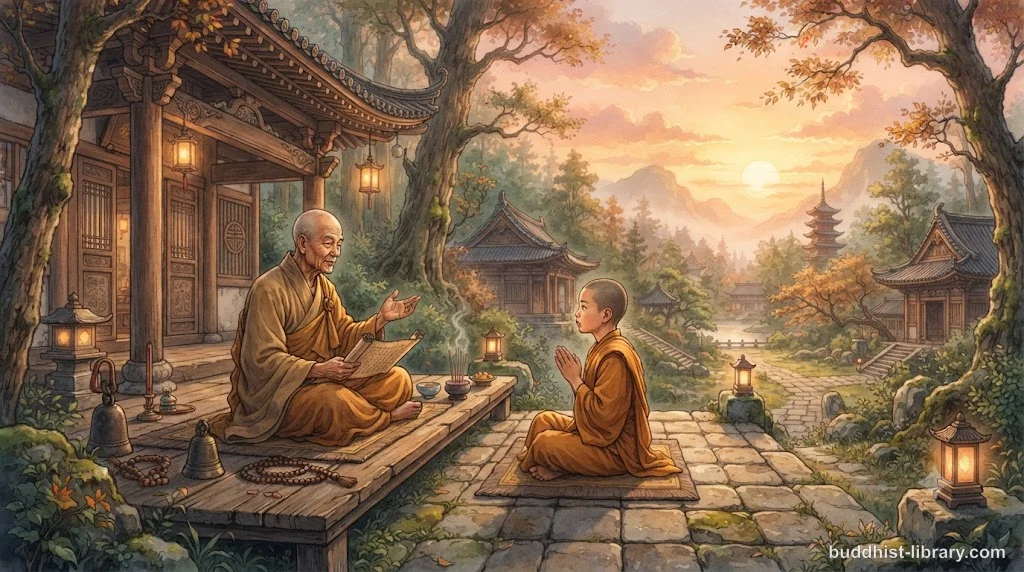
The Buddha gave his son Rāhula a complete spiritual education, preserved in several canonical suttas — beginning with absolute truthfulness, progressing through mindfulness of breathing and elemental reflection, culminating in penetrating the nature of the five aggregates and non-self. These teachings form a graduated path accessible to any practitioner.
The relationship between the Buddha and his son Rāhula is unique in early Buddhist literature. Rāhula ordained as a novice at age seven and received personal instruction from his father across many years, documented in suttas that remain among the most practical and profound in the Pali Canon. These discourses aren’t abstract philosophy — they’re a father’s careful transmission of liberating wisdom to his own child.
Who Was Rāhula?
Rāhula (“fetter” or “obstacle”) was born to Prince Siddhattha Gotama and Princess Yasodharā on the very night the future Buddha decided to renounce palace life. The name reflects the tension of that moment — the child represented both love and the final tie binding Siddhattha to worldly existence.
Six years later, after the Buddha’s awakening, he returned to Kapilavatthu. The seven-year-old Rāhula, prompted by his mother, approached the Buddha and asked for his inheritance. The Buddha’s response was radical: he gave Rāhula ordination as the first novice monk (sāmaṇera) in the Saṅgha, calling it “the greatest inheritance” — the Dhamma itself.
Rāhula eventually became an arahat, recognized as “foremost among those desiring training” (Aṅguttara Nikāya 1.24). His path from curious child to fully enlightened disciple is traced through several key suttas.
The Shorter Discourse at Ambalaṭṭhikā (MN 61): Truthfulness as Foundation
The Ambalaṭṭhikārāhulovāda Sutta is the Buddha’s stern lesson on truthfulness to the young novice Rāhula. It begins with a striking teaching device.
The Buddha pours a small amount of water into a basin, then throws it away. He asks Rāhula:
“Do you see, Rāhula, this little leftover water?”
When Rāhula confirms, the Buddha says:
“So little is the recluseship of those who are not ashamed to tell a deliberate lie.”
Then the Buddha overturns the empty basin:
“Just as this water basin is overturned, so is the recluseship of one who tells a deliberate lie overturned.”
The teaching is uncompromising: without truthfulness, no spiritual practice can function. One who lies deliberately has “no shame” and “no regard for wholesome states.” For the Buddha, truth isn’t merely ethical — it’s the foundation that makes meditation, concentration, and insight possible.
The sutta then moves to reflection practice: before any action of body, speech, or mind, Rāhula should ask:
- “Would this action harm myself or others?”
- If yes — don’t do it.
- If uncertain — consult a wise teacher.
- After the action — reflect on the result and purify any harm done.
This contemplation (yoniso manasikāra) establishes sīla (moral conduct) through awareness, not rigid rule-following. It trains the mind to consider consequences, developing both ethical sensitivity and self-knowledge.
Read more:
- What Is Yoniso Manasikāra? Wise Attention in Buddhist Meditation — explores the reflection practice the Buddha taught Rāhula to establish ethical clarity before action.
- Right Action (Sammā Kammanta): Buddhist Ethics in Body and Deed — explains how embodied ethics prepare the ground for deeper meditation and insight.
The Greater Discourse to Rāhula (MN 62): From Elements to Emptiness
The Mahārāhulovāda Sutta, delivered when Rāhula is older, introduces profound meditation practices.
Elemental Reflection
The Buddha teaches Rāhula to develop specific mental qualities by contemplating the four elements:
- Earth meditation (paṭhavī-kasiṇa): cultivate equanimity like the earth, which receives both pleasant and unpleasant without preference.
- Water meditation: develop non-resistance, accepting experience as water accepts all objects.
- Fire meditation: cultivate non-attachment — fire neither grasps nor rejects what it burns.
- Wind meditation: practice non-reactivity, like space that remains unaffected by what moves through it.
These aren’t visualization exercises but attitude meditations — training the mind to meet experience without clinging or aversion.
The Four Brahmavihāras
The Buddha then instructs Rāhula to develop:
- Mettā (loving-kindness) to overcome ill-will
- Karuṇā (compassion) to overcome cruelty
- Muditā (sympathetic joy) to overcome discontent
- Upekkhā (equanimity) to overcome attachment and aversion
These practices stabilize the heart, making it fit for insight.
Mindfulness of Breathing
Finally, the Buddha gives the core instruction:
“Develop mindfulness of breathing, Rāhula. When mindfulness of breathing is developed and cultivated, it is of great fruit and great benefit.”
This is ānāpānasati — sustained attention on the breath as it naturally flows in and out. The Buddha elaborates this practice in detail in the Ānāpānasati Sutta (MN 118), showing sixteen stages from basic breath awareness through the four establishments of mindfulness to full awakening.
For Rāhula, this wasn’t theory. The Buddha was handing his son a complete meditation practice, one the Buddha himself had used on the night of his enlightenment.
Contemplation of the Five Aggregates (SN 22.91)
In Saṃyutta Nikāya 22.91, the Buddha teaches Rāhula insight into the five aggregates (khandhas):
“Any form whatsoever, whether past, future, or present, internal or external, gross or subtle, inferior or superior, far or near — all form should be seen as it actually is with proper wisdom thus: ‘This is not mine, this I am not, this is not my self.’”
The same is said for feeling (vedanā), perception (saññā), mental formations (saṅkhārā), and consciousness (viññāṇa).
This is the direct contemplation of anattā (non-self). By systematically seeing that none of the five aggregates constitutes a permanent, independent self, the mind lets go of identification and grasping.
The sutta reports that “through not clinging, Rāhula was liberated from the taints.” This is the culmination — the child who once asked for his worldly inheritance received something infinitely greater: full awakening.
The Gradual Path in Rāhula’s Training
The Buddha’s teaching sequence with Rāhula models the complete Buddhist path:
- Sīla (moral discipline) — truthfulness and reflection before action (MN 61)
- Samādhi (concentration) — elemental meditations, brahmavihāras, ānāpānasati (MN 62)
- Paññā (wisdom) — contemplation of the five aggregates, insight into non-self (SN 22.91)
This is the classical threefold training (tisso sikkhā), presented not as abstract doctrine but as lived instruction from father to son.
The Buddha didn’t rush Rāhula into advanced practices.
He began with ethics — the capacity to be truthful and reflective. Only on that stable foundation did concentration practices follow. And only when concentration was established did he introduce the penetrating insight that leads to liberation.
This patience contradicts the modern tendency to jump straight to “meditation” without ethical preparation. The Buddha knew that genuine awakening requires a gradual maturation of the whole person.
Why the Rāhula Suttas Matter Today
These teachings remain profoundly relevant.
If you’re just beginning, the Rāhula suttas show that the path starts simply — with honesty and careful reflection. You don’t need years of study. The Buddha gave his seven-year-old son practices he could do immediately.
Already meditating? Ānāpānasati, elemental contemplations, and the brahmavihāras aren’t preliminary exercises. They’re the core practices that led Rāhula (and countless others) all the way to full awakening.
For teachers and parents, the Buddha’s pedagogical skill is striking. He taught in stages. Used vivid similes (the overturned water pot). Gave practices appropriate to Rāhula’s maturity. Balanced warmth with rigor. This is teaching rooted in care, not authority.
And these suttas reveal something essential about the path itself: ethics, concentration, and wisdom aren’t separate compartments but a unified unfolding. Each supports the next. Without truthfulness, meditation is unstable. Without concentration, wisdom can’t arise. Without wisdom, liberation remains out of reach.
Practical Application
If you’re working with these suttas, start where the Buddha started with Rāhula: with reflection. Before acting, ask yourself: “Will this harm anyone, including myself?” Make this a daily habit.
Then establish ānāpānasati practice. Set aside 15–30 minutes daily to simply watch the breath. No control, no force — just sustained, gentle attention.
Cultivate the brahmavihāras. Spend a few minutes generating mettā (wishing well for yourself and others), karuṇā (empathy for suffering), muditā (joy in others’ happiness), and upekkhā (balanced acceptance). These stabilize the heart.
As your practice matures, contemplate the aggregates. Periodically notice: “This feeling isn’t me. This thought isn’t mine. This body changes — where is a permanent self?” Let understanding grow naturally.
The Buddha gave Rāhula not just information but a way of living. That’s what these suttas offer: not another concept to collect, but a path you can walk today, step by careful step, toward freedom.
Frequently Asked Questions
Who was Rāhula in Buddhism?
Rāhula was the Buddha’s only son, born before Siddhattha Gotama renounced the palace life. He later ordained as a novice monk at age seven and became one of the Buddha’s foremost disciples, eventually attaining full enlightenment as an arahat.
What is the main teaching in the Ambalaṭṭhikārāhulovāda Sutta (MN 61)?
The main teaching is the absolute importance of truthfulness — the Buddha tells young Rāhula that just as an overturned water pot is useless, one who deliberately lies has no use for spiritual practice. The sutta emphasizes that moral foundation must come before meditation, using the vivid simile of discarded water and an overturned basin to show how lying destroys one’s spiritual potential.
What meditation practice did the Buddha teach Rāhula?
The Buddha taught Rāhula mindfulness of breathing (ānāpānasati) as a primary meditation practice, along with contemplation of the four elements (earth, water, fire, wind), development of the four brahmavihāras (mettā, karuṇā, muditā, upekkhā), and reflection on the five aggregates to develop insight into non-self (anattā).
Are the Rāhula suttas suitable for beginners?
Yes. The Buddha’s gradual approach with Rāhula — starting with basic ethics (truthfulness and reflection), moving through foundational concentration practices (breath meditation and brahmavihāras), to penetrating wisdom (the five aggregates and non-self) — models the complete Buddhist path and is highly accessible for practitioners at any level. The teachings begin with what a seven-year-old can understand and grow into profound liberating insight.
Did Rāhula attain enlightenment?
Yes. Saṃyutta Nikāya 22.91 records that through the contemplation of the five aggregates and non-clinging, “Rāhula was liberated from the taints.” He became an arahat and was recognized by the Buddha as “foremost among those desiring training” (AN 1.24). His path from ordained child to fully awakened disciple demonstrates that the gradual training truly leads to complete liberation.
What does the name “Rāhula” mean?
The name Rāhula means “fetter” or “obstacle” in Pali. It was given because Rāhula was born on the very night Prince Siddhattha decided to renounce palace life — the child represented both deep love and the final tie binding the future Buddha to worldly existence. Despite the name, Rāhula became one of the Buddha’s most accomplished disciples.
How can I practice what the Buddha taught Rāhula?
Begin with honest reflection before actions of body, speech, and mind — ask if this will cause harm, and adjust accordingly. Then establish a daily ānāpānasati (mindfulness of breathing) practice, even just 15–30 minutes. Cultivate the brahmavihāras (loving-kindness, compassion, sympathetic joy, equanimity) to stabilize the heart. As your practice matures, contemplate the five aggregates to see their impermanent, non-self nature. Follow the gradual sequence the Buddha modeled: ethics → concentration → wisdom.
📖 Source / license: Majjhima Nikāya 61, 62, 147; Saṃyutta Nikāya 22.91; translations by Bhikkhu Bodhi and Ñāṇamoli Thera (Access to Insight / Wisdom Publications)
Frequently asked questions
Who was Rāhula in Buddhism?
Rāhula was the Buddha's only son, born before Siddhattha Gotama renounced the palace life. He later ordained as a novice monk and became one of the Buddha's foremost disciples, eventually attaining full enlightenment.
What is the main teaching in the Ambalaṭṭhikārāhulovāda Sutta (MN 61)?
The main teaching is the absolute importance of truthfulness — the Buddha tells young Rāhula that just as an overturned water pot is useless, one who deliberately lies has no use for spiritual practice. This sutta emphasizes moral foundation before meditation.
What meditation practice did the Buddha teach Rāhula?
The Buddha taught Rāhula mindfulness of breathing (ānāpānasati) as a primary meditation practice, along with contemplation of the elements and reflection on the five aggregates to develop insight into non-self.
Are the Rāhula suttas suitable for beginners?
Yes. The Buddha's gradual approach with Rāhula — starting with basic ethics, moving through concentration practices, to wisdom — models the complete Buddhist path and is highly accessible for practitioners at any level.