The Devadūta Sutta: The Buddha's Teaching on Divine Messengers
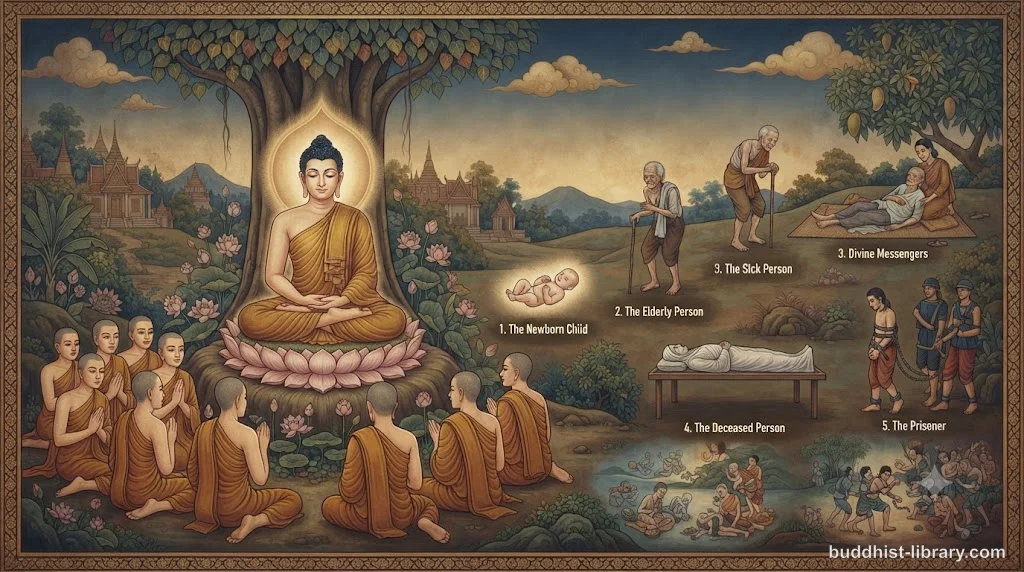
The Devadūta Sutta teaches that old age, sickness, and death are “divine messengers”—universal warnings urging us to live ethically and practice the Dhamma before time runs out. When we ignore these signs and harm others, we face painful karmic consequences; when we heed them wisely, we create the conditions for a fortunate rebirth and eventual liberation.
The Devadūta Sutta stands out among Buddhist scriptures for its visceral imagery and uncompromising urgency. Found in the Majjhima Nikāya (MN 130), this discourse reframes aging, illness, and mortality. These aren’t random misfortunes. They’re purposeful warnings—messengers sent by existence itself to shake us awake.
What is the Devadūta Sutta?
The Devadūta Sutta, often translated as the “Discourse on the Divine Messengers,” is one of the Buddha’s most memorable teachings on karma, rebirth, and moral urgency. The word devadūta literally means “messengers of the gods” or “divine messengers,” though the Buddha’s meaning is more symbolic than literal: these messengers aren’t mythological beings but the inevitable experiences of old age, sickness, and death that every human encounters.
The sutta takes the form of a narrative. The Buddha describes what happens to someone after death who has lived harmfully and ignored the warnings embedded in life itself. A judge-like figure (sometimes identified as Yama, the king of death in Indian cosmology) questions the deceased: “Did you not see an old person? A sick person? A dead body? Did these sights not warn you to act well, to practice the Dhamma?”
Why are aging, sickness, and death called “messengers”?
Here’s where the sutta gets interesting. We usually treat aging, illness, and death as enemies—problems to solve, misfortunes to avoid. The Buddha flips this completely: see them as teachers.
When you encounter an elderly person bent with age, that’s the first messenger showing you, “This will be your body too—if you’re fortunate enough to live that long.” When you see someone wracked by illness, that’s the second messenger reminding you, “This body is fragile; health is not guaranteed.” When you witness death—whether a funeral, a corpse, or even news of someone’s passing—that’s the third messenger declaring, “Your time here is finite.”
These aren’t punishments or accidents. They’re built into the nature of embodied existence, and they carry a clear message: Use your time well. Act ethically. Develop your mind. Don’t squander this precious human birth on harm and delusion.
What happens to those who ignore the messengers?
The sutta doesn’t shy away from vivid consequences. The Buddha describes beings reborn in painful realms—sometimes translated as “hell realms” or niraya—because they ignored the divine messengers and lived lives marked by killing, stealing, lying, sexual misconduct, intoxication, and cruelty.
In the narrative, Yama confronts them: “You saw the messengers. You knew aging, sickness, and death were coming for you. Yet you did not restrain yourself from harmful actions. You did not practice generosity, virtue, or kindness.” The implication is clear: ignorance is no excuse when the warnings were right in front of you.
This isn’t a deity handing down punishment from above. It’s simpler and more impersonal than that: actions rooted in greed, hatred, and delusion create painful mental states. In the Buddhist framework, those states ripple forward into painful rebirths. Cause and effect, not cosmic judgment.
What about those who heed the warnings?
The sutta also describes a contrasting fate. Those who see the divine messengers and respond wisely—practicing generosity (dāna), ethical conduct (sīla), and mental cultivation (bhāvanā)—create the karmic conditions for fortunate rebirths. They’re reborn in pleasant realms, among humans or even celestial beings, where they have further opportunities to practice and progress toward liberation.
But narrow that reading down to “behave well, get a good rebirth” and you miss the sharper point. This sutta is about now. The messengers aren’t offering abstract moral lessons—they’re demanding immediate response. Practice while you have capacity, opportunity, functioning faculties. Wait until you’re bedridden or dying? Too late. The mental habits that lead to peace take time to establish.
How does the Devadūta Sutta inspire practice?
Many Buddhists use this sutta as a regular gut-check: Am I living like I have forever? Putting off meditation, ethical refinement, generosity until “someday”?
The messengers don’t require dramatic encounters. You don’t need weekly cemetery visits (though some traditions do practice charnel ground contemplation). A gray hair does the job. A joint that didn’t used to ache. Slower recovery from a cold. A public figure’s death. A friend’s diagnosis. An ambulance screaming past. Each one whispers the same message if you’re listening.
The key is response. Seeing the messenger is one thing; heeding the message is another. The sutta invites you to let these moments land, to feel the appropriate sense of saṃvega—a stirring mix of urgency, disenchantment with trivial pursuits, and motivation to practice. Then translate that feeling into action: sit down and meditate, keep a precept you’ve been lax about, forgive someone, give generously, study the Dhamma.
Key points about the Devadūta Sutta
- The three messengers are old age, sickness, and death—universal experiences that warn us of life’s fragility and impermanence.
- Divine doesn’t mean supernatural: The sutta uses poetic language to elevate everyday experiences into meaningful warnings, not to invoke literal gods.
- Karma is central: Ignoring the messengers and acting harmfully leads to painful results; heeding them and acting wholesomely leads to fortunate outcomes and progress on the path.
- Urgency, not fear: The goal is to inspire saṃvega—a healthy spiritual urgency—rather than paralyzing dread.
- It’s about now: The sutta challenges procrastination and complacency, urging immediate ethical action and meditative practice.
How does this sutta fit into the Pali Canon?
The Devadūta Sutta appears in the Majjhima Nikāya (Middle Length Discourses), specifically as MN 130. It’s part of a broader body of teachings on karma, rebirth, and moral consequences. Similar themes appear in the Jātaka tales (stories of the Buddha’s past lives) and other suttas that emphasize the kammic results of actions.
The narrative style—a courtroom-like interrogation by Yama—would have resonated with the Buddha’s original audience, steeped in Indian storytelling conventions. Modern readers often stumble over the cosmology: multiple realms, literal rebirth, a “king of death.” Fair enough. But strip that away and the psychological and ethical core remains sharp: your actions have consequences. The warnings are already in front of you.
What is the relationship between this sutta and meditation practice?
The Devadūta Sutta is closely related to practices like maraṇasati (death awareness meditation), where practitioners deliberately contemplate mortality to reduce attachment, sharpen priorities, and generate urgency for the path. By regularly reflecting on the messengers, you weaken complacency and strengthen the motivation to practice daily.
Some meditators use a simple reflection: “I am of the nature to age. I am of the nature to sicken. I am of the nature to die. All that is dear to me will change and vanish.” This brings the messengers into conscious awareness, making their message vivid and personal.
Is this teaching relevant to secular or non-rebirth Buddhists?
Set aside literal rebirth if you need to. The ethical core doesn’t budge. Ignore life’s fragility and you end up with regret, wasted years, undeveloped capacity for kindness and wisdom. Heed the warnings and you get something closer to an intentional life—less harm caused, more good cultivated, a mind that can handle what comes.
Read “painful rebirth” as the internal suffering of a life poorly lived: regret, guilt, unresolved harm that gnaws at you. Read “fortunate rebirth” as the peace and clarity of a life aligned with what matters. The cosmology is negotiable. The practical wisdom isn’t.
Read more:
- Maraṇasati: Death Awareness Meditation in Buddhism — Learn the formal practice of contemplating death to cultivate urgency and dispassion.
- What Is Saṃvega? Spiritual Urgency in Buddhism — Understand the wholesome emotion the Devadūta Sutta aims to evoke.
- Karma and Rebirth in Buddhism: How They Actually Work — Explore the doctrinal framework underlying this sutta’s narrative of consequences and future lives.
📖 Source / license: Devadūta Sutta, Majjhima Nikāya 130. Translation by Bhikkhu Ñāṇamoli and Bhikkhu Bodhi, The Middle Length Discourses of the Buddha (Wisdom Publications, 1995); also available on Access to Insight and SuttaCentral.
Frequently asked questions
What are the three divine messengers in Buddhism?
The three divine messengers (devadūta) are old age, sickness, and death. They are called 'divine' because they serve as warnings from the universe itself, urging us to practice the Dhamma before time runs out.
Why does the Buddha call aging and death 'messengers from the gods'?
The Buddha uses this poetic language to emphasize that these experiences carry a crucial message: our time is limited, and we should use it wisely. They aren't punishments but wake-up calls prompting ethical conduct and spiritual practice.
How does the Devadūta Sutta relate to karma and rebirth?
The sutta describes a person being questioned after death about whether they heeded these messengers. Those who ignored the warnings and acted harmfully face painful consequences, while those who practiced virtue and wisdom experience better rebirths. It's a vivid illustration of karmic results.
Is this sutta meant to scare people into practicing Buddhism?
While the imagery is stark, the purpose isn't fear-mongering but motivation through urgency. The sutta aims to inspire what Buddhists call saṃvega—a wholesome sense of spiritual urgency that moves us from complacency to meaningful action.