The Sammādiṭṭhi Sutta: The Buddha's Teaching on Right View
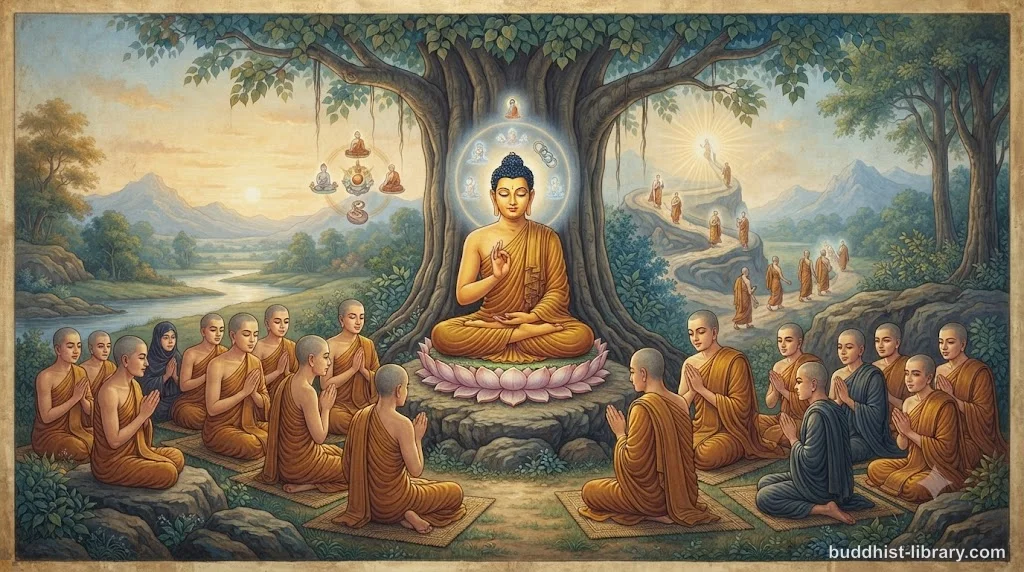
The Sammādiṭṭhi Sutta (MN 9) is the Buddha’s most comprehensive single discourse on Right View, presenting sixteen interconnected frameworks for understanding reality—from recognizing wholesome and unwholesome actions to penetrating dependent origination. Taught by Sāriputta with the Buddha’s approval, this sutta reveals that Right View isn’t one fixed belief but a flexible, penetrating wisdom that sees things as they actually are.
The discourse gets its name from sammā diṭṭhi—Pali for “right view” or “correct understanding.”
While Right View appears as the first factor of the Noble Eightfold Path in countless teachings, the Sammādiṭṭhi Sutta stands alone in its systematic exploration of what that understanding actually entails.
What is the Sammādiṭṭhi Sutta and where does it come from?
The Sammādiṭṭhi Sutta is the ninth discourse in the Majjhima Nikāya (Middle Length Discourses), one of the five divisions of the Sutta Piṭaka in the Pali Canon. Unlike most suttas delivered by the Buddha himself, this teaching was given by Venerable Sāriputta, the Buddha’s chief disciple, renowned throughout the tradition as foremost in wisdom.
The setting is Sāvatthī, at Jeta’s Grove. The Buddha is present but silent—a significant detail. Sāriputta delivers the entire teaching while the Buddha listens, and at the end, the Buddha explicitly approves what has been said. This structure gives the sutta special weight: it represents wisdom explained by the master of analytical understanding, validated by the Awakened One himself.
The discourse addresses the community of monks, but its content applies to anyone walking the Buddhist path. Sāriputta’s approach is methodical and comprehensive, examining Right View from sixteen different angles—each a complete way of seeing reality correctly.
Why are there sixteen aspects of Right View?
Sāriputta begins each section with a variation of the same formula: “When a noble disciple understands [X], and the origin of [X], and the cessation of [X], and the way leading to the cessation of [X]—in that way too they have Right View.”
The sixteen aspects are:
- The wholesome and the unwholesome — Understanding which mental states and actions lead to harm and which lead to welfare
- Nutriment — Seeing what sustains existence and suffering
- The Four Noble Truths — The classical framework: suffering, its origin, its cessation, and the path
- Aging and death — Understanding mortality and what conditions it
- Birth — Recognizing rebirth and its causes
- Existence (becoming) — Understanding the process of continued being
- Clinging — Seeing the four types of attachment that fuel existence
- Craving — Understanding taṇhā, the thirst that drives experience
- Feeling — Recognizing how vedanā conditions craving
- Contact — Understanding how sense-contact shapes experience
- The six sense bases — Seeing how the senses condition contact
- Mind-and-body — Understanding nāma-rūpa, the psychophysical process
- Consciousness — Recognizing how consciousness arises dependently
- Formations — Understanding saṅkhāra, the volitional formations that condition consciousness
- Ignorance — The root obscuration that fuels the entire cycle
- The taints — The deepest corruptions: sensuality, becoming, and ignorance
Why sixteen?
Because reality can be correctly understood from multiple angles. A doctor diagnosing illness might look at symptoms, causes, bloodwork, or patient history—each gives valid information. The sixteen aspects work the same way: they’re not competing theories but complementary lenses. Understanding any one deeply can catalyze awakening. Understanding all sixteen represents complete penetration of how things work.
Most importantly, aspects 4 through 15 form the classical twelve-link chain of dependent origination (paṭiccasamuppāda)—the Buddha’s signature teaching on conditionality—presented here in reverse order, showing how each link depends on the next.
How does the Sammādiṭṭhi Sutta define the wholesome and unwholesome?
Sāriputta begins with the most practical entry point: actions and their consequences.
The unwholesome (akusala) has three roots:
- Greed (lobha)
- Hatred (dosa)
- Delusion (moha)
These manifest as:
- Bodily misconduct: killing, stealing, sexual misconduct
- Verbal misconduct: lying, divisive speech, harsh speech, idle chatter
- Mental misconduct: covetousness, ill will, wrong view
The wholesome (kusala) has three roots:
- Non-greed (generosity, letting go)
- Non-hatred (loving-kindness, goodwill)
- Non-delusion (wisdom, clarity)
These manifest as their opposites: abstaining from harm, truthful and beneficial speech, contentment, goodwill, and right understanding.
Right View here means seeing clearly that unwholesome actions—rooted in greed, hatred, and delusion—lead to suffering for oneself and others, while wholesome actions lead to welfare and peace. This isn’t moralism; it’s pragmatic understanding of cause and effect in the ethical domain.
What does the sutta teach about nutriment and dependent origination?
The second aspect—nutriment (āhāra)—introduces dependent origination through the question: what sustains existence?
The sutta identifies four nutriments:
- Physical food — sustains the body
- Contact — sustains feeling
- Mental volition — sustains becoming and rebirth
- Consciousness — sustains mind-and-body
Right View understands that these nutriments, when grasped with craving, perpetuate the cycle of suffering. When craving for nutriment ceases, the fuel for continued existence runs out.
From this foundation, Sāriputta methodically works through the twelve links of dependent origination in reverse—from aging-and-death back to ignorance—showing how each link arises dependent on conditions and ceases when those conditions cease.
This isn’t abstract philosophy.
It’s a map of how suffering actually operates: ignorance conditions volitional formations, which condition consciousness, which conditions mind-and-body, which conditions the six senses, which condition contact, which conditions feeling, which conditions craving, which conditions clinging, which conditions becoming, which conditions birth, which conditions aging-and-death.
Suffering.
Understanding this chain is Right View. Seeing it clearly undermines the illusion of a permanent self and reveals the conditional, constructed nature of all experience.
How do the sixteen aspects work together in practice?
While the sutta presents sixteen distinct frameworks, they’re not isolated teachings—they overlap and reinforce each other.
Key points:
-
Different entry points for different practitioners: Some grasp Right View first through ethical clarity (wholesome vs. unwholesome), others through insight into impermanence (aging and death), others through understanding craving and clinging. The multiplicity accommodates different temperaments and starting points.
-
Depth increases with understanding: Early in practice, you might understand the wholesome and unwholesome intellectually. As insight deepens, you see directly how greed, hatred, and delusion condition suffering—not as belief, but as observed reality. The same applies to each aspect.
-
Dependent origination as the master framework: Aspects 4-15 together form the complete paṭiccasamuppāda teaching. Understanding any single link helps; understanding the full chain transforms.
-
Right View evolves: The sutta distinguishes between mundane Right View (understanding karma and rebirth, which leads to fortunate rebirths) and supramundane Right View (direct penetration of the Four Noble Truths, which leads to liberation). Both are valid; the latter is the culmination.
-
Wisdom supported by virtue and concentration: While the sutta focuses on understanding, Sāriputta assumes his audience practices the full Noble Eightfold Path. Right View doesn’t arise in isolation—it’s cultivated through ethical conduct, meditative concentration, and systematic investigation of experience.
In practice, you might start by examining your own actions—wholesome or unwholesome? Then investigate what fuels them: craving, feeling. Then see how those arise: contact, sense bases.
Eventually, you recognize the entire conditional chain. Each insight is Right View deepening.
What is the practical application of this sutta today?
The Sammādiṭṭhi Sutta isn’t meant for memorization—it’s a training manual for developing wisdom.
Practical steps:
-
Start with ethics: Examine your own behavior through the lens of wholesome and unwholesome. Notice how greed, hatred, and delusion manifest in speech and action. Recognize the consequences. This builds foundational Right View.
-
Investigate dependent arising in daily life: When suffering arises—anxiety, anger, disappointment—trace it back. What contact triggered it? What feeling? What craving? What clinging? You don’t need to see twelve links at once; seeing even one or two breaks the automatic chain.
-
Study the Four Noble Truths deeply: The third aspect of the sutta is the classical framework. Understanding suffering, its origin (craving), its cessation (nibbāna), and the path remains the heart of Right View.
-
Use the sutta as a checklist: Periodically review the sixteen aspects. Which do you understand clearly? Which remain abstract? Where is your practice weak? The sutta reveals gaps in understanding.
-
Combine study with meditation: Conceptual understanding prepares the mind, but direct insight arises in meditation. Use the frameworks from the sutta to guide investigation during vipassanā practice.
-
Recognize progress isn’t linear: You won’t understand all sixteen aspects evenly. That’s fine. Even partial Right View—clearly seeing impermanence in your own experience, or the conditional nature of thoughts—moves you toward liberation.
The Sammādiṭṭhi Sutta teaches that Right View is alive, not static.
It starts with believing correct teachings, matures into seeing them directly, and culminates in the complete uprooting of ignorance. Each of the sixteen aspects is a thread. Pull any one and the whole fabric of delusion begins to unravel.
Conclusion: The foundation of the path
The Sammādiṭṭhi Sutta stands as perhaps the most thorough exploration of Right View in the Pali Canon. Sāriputta, with the Buddha’s approval, demonstrates that understanding reality correctly isn’t a single insight but a multifaceted penetration of how things actually work—ethically, causally, and ultimately.
Right View is called the forerunner of the path because it orients everything else. Wrong view leads to wrong intention, wrong speech, wrong action—the entire path goes astray. Right View, even partially developed, guides you toward liberation.
The sixteen aspects aren’t burdens to master but gifts: sixteen doorways into wisdom, sixteen ways to see through the illusion of a permanent self, sixteen tools for dismantling suffering at its root.
Start anywhere. Understand one aspect clearly, and the others become accessible. The path is gradual, but every step of genuine understanding counts. As the Buddha said elsewhere, Right View is the foundation—everything wholesome that follows has Right View as its source.
Read more:
- Right View (Sammā Diṭṭhi): The Foundation of the Buddhist Path — Explores Right View as the first factor of the Noble Eightfold Path and how it guides all other aspects of practice.
- What Is Dependent Origination (Paṭiccasamuppāda)? — A detailed explanation of the twelve-link chain of conditionality that forms the core of aspects 4-15 in the Sammādiṭṭhi Sutta.
- What Is Paññā? Understanding Wisdom in Buddhism — Examines the nature of Buddhist wisdom (paññā) and how it develops through the cultivation of Right View and insight meditation.
📖 Source / license: Majjhima Nikāya 9 (Sammādiṭṭhi Sutta), translated by Bhikkhu Ñāṇamoli and Bhikkhu Bodhi
Frequently asked questions
What makes the Sammādiṭṭhi Sutta different from other teachings on Right View?
Unlike shorter teachings that define Right View as understanding the Four Noble Truths, the Sammādiṭṭhi Sutta presents sixteen distinct frameworks for understanding reality—from the wholesome and unwholesome to dependent origination—making it the most comprehensive single discourse on wisdom in early Buddhism.
Who taught the Sammādiṭṭhi Sutta?
The sutta was taught by Sāriputta, the Buddha's chief disciple renowned for his wisdom, with the Buddha present and approving. This gives it special authority as wisdom explained by the foremost master of analytical understanding in the early Sangha.
Do I need to master all sixteen aspects to develop Right View?
Not simultaneously. The sixteen aspects are complementary ways of seeing reality correctly. Understanding any one deeply—such as the wholesome and unwholesome, or the Four Noble Truths—can catalyze insight. The sutta offers multiple entry points, acknowledging that practitioners approach understanding from different angles.
How does the Sammādiṭṭhi Sutta relate to the Noble Eightfold Path?
Right View is the first factor of the Noble Eightfold Path and the foundation for all other factors. The Sammādiṭṭhi Sutta shows that Right View isn't a single belief but a penetrative understanding of how things actually work—from karma to dependent origination—which then guides intention, speech, action, and the rest of the path.