The Itivuttaka: The Buddha's 'Thus Said' Teachings Explained
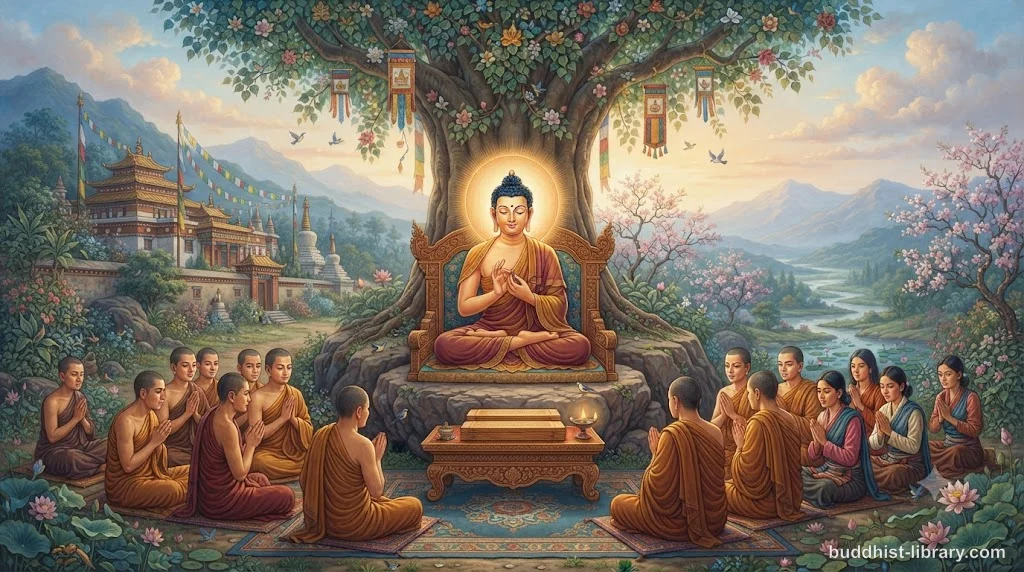
The Itivuttaka is a collection of 112 short discourses attributed directly to the Buddha, each beginning with the formula “This was said by the Blessed One.” Part of the Khuddaka Nikāya in the Pali Canon, these teachings cover meditation, ethical conduct, the nature of reality, and the path to liberation—all delivered in concise prose followed by memorable verses.
The name itself—Itivuttaka—comes from the Pali phrase iti vuttaṃ Bhagavatā, meaning “thus was said by the Blessed One.” This repetitive opening marks each discourse as a direct transmission, words the Buddha spoke and his disciples preserved. Unlike longer suttas that unfold through dialogue or narrative, the Itivuttaka delivers its wisdom quickly: a teaching, an elaboration, and a verse summary. It’s Buddhism distilled.
What makes the Itivuttaka special?
The Itivuttaka occupies a unique place in Buddhist scripture. It’s neither as systematic as the Dīgha Nikāya nor as sprawling as the Saṃyutta Nikāya. Think of it as a collection of contemplative snapshots. Each discourse captures one insight, one angle of the Dhamma, then steps aside.
Brevity with depth. Most discourses run less than a page—some just a few paragraphs. The Buddha explains the danger of wrong view or the benefit of seclusion, then concludes with a verse that locks the teaching into memory. This structure made the Itivuttaka highly quotable, which is probably why it survived oral transmission so well.
Poetic reinforcement. Every discourse ends with verses (gāthā) that restate the teaching in concentrated form. These aren’t decorative. They’re mnemonic devices and meditation anchors—something a practitioner could carry through the day, letting it unfold in different contexts. The prose explains; the verse embeds.
Practical focus. The Itivuttaka doesn’t spend much time on cosmology or metaphysics. What it emphasizes instead: what to cultivate (generosity, virtue, meditation) and what to abandon (greed, hatred, delusion). How to live. How to train the mind. How to progress on the path.
Structure of the Itivuttaka
The text is organized into four nipātas (sections) based on the number of items discussed:
- Eka-nipāta (The Book of Ones) — 27 discourses on single themes like heedfulness, the mind, and jhāna
- Duka-nipāta (The Book of Twos) — 22 discourses on pairs, such as wholesome and unwholesome, giving and receiving
- Tika-nipāta (The Book of Threes) — 50 discourses on triads, including the three trainings (ethics, concentration, wisdom) and three kinds of misconduct
- Catukka-nipāta (The Book of Fours) — 13 discourses on sets of four, such as the four nutriments and four ways of answering questions
This numerical organization makes the text easy to navigate and reflects a common pedagogical method in early Buddhism: grouping teachings by number to aid memory and systematic study.
Key teachings from the Itivuttaka
The mind leads everything (Iti 1.17)
One of the most quoted passages from the Itivuttaka appears in discourse 17, which states that the mind is the forerunner of all things—when the mind is defiled, suffering follows; when the mind is pure, happiness follows. This teaching echoes the opening verses of the Dhammapada and underscores the centrality of mental cultivation in the Buddhist path.
Craving is the seamstress (Iti 2.15)
The Buddha uses a striking metaphor: craving (taṇhā) is like a seamstress, stitching one existence to the next. As long as craving persists, beings are bound to the cycle of rebirth. The discourse points to the second noble truth—suffering originates from craving—and emphasizes that liberation requires cutting this thread.
The two kinds of gifts (Iti 1.26)
The Buddha distinguishes between material gifts and the gift of Dhamma. While material generosity brings merit and happiness, teaching the Dhamma surpasses it because it offers the possibility of liberation. This teaching encourages both forms of giving while clarifying their relative value.
Heedfulness is the path to the deathless (Iti 1.21)
Echoing the Dhammapada, the Itivuttaka declares that heedfulness (appamāda) leads to the deathless (nibbāna), while heedlessness leads to death. Those who are heedful do not die (in the ultimate sense—they are not reborn); those who are heedless are already dead, spiritually speaking. This discourse frames the entire path as a matter of attention and care.
The three kinds of unwholesome roots (Iti 3.17)
The Buddha identifies greed, hatred, and delusion as the roots of all unwholesome actions. These three poisons drive the cycle of suffering. By recognizing their presence and working to uproot them through ethical conduct, concentration, and wisdom, practitioners cut off the source of suffering at its origin.
Who transmitted the Itivuttaka?
Buddhist tradition credits Khujjuttarā, a remarkable female lay disciple, with preserving these teachings. Khujjuttarā served as an attendant to Queen Sāmāvatī of Kosala. Though she had no formal education, she possessed an extraordinary memory. According to the commentaries, she would listen to the Buddha’s teachings, memorize them perfectly, and then recite them to the queen and her retinue.
Her role highlights something often overlooked in early Buddhism: women were active in preserving and transmitting the Dhamma. Without Khujjuttarā’s exceptional memory, these 112 teachings might have been lost. Instead, they survived the centuries and made their way into the written Pali Canon.
How to read the Itivuttaka
The Itivuttaka rewards slow, contemplative reading. Don’t race through all 112 discourses. Try this instead:
Read one discourse at a time. Let each teaching stand on its own. Read the prose to grasp the principle. Then read the verse to internalize it.
Memorize the verses. They’re short and rhythmic—perfect for carrying through the day. Commit one to memory and notice when the teaching applies to what you see, think, or feel.
Look for patterns. The numerical organization isn’t arbitrary. Groupings reveal how the Buddha approached different aspects of the path, and comparing discourses within a section deepens understanding.
Apply the teachings. The Itivuttaka isn’t meant for academic study alone. Each discourse points to practice. Choose one teaching and implement it. Test it.
Why the Itivuttaka matters today
In a time when attention is fragmented and information overwhelms, the Itivuttaka offers something rare: brevity without shallow simplification. Each teaching is complete in itself, yet part of a larger whole. Open it anywhere and you’ll find something useful.
The text proves that profound wisdom doesn’t need lengthy exposition. The most powerful teachings can be the shortest. The mind shapes experience. Craving binds us. Heedfulness frees us. The Itivuttaka delivers these truths without ornament, trusting their inherent power.
If you’re looking for a daily contemplative practice, the Itivuttaka hands you 112 ready-made reflections. If you study early Buddhism, it shows you how the Buddha and his disciples actually taught. And if you care about how ancient knowledge survived, it’s a case study in what memory, devotion, and oral tradition can accomplish.
The Itivuttaka is a quiet treasure in the Pali Canon. Not as famous as the Dhammapada. Not as analyzed as the Satipaṭṭhāna Sutta. But just as valuable.
It deserves more readers.
Read more:
- What Is the Pali Canon (Tipiṭaka)? Structure and Contents of Early Buddhist Scriptures — Understanding where the Itivuttaka fits within the broader structure of the Buddhist scriptural tradition.
- The Dhammapada: An Introduction to the Buddha’s Verses — Another verse-based collection in the Khuddaka Nikāya that shares thematic overlap with the Itivuttaka.
- The Udāna: The Buddha’s Inspired Utterances — A companion text in the Khuddaka Nikāya featuring the Buddha’s spontaneous exclamations, similar in spirit to the Itivuttaka.
📖 Source / license: Itivuttaka (trans. Thanissaro Bhikkhu, Access to Insight; trans. John D. Ireland)
Frequently asked questions
What does Itivuttaka mean?
Itivuttaka means 'thus said' or 'this was said' in Pali. Each discourse begins with the phrase 'This was said by the Blessed One,' marking these as direct teachings remembered and transmitted by the Buddha's disciples.
How is the Itivuttaka different from other Pali texts?
The Itivuttaka is unique for its concise, poetic format. Each teaching is brief—often just a few paragraphs—followed by verses that summarize the key points. It bridges prose and poetry, making profound teachings accessible.
Who compiled the Itivuttaka?
According to tradition, the Itivuttaka was compiled by Khujjuttarā, a female lay disciple who had an exceptional memory. She would listen to the Buddha's teachings and later recite them to Queen Sāmāvatī and her attendants.
Can beginners study the Itivuttaka?
Absolutely. The Itivuttaka's short, focused teachings make it ideal for beginners. Each discourse addresses a single theme—such as generosity, mindfulness, or letting go—without overwhelming detail, making it perfect for daily contemplation.